
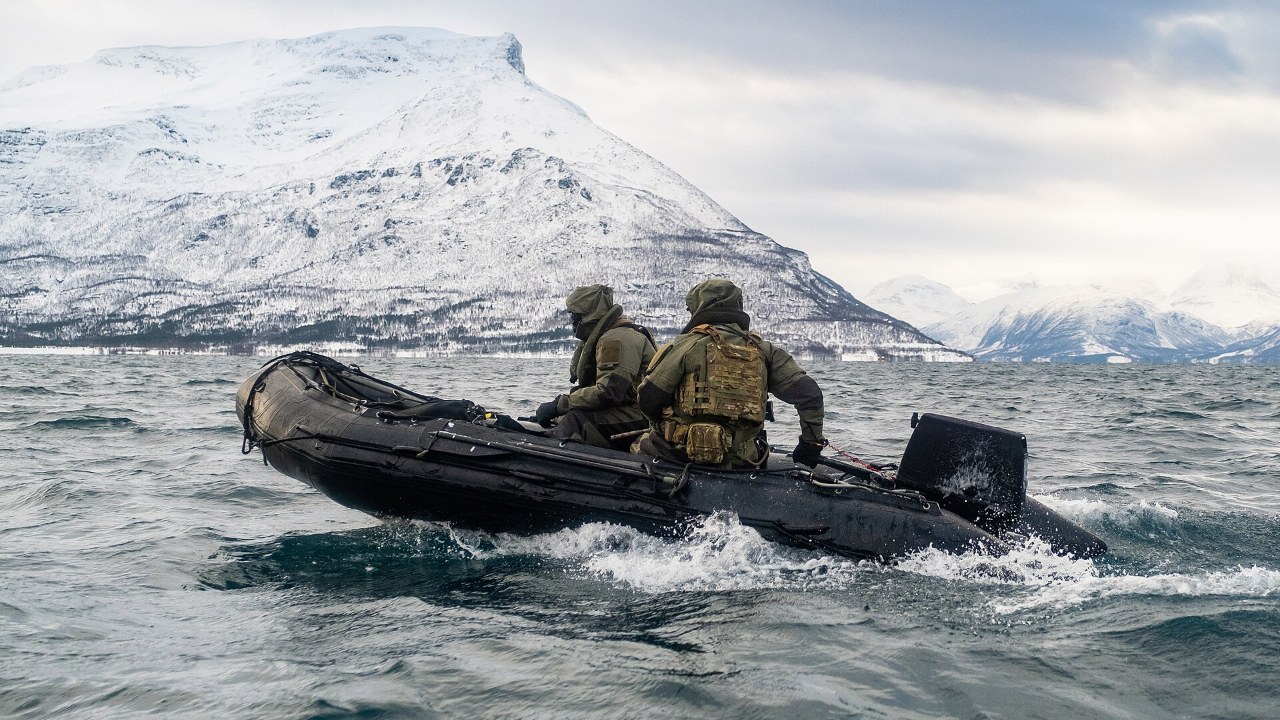
The last time Royal Marines operated in the Faroe Islands, Denmark had just fallen to Germany and HMS Suffolk was putting 250 of them ashore. In 2026, commandos went back, this time to train alongside Danish forces and Faroese maritime agencies during Exercise Lion Protector, a multinational workout across the North Atlantic, the High North and the Baltic.
The Faroes sit in the middle of the Greenland-Iceland-UK Gap, the stretch of sea between those three landmasses that links the Arctic to the open North Atlantic. That position, on a gateway between the Arctic and the Atlantic, is what brought the commandos back to an archipelago of 18 islands.
The Royal Navy announced the deployment in a news release dated Oct. 2, 2026, stating that “Royal Marines have returned to the Faroe Islands for the first time since the Second World War.” The release describes the GIUK Gap as “one of NATO and JEF’s most important maritime approaches as the North Atlantic gateway for Russian ships sailing to and from the Arctic.” It says Lion Protector “took place between August and October.”
“Defending the Atlantic is fundamental to our economy, national security and way of life. In troubling times, we cannot be complacent. The return of the Royal Marines to the Faroe Islands should send an unequivocal message: the UK, alongside Denmark and our other allies in the Joint Expeditionary Force, stand ready to protect the waters, islands and vital routes that keep our nations secure.” — General Sir Gwyn Jenkins, First Sea Lord, per the Royal Navy release
The task group that went ashore
The unit sent north was the UK Commando Force’s Allied Reaction Force Special Operations Maritime Task Group, or SOMTG. The Oct. 2 release says the group “provides NATO with elite troops able to deploy at extremely short notice to carry out missions such as recapturing vessels and oil rigs, as well as covert coastal raids to pave the way for allied amphibious landings.” It draws pilots, boarding teams, engineers and boat operators from across the Royal Navy and the Commando Force, and the release calls Lion Protector “the first major workout” for the group.
The NATO role behind the group is a one-year standby. A Royal Navy release of Feb. 9, 2026 described the task as “the Special Operation Component of NATO’s Allied Reaction Force,” a force meant to be immediately deployable for deterrence or emerging crises, and said British forces would hold it “from July for a year.” The same release said 42 Commando was “primed to recapture vessels and oil rigs, as well as carry out covert raids from the sea.”
Boarding drills and basalt cliffs
In the Faroes, the Royal Navy says, the British, Danish and Faroese teams ran maritime interdiction drills, which the release translates as “boarding, inspecting and seizing target vessels.” They practised approaching ships, working from boarding ladders and climbing onto a target. A Royal Navy photo caption dates boarding training in the islands to Sept. 23, 2026, and images published by Joint Forces News on Oct. 3, 2026, credited to PO Phot Alex Ceolin, show the training aboard the vessel Gotunes FD 950.
The coastal phase moved onto terrain the release describes as “defined by basalt layers, extreme vertical drops and a fractured landscape carved out over millennia by glaciers, wind and the sea.” The teams set up clifftop observation posts to watch maritime traffic routes, then made cliff ascents. Small boat missions ran alongside the landings.
A wider exercise across three seas
The Faroes were one piece of a larger British-led effort. A UK government release published Oct. 2, 2026 says Lion Protector “launched in August with a rehearsal of a multi-national maritime escort operation stretching the length of the Baltic Sea,” in which warships and aircraft from Denmark, Latvia, Sweden and the UK escorted a Danish vessel carrying military equipment to Latvia. The UK’s Standing Joint Force Headquarters coordinated activity across the High North and Baltic, deploying north of the Arctic Circle in Norway, according to the same release.
The Joint Expeditionary Force behind the exercise is a ten-nation grouping led by the UK: Denmark, Estonia, Finland, Iceland, Latvia, Lithuania, the Netherlands, Norway and Sweden, plus Britain, as listed in the Royal Navy release. The Faroe Islands themselves are, in the Navy’s words, “a self-governing country that is part of the Kingdom of Denmark.”
Operation Valentine, 1940
The Royal Navy release ties the 2026 deployment directly to 1940. Denmark fell to Germany on April 9 of that year. Britain then launched Operation Valentine to occupy the islands, and the Royal Navy sent two destroyers to Tórshavn “before 250 Royal Marines were landed ashore from HMS Suffolk,” per the release. British forces stayed until 1945 before handing the islands back to Denmark, in what the Navy calls “a cordial occupation that is still celebrated to this day.”
The Army garrison that followed the Marines is recorded by the Imperial War Museums. Its record for the wartime Faroe Islands Force formation badge says the islands “were occupied by British forces in 1940 to forestall any attempt by Germany to establish a base there that could threaten the UK’s sea communications,” and that the original garrison “comprised the Lovat Scouts” along with Royal Artillery coast defence and anti-aircraft units and Royal Engineers. The force’s badge carried an oystercatcher, which the museum notes was the national emblem of the Faroes.
Eighty-six years later, the Royal Navy framed the return around the same sea lanes. Its release says the allied nations are stepping up security work ahead of the Atlantic Future Forum and the International Sea Power Conference aboard HMS Prince of Wales, scheduled for later in autumn 2026.
Top image: Royal Marines in a raiding craft during Arctic training in Norway in 2022. Not the Faroe Islands exercise. Image Credit: PO Phot Si Ethell / UK MOD © Crown copyright — OGL v3.0 / Wikimedia Commons
This article was produced with the assistance of AI and reviewed by Combat Rated editors prior to publication.