
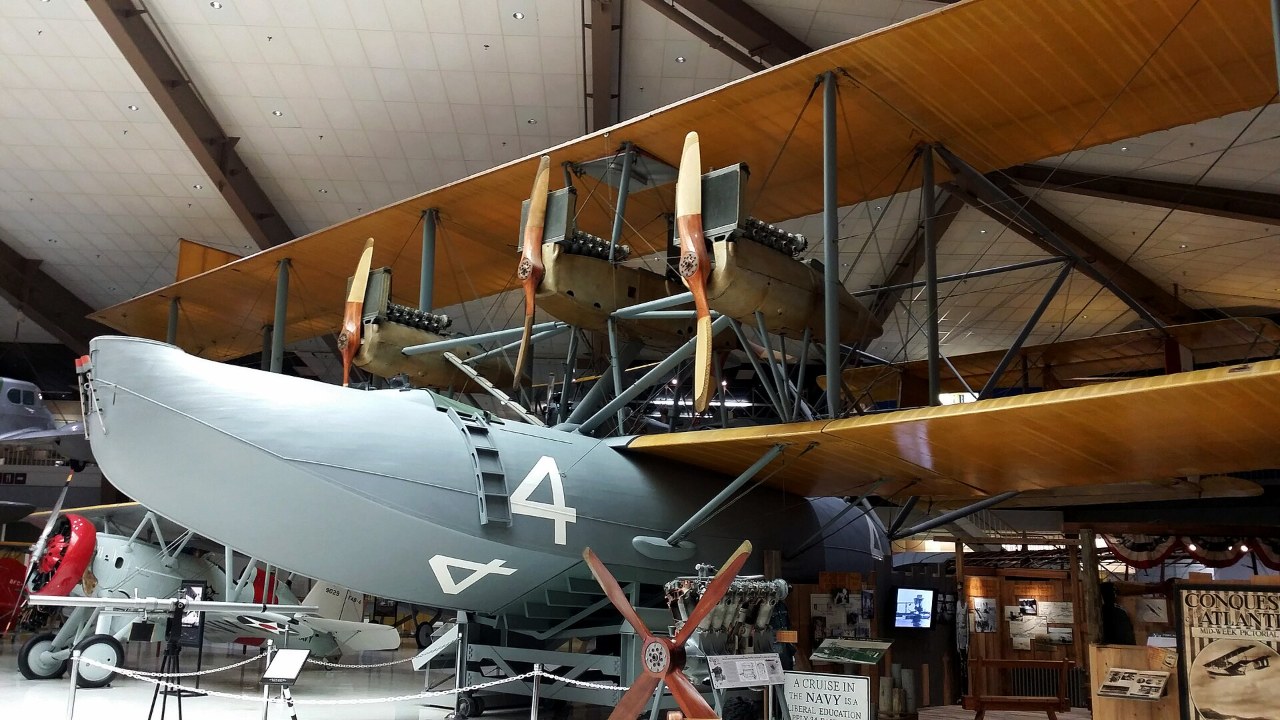
A U.S. Navy flying boat came down in the harbor at Lisbon, Portugal, on May 27, 1919, and with it came the first successful flight across the Atlantic Ocean. The aircraft was the Curtiss NC-4, commanded by Lt. Cmdr. Albert C. Read, and it had come by way of Newfoundland and the Azores.
The NC-1 and NC-3 were forced down at sea on the long leg from Newfoundland to the Azores. The NC-4, an aircraft the press had nicknamed the “Lame Duck” after it broke down in the first days of the trip, was the only one of the three to finish.
The National Naval Aviation Museum in Pensacola, Fla., where the NC-4 is displayed, tells the story on its NC-4 exhibit page: “Ironically, the NC-4 was the only one of the three aircraft to reach the Azores, the other flying boats making forced landings at sea.” The museum continues: “Eventually, Read and his crew reached Lisbon, Portugal, on May 27, 1919, completing the first successful transatlantic flight.”
U-boat hunters with a 126-foot wingspan
The NC boats were not built for a record. The museum describes them as “U-boat hunters that could fly across the Atlantic and be ready on arrival to conduct antisubmarine warfare in European waters.” The NC-1 made its maiden flight on Oct. 4, 1918, according to the museum; the NC-4 did not fly until May 1, 1919, days before the attempt.
They were large for their era. The museum gives a 45-foot hull, biplane wings that “at their longest point stretched a distance of 126 feet,” and “three tractor engines (propellers facing forward) and one pusher engine,” good for a top speed of 85 mph. The Naval History and Heritage Command’s NC-4 collection page identifies the powerplant as four 400-horsepower Liberty 12 engines and lists a range of 1,470 miles.
World War I ended before the boats could hunt submarines. The NHHC credits the transatlantic attempt to “a bold proposal written by Commander John H. Towers” that “caught the imagination of the Navy Department.”
From Rockaway to Trepassey: the “Lame Duck” falls behind
Crews of the NC-1, NC-3 and NC-4 gathered at Naval Air Station Rockaway on Long Island on May 3, 1919, according to the NHHC. The Cradle of Aviation Museum on Long Island, in its history of the NC-4 flight, notes that the boats were developed with the Curtiss Engineering Company of Garden City and that “Commander John Towers had chosen the NC-3 as his flagship.” By May 8, with a four-leaf clover presented to each crew member for luck, the three boats launched on the first leg, from Rockaway to Halifax, Nova Scotia, its account reads.
The NC-4 did not make Halifax with the others. Per the NHHC, “Only two completed the nine-hour trip, the NC-4 being forced down off Massachusetts with engine trouble and the media giving her the nickname the ‘Lame Duck.'” The Pensacola museum adds that the NC-4 “taxied into NAS Chatham for repairs, falling behind the other aircraft as they made their way toward Nova Scotia and Newfoundland.” It caught up in time.
The 1,200-mile leg that only NC-4 finished
The three boats were together again at Trepassey, Newfoundland, and, in the NHHC’s words, “launched into the early evening sky on 16 May 1919, bound for the Azores Islands, the longest and most demanding leg of the transatlantic flight, covering some 1,200 nautical miles.” The Pensacola museum describes it as a 13-hour flight.
Weather broke up the formation. “Increasing clouds and rain caused the aircraft to separate, with NC-1 and NC-3 making forced landings,” the NHHC records. Both crews came through: according to the command, “the crew of NC-1 rescued by a Greek freighter and the crew of NC-3 actually sailing their battered craft 205 miles to the Azores.” Clark G. Reynolds followed that second crew, Towers among them, in “Voyage of the NC-3,” published in Naval History magazine in April 1987; his account ends with the boat safely in port: “The NC-3 reached her moorings at 1830.”
That left the NC-4. The NHHC writes that “the ‘Lame Duck’ became the sole survivor of Seaplane Division One,” and on May 27 its keel “sliced through the waters of the harbor in Lisbon, Portugal.” Read later wrote to his wife, per the same account, that the flight represented “a continuous run of unadulterated luck.”
Eight years before Lindbergh
The Smithsonian’s National Air and Space Museum, which owns the aircraft, notes on its Curtiss NC-4 collection record that “The U.S. Navy achieved the first transatlantic flight eight years before Charles Lindbergh,” and that the flight, which began May 8, 1919, took 24 days in all. The Smithsonian loaned the NC-4 to what was then the Naval Aviation Museum in Pensacola in 1974, and it remains on display there.
Top image: The Curtiss NC-4 flying boat on display at the National Naval Aviation Museum in Pensacola, Florida. Image Credit: Eric Friedebach — CC BY 2.0 / Wikimedia Commons
This article was produced with the assistance of AI and reviewed by Combat Rated editors prior to publication.