
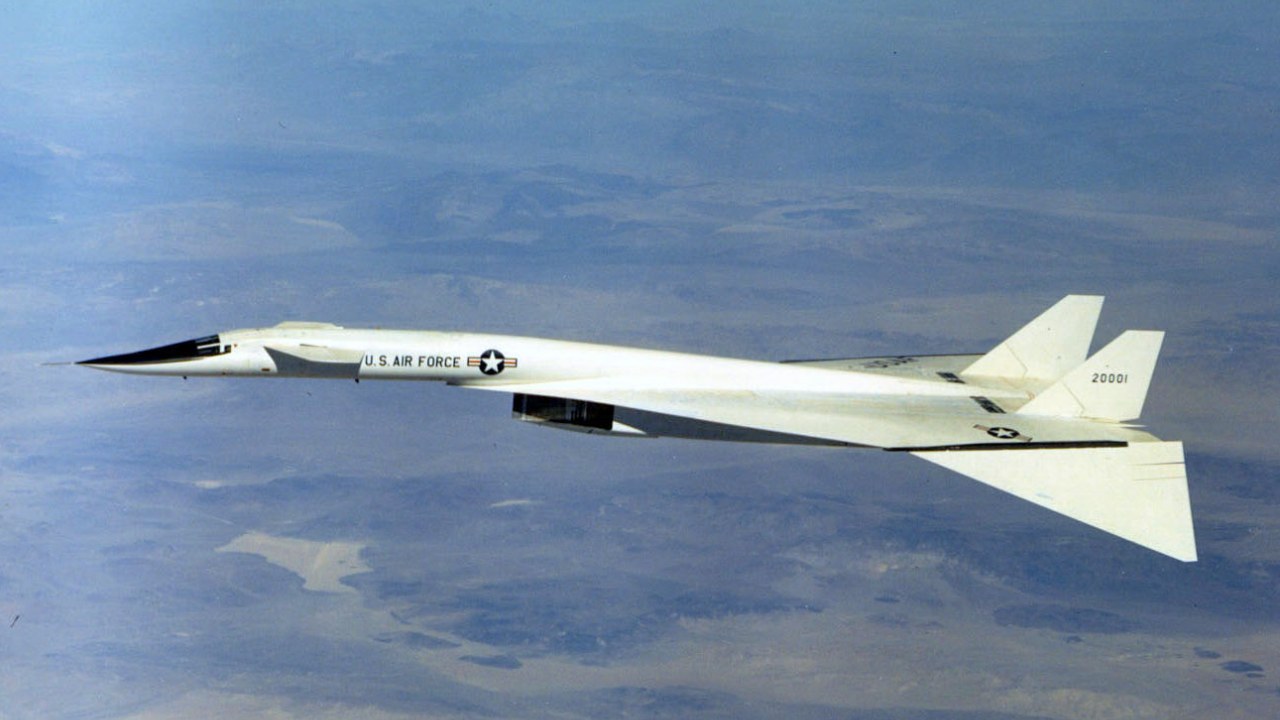
Two XB-70A Valkyries left North American Aviation’s factory, and neither was ever a bomber. The aircraft was designed to cruise at Mach 3 at 70,000 feet with a nuclear payload, but the B-70 bomber program was canceled before a prototype was built. The pair became research aircraft instead, and one of them survives.
The first flew in September 1964; the program’s last flight came in February 1969. In between, the two aircraft spent less than two hours, combined, at their design speed.
NASA’s Armstrong Flight Research Center keeps the history in its XB-70 Valkyrie overview. The page describes the XB-70 Valkyrie as a high-altitude, high-speed manned strategic bomber “with a planned cruise speed of Mach 3 and operating altitude of 70,000 feet.” After “the Kennedy Administration ended plans to deploy the B-70,” NASA records, “two experimental XB-70A prototypes were under construction,” and the aircraft’s role “changed from a manned bomber prototype to one of the most remarkable research aircraft ever flown.”
A bomber canceled before it flew
The National Museum of the U.S. Air Force puts the decision at 1961. Its XB-70 Valkyrie fact sheet says the aircraft was “conceived in the 1950s as an intercontinental strategic nuclear bomber,” that “in 1961—before a prototype was built—the B-70 bomber program was canceled,” and that the Air Force then “ordered two XB-70As (AV-1 and AV-2) as pure test aircraft.”
The museum’s specifications show the scale of the machine. Six General Electric YJ93 engines produced 30,000 pounds of thrust each with afterburner. The airframe measured 185 feet, 10 inches long and weighed 534,700 pounds loaded. The museum lists a maximum speed of 2,056 mph, Mach 3.1, at 73,000 feet, and a service ceiling of 77,350 feet.
Mach 3, research flights and one survivor
XB-70A number 1, serial 62-001, “made its first flight from Palmdale to Edwards Air Force Base, CA, on Sept. 21, 1964,” per NASA. The second aircraft “made its first flight on July 17, 1965.”
The two records mark different milestones. The Air Force museum says the first aircraft achieved Mach 3 in October 1965. NASA’s page says “the second XB-70 achieved Mach 3 for the first time on Jan. 3, 1966,” and that it “made a total of nine Mach 3 flights by June.” The second aircraft was lost on June 8, 1966, after a midair collision.
The surviving aircraft flew on in a joint NASA-Air Force program studying problems facing supersonic transport (SST) designs. NASA says those flights evaluated the aircraft “on typical SST flight profiles” and studied “the problems of sonic booms on overland flights.”
The airframe suited that work. A NASA Dryden Flight Research Center fact sheet on the XB-70 research program (FS-2003-07-084 DFRC) notes that “it was the same size as the projected SST designs, and used similar structural materials, such as brazed stainless steel honeycomb and titanium.” The outer wing panels were hinged: “Once the aircraft was supersonic, the wing panels would be hinged downward,” the fact sheet says. It also records that the aircraft never returned to its peak: “A top speed of Mach 2.57 was the highest attained during the remainder of the XB-70 program.”
NASA tallies the record precisely. “The first XB-70 made 83 flights totaling 160 hours and 16 minutes,” while “the second XB-70 logged 46 flights in its brief life, totaling 92 hours and 22 minutes.” Across both aircraft, the agency says, the Valkyries “had logged 1 hour and 48 minutes of Mach 3 flight time.”
The last flight was a delivery. On Feb. 4, 1969, according to NASA, “the XB-70 took off from Edwards and flew to Wright-Patterson Air Force Base, OH, where the aircraft was put on display at the Air Force Museum.” It remains at the National Museum of the U.S. Air Force at Wright-Patterson, where the museum’s fact sheet places it in the Fourth Building.
Top image: A North American XB-70A Valkyrie in flight. Image Credit: U.S. Air Force — Public domain / Wikimedia Commons
This article was produced with the assistance of AI and reviewed by Combat Rated editors prior to publication.