
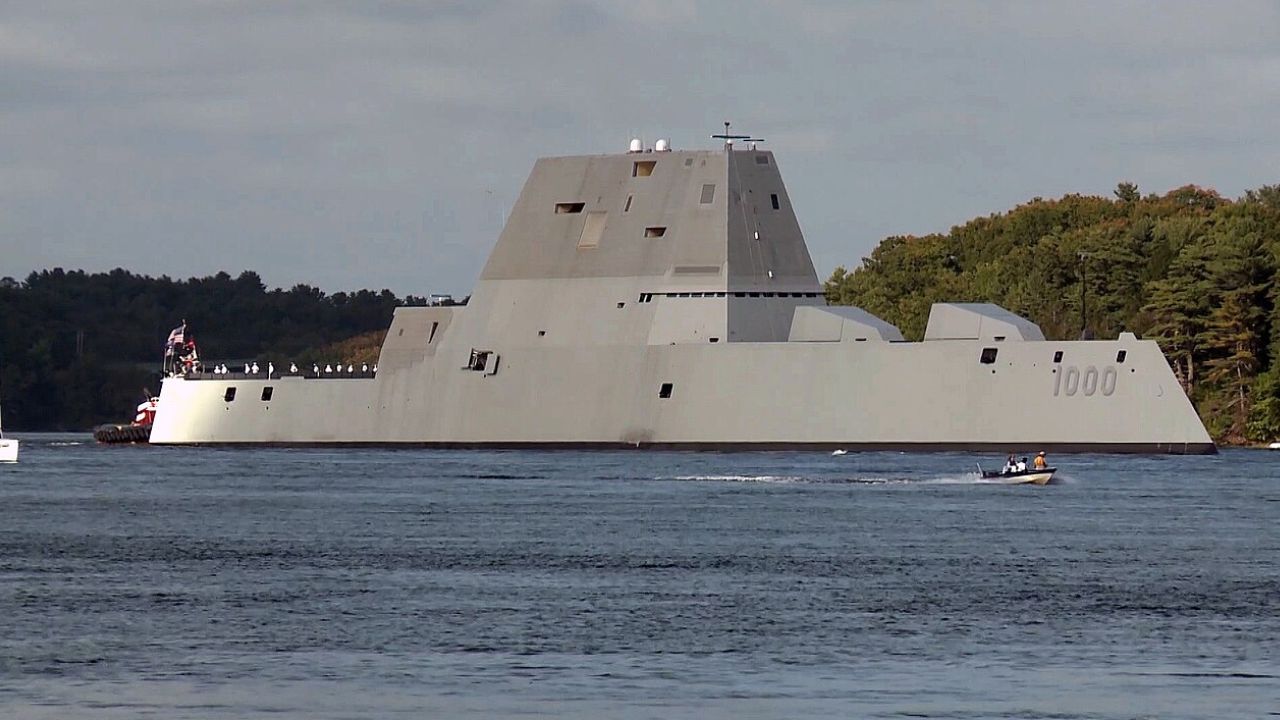
The U.S. Navy built the Zumwalt-class destroyer to move beyond the incremental upgrades that shaped many post–Cold War surface combatants. The goal was a next-generation ship designed for demanding operations close to shore—able to contribute meaningful land-attack capability, operate in complex threat environments, and bring new approaches to survivability and ship integration. To get there, the Navy pursued an unusually low-signature design, high levels of automation, and an integrated electric-power architecture intended to support advanced sensors and provide room for future growth.
Those choices produced one of the most distinctive warship designs of the modern era—and one of the most debated. Only three ships were built, and the program’s mission emphasis shifted over time, moving away from a primarily littoral land-attack concept toward surface strike and broader fleet roles. Understanding why the Navy built Zumwalt requires looking at the strategic assumptions of the era, the technology goals embedded in the design, and the reality that revolutionary ships are hard to buy and sustain at scale.
A post–Cold War focus: operating near shore and striking ashore
Zumwalt took shape when U.S. planners were heavily focused on regional crises and power projection rather than classic blue-water fleet battles. In that environment, the Navy wanted surface combatants that could operate closer to coastlines, provide persistent presence, and contribute to joint campaigns with strike options from the sea—without relying exclusively on carriers or land bases.
That context shaped a ship optimized for a specific set of challenges: short decision timelines, complex coastal geography, and threats that could appear with limited warning. The response was not simply a larger version of an existing destroyer, but a leap toward a lower-signature surface combatant with new integration choices and built-in margin to evolve.
Signature management: harder to detect and track, not “invisible”
A central reason for the Zumwalt design was signature reduction, especially in the radar domain. The practical aim was to complicate detection, classification, and tracking—buying time and degrading the quality of an opponent’s targeting picture. It was never a promise of invisibility, and the operational value depends on the broader fight: tactics, emissions control, situational awareness, and how an adversary searches and cues weapons.
Signature management is particularly relevant near shore, where clutter and compressed engagement ranges can shrink reaction time. A ship that is more difficult to detect and track may have more freedom to maneuver, more options for when and how to use its sensors, and a better chance of positioning for missions without advertising itself early.
Automation and crew size: capability with fewer sailors
The Navy also pursued a high degree of automation. Beyond the technological ambition, automation was tied to long-term manpower and operating-cost pressures. Smaller crews can reduce lifecycle burden in training, billets, and sustainment—while still enabling a large ship to run sophisticated combat and ship systems.
At the same time, heavy automation changes how a ship is built and supported. It increases reliance on software, integration testing, and specialized maintenance skills. Zumwalt was, in part, a bet that these tradeoffs were worth taking—and that the Navy would learn useful lessons about operating and sustaining highly automated surface combatants.
Integrated electric power: margin for demanding systems
Another key “why” is electrical power. Zumwalt’s integrated electric-power architecture reflects the Navy’s interest in accommodating high-demand sensors and allowing space for future capabilities. The underlying logic is straightforward: power generation and distribution can become limiting factors as combat systems grow more energy-hungry, and ships without sufficient margin can be constrained as technology and threats evolve.
In that sense, the design is both capability and hedge. A power-rich ship gives the Navy real-world experience integrating and operating a more electrically intensive combatant—experience that can inform future designs intended to carry more demanding sensors, electronic warfare systems, or other advanced ship systems.
Industrial base and risk: ambitious integration comes with costs
Major naval shipbuilding programs are also industrial decisions. The Zumwalt class is closely associated with General Dynamics Bath Iron Works, supported by a wide network of suppliers and other shipbuilding partners. Choosing a new class rather than extending an existing design reshapes how work is distributed—and concentrates risk in integration-heavy areas such as combat systems, power architecture, and automation.
That risk has consequences. Revolutionary designs typically require more testing, more change, and more problem-solving than evolutionary upgrades. When requirements shift, that complexity can translate into higher cost and schedule pressure. With only three ships built, the Navy also had fewer opportunities to spread unique training, logistics, and sustainment investments across a larger fleet.
Why only three ships: changing priorities meet complexity
The Zumwalt story cannot be separated from its final scale: three ships. Over time, the program’s mission emphasis moved away from the early land-attack and littoral framing toward surface strike and broader fleet roles. When the mission focus changes, navies face difficult choices—modify the design, repurpose the ships already built, or stop buying more and rely on proven platforms for the bulk of fleet needs.
The Navy’s continued reliance on the Arleigh Burke-class underscores the value of an established, upgradeable destroyer line with deep operational experience and support infrastructure—especially for high-demand fleet roles such as air-defense escort. In that light, Zumwalt became easier to justify as a technology pathfinder and specialized capability than as a mass-produced replacement for the Burke.
What Zumwalt represents now: a bridge, not the workhorse
Today, the most grounded way to view the Zumwalt class is as a bridge between generations. It puts signature management, advanced integration approaches, and power margin into real fleet hulls—ships that can deploy, be maintained, and be used to refine tactics and operating concepts. Even in small numbers, that practical learning has value.
But the class’ small size also brings constraints. Unique systems across a limited number of ships can complicate spare parts pipelines, specialized training, and long-term sustainment planning. In a Navy balancing immediate operational demand against modernization, those tradeoffs help explain why Burkes continued to carry much of the workload while Zumwalt evolved into a more specialized platform rather than a default template for the fleet.
Why it matters: lessons for the next generation of surface combatants
Zumwalt’s importance increasingly lies in what it teaches. Many of the pressures that drove the program—contested seas, survivability, and growing demand for power and cooling—still shape discussions about future surface combatants, including efforts often associated with DDG(X). The Navy wants ships that can keep pace with evolving threats without running out of electrical headroom or becoming too easy to detect and target.
The cautionary lesson is just as relevant: building a revolutionary ship and fielding that revolution at scale are different problems. Zumwalt shows how cost, complexity, and shifting priorities can compress an ambitious “next-gen” program into a small number of highly capable ships. The opportunity is that those ships can still reduce risk for whatever comes next—if the Navy deliberately applies what it learns about signature management, automation, and integrated power to a future design that is affordable and supportable in the numbers the fleet needs.
That is the core answer to why the Navy built Zumwalt: to explore a different way of operating near contested shores, to pursue survivability through reduced signatures, and to invest in the power and automation foundation needed for future surface warfare. It did not become the Navy’s standard destroyer, but it was built to push the boundaries of what a surface combatant could be—and to inform the ships that follow.