
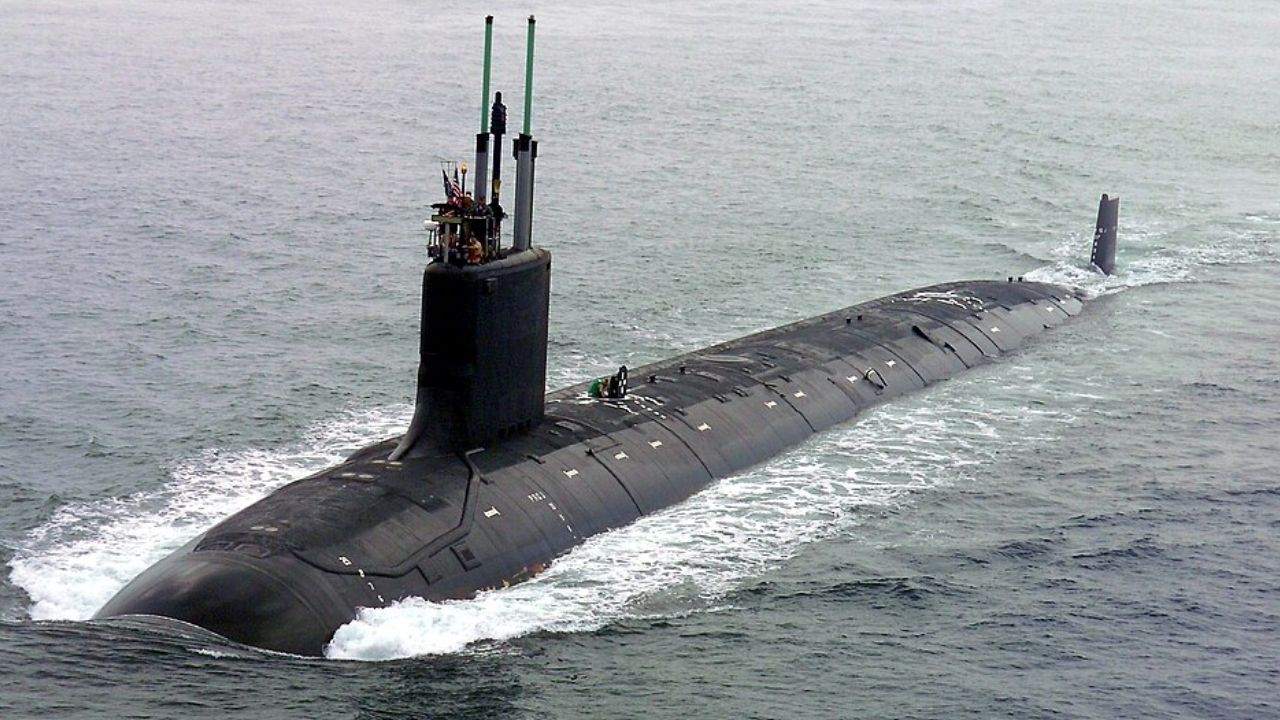
The Virginia-class (SSN-774) nuclear-powered attack submarine began as the U.S. Navy’s post–Cold War replacement for an aging SSN fleet. Its most relevant story, though, is how the design has been adapted for the reality the Navy faces now: sustained competition and potential conflict in seas where rivals are investing in layered anti-access/area-denial systems and undersea presence is in constant demand. In program terms, the class has been shaped by an iterative approach—successive block upgrades and payload-focused variants—that keeps it aligned with a multi-mission fight rather than a single, narrow matchup.
That matters because the United States rarely gets to pick the time or location of a crisis. In both the Indo-Pacific and the North Atlantic, the ability to deploy quietly, stay on station, and operate when communications are limited is a practical advantage. A Virginia-class submarine can provide options and information without requiring a large, visible force to arrive first—or automatically raising the temperature of a situation.
Built for missions, not just undersea duels
Attack submarines were long discussed primarily in terms of high-end blue-water roles: hunting other submarines, screening carriers, and contesting sea control. Public descriptions of the Virginia-class mission set emphasize a broader portfolio—intelligence, surveillance, and reconnaissance; anti-submarine and anti-surface warfare; support to special operations; and land-attack integration. The point is not that any one boat does all of these at once, but that the class was designed with the expectation that modern submarines will spend as much time in ambiguous competition and shaping operations as in clearly defined wartime scenarios.
Compared with older designs like the Los Angeles class, the Virginia approach places more emphasis on adaptability and planned modernization. And relative to the smaller Seawolf cohort—often associated in public discussion with a more specialized, high-end profile—the Virginia-class concept is about fielding a versatile force that can be updated across its service life, not locked into a single set of design assumptions.
Modularity and block upgrades: how relevance is maintained
The clearest answer to “how it was built” is architectural: the Virginia-class has been managed as a platform that can absorb change. The block structure provides a pathway to insert improvements in areas that matter in modern undersea warfare—sensors, processing, maintainability, and how payloads are handled—without waiting for a clean-sheet replacement. That matters because detection methods, data processing, and maritime surveillance evolve faster than shipbuilding cycles.
Payload-focused variants, including the publicly referenced Virginia Payload Module (VPM), reflect the same logic. While configurations can vary by block and are not uniform across the class, the strategic intent is consistent: create room for growth and additional mission flexibility without treating any single loadout as a decisive, guaranteed advantage.
Why payload flexibility matters operationally
It is easy to slip into “spec-sheet” thinking about submarines—especially around performance claims that are not responsibly verifiable in public. A more grounded way to understand Virginia-class value is to focus on what additional payload options and adaptable mission spaces can enable: more ways to support a joint commander’s plan while operating in contested areas.
That can include supporting land-attack integration, carrying different mission packages as requirements shift, or embarking specialized equipment for intelligence collection and special operations support. The benefit is flexibility under uncertainty—being able to contribute useful effects without forcing commanders to use a platform only in the role it was originally optimized for. The limitation is also straightforward: the operational payoff depends on readiness, training, sustainment, and having the right weapons and systems available when the submarine deploys.
Networked warfare—without assuming constant connectivity
Naval operations are increasingly networked, but submarines live with a built-in tradeoff: their best protection is discretion, and discretion can constrain communications. Virginia-class modernization is therefore best understood as strengthening on-board sensing, data fusion, and processing so the boat can collect and act locally when it must, while using connectivity when it can be managed without undermining survivability.
This is one reason submarines can complement carrier and expeditionary operations without requiring a large surface presence. A submerged platform can contribute intelligence collection, cueing, and sea-denial effects without broadcasting its position or signaling a major escalation—though that discretion is a tactical advantage, not a guarantee of dominance.
Quieting, survivability, and maintainability: the advantages that last
Public discussion often collapses submarine survivability into a single question of “how quiet” a boat is. In practice, survivability is broader: the ability to operate effectively across long deployments as adversaries improve sensors, patrol aircraft, and maritime surveillance. Virginia-class evolution has been framed around improving performance and survivability in contested environments while avoiding claims about specific acoustic signatures or other classified metrics.
Maintainability is the other side of combat power. A submarine that is capable on paper but unavailable in practice cannot generate deterrence or meet operational demand. The block approach and associated sustainment decisions reflect an implicit recognition that availability is a combat multiplier—and that design choices made early affect readiness for decades.
Who builds it—and why the industrial base shapes outcomes
The Virginia-class is produced by a U.S. submarine industrial base anchored by two primary builders: General Dynamics Electric Boat and HII/Newport News Shipbuilding. That two-yard structure provides resilience and capacity, but it also depends on workforce development and a specialized supplier network that must deliver consistently.
Today’s submarine picture also includes competing demands within that same ecosystem. The Navy’s Columbia-class (SSBN) program is a major priority, and balancing new construction with maintenance and modernization pressures makes schedules, labor, and supplier capacity strategic variables. In other words, undersea capability is not only about design—it is also about how reliably the Navy can build, sustain, and return submarines to operational availability.
What a Virginia can do that surface ships and airpower can’t
Surface forces and aircraft bring speed, volume, and visible presence. Submarines bring persistence and discretion. A Virginia-class submarine can conduct intelligence and surveillance closer to an adversary’s operating areas, pursue anti-submarine missions while remaining difficult to target, and support special operations in ways that do not require a large surface footprint. It can also contribute to strike planning and land-attack integration while operating inside contested zones that may push other forces farther back.
None of this means a Virginia wins wars alone. Submarines are most effective when paired with strong intelligence, disciplined employment, and a sustainment enterprise that keeps boats and crews ready. But in contested maritime environments, they often provide options that are otherwise too risky, too visible, or too escalatory to employ early.
What changes next: iterative upgrades under real-world pressure
Looking ahead, the Virginia-class story is less about a single breakthrough than about the pace and discipline of iterative improvement. The continued use of block upgrades and payload-focused variants such as VPM reflects an emphasis on modularity, evolving payloads, and updated processing and sensors as the broader undersea environment changes.
The strategic bet is clear: a modernized, multi-mission SSN force helps sustain deterrence and day-to-day competition in both the Indo-Pacific and the North Atlantic. Whether that bet pays off will depend not just on design choices, but on industrial execution, readiness generation, and the weapons and systems that turn stealth into usable combat power. The Virginia-class was built to be adaptable; the decisive factor is how consistently that adaptability can be delivered at sea.