
The Cold War produced an arsenal that was rarely designed with routine battlefield use in mind. Across the United States and the Soviet Union—along with the UK, France, and other NATO partners—defense industries pursued prototypes and limited-run systems built for a worst-case scenario: a high-intensity NATO–Warsaw Pact war with little warning and enormous consequences. Many of those projects were canceled before they reached operational units, while others were fielded in small numbers but never used in combat.
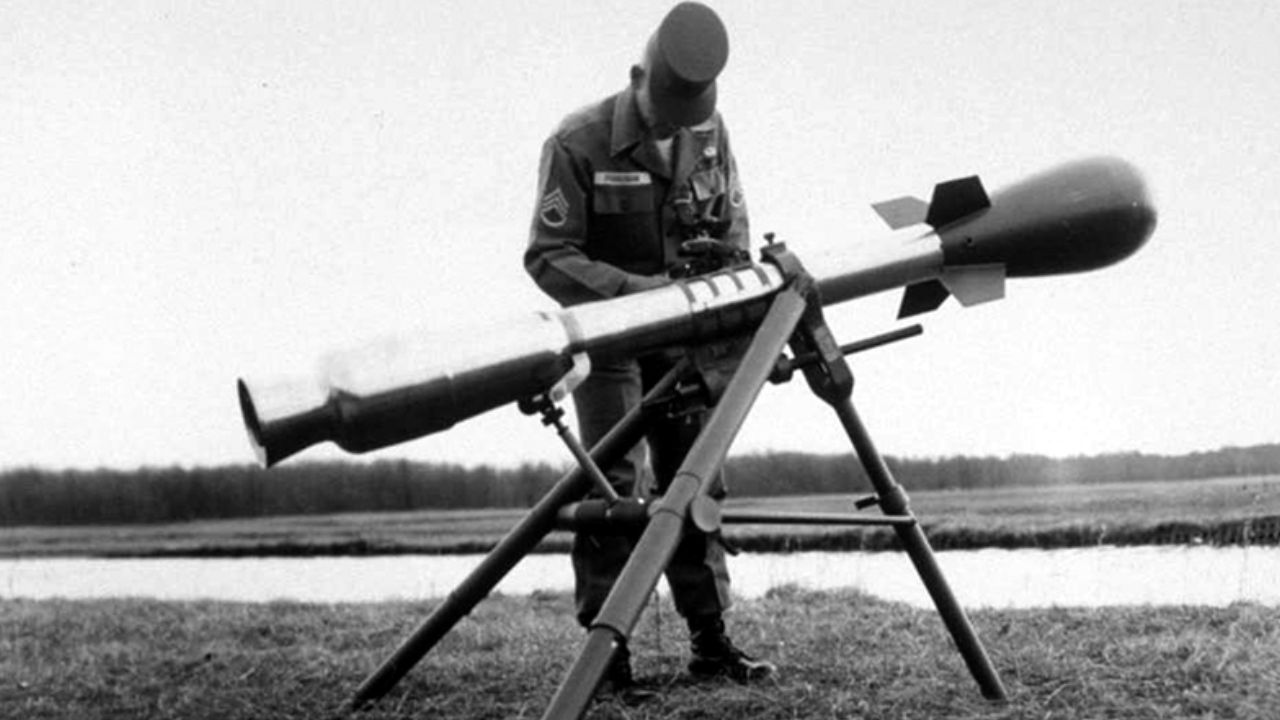
These “weapons that never saw combat” are more than trivia. They show how threat perceptions, procurement risk, and political timing can determine what actually reaches the force. They also underline a quieter reality: even when a platform is shelved, pieces of it—avionics, materials, radar and electronic warfare techniques, propulsion work, and guidance concepts—can carry forward into later programs. Shown above: M-28 / M-29 Davy Crockett: A U.S. portable, recoilless nuclear mortar designed to fire a low-yield W54 warhead up to 2.5 miles; it was deployed in Europe but never fired in a conflict.
Why so many never made it: ambition met budgets, timing, and constraints
Many Cold War “next big things” followed a familiar pattern: an urgent requirement, rapid development, promising tests, and then a hard collision with cost, complexity, or changing priorities. Sometimes the obstacle was technical maturity. Sometimes it was sustainment—what it would take to field the system at scale, train crews, stock parts, and keep readiness high. In other cases, strategic shifts reduced the perceived need for an expensive, high-risk capability.
Treaties and political agreements also shaped what could realistically be deployed, especially in areas tied to strategic missiles and defenses. But it’s important not to treat every cancellation as treaty-driven; many programs ended for more ordinary reasons, including budget pressure and shifting doctrine.
Air power: advanced concepts that stayed in testing
Air forces were a natural home for ambitious leaps because aircraft combine costly airframes with fast-moving electronics. Cold War-era experimental strike aircraft, high-end interceptors, early stealth-related work, and stand-off nuclear delivery concepts aimed to solve problems that looked existential on paper: penetrating dense air defenses, defeating bombers and cruise missiles, and holding hardened targets at risk.
Yet aviation projects could falter when sensors, signatures, propulsion, or flight-control complexity proved harder to mature than planned—or when the maintenance burden looked unrealistic for sustained operations. Even so, canceled aircraft often left behind valuable engineering and industrial experience. Work on radar, electronic warfare, materials, software, and manufacturing methods could migrate into other platforms that did enter service.
What these programs cannot provide is a clean combat verdict. Test success does not automatically translate into wartime effectiveness, which depends on training, basing, sortie generation, reliability under stress, and how an enemy adapts.
Missiles and missile defense: programs built for deterrence, not battlefield proof
Many Cold War missile efforts were designed to influence adversary calculations as much as to be used. Strategic delivery concepts and missile-defense programs, in particular, served as signals: claims about what could be threatened, what might be intercepted, and how confident an opponent could be in a first strike or coercive pressure.
These programs were also vulnerable to cost growth and technical uncertainty. Missile defense, for example, is unforgiving: it depends on sensors, computing, discrimination, command-and-control, and reliability under tight timelines. Some initiatives therefore produced demonstrations, limited deployments, or partial capabilities without ever reaching the kind of proven, large-scale operational use their advocates envisioned.
Even when a specific system did not endure, the underlying work on seekers, propulsion, guidance, and command architectures often informed later approaches—sometimes years later, when technology and budgets aligned more comfortably.
Land warfare: heavy concepts, air defense experiments, and soldier-system ambitions
On the ground, planners chased overmatch through heavy armor and anti-armor concepts meant to blunt massed formations in Europe. Some experimental vehicles promised major gains in protection, firepower, or mobility, but ran into the realities of weight, complexity, and the logistics footprint required to keep them running.
Other efforts focused on next-generation air-defense prototypes or more integrated battlefield networks. Here, the limiting factors were often practical rather than theoretical: communications reliability, computing capacity, integration challenges, and doctrine that had not caught up with what the technology was trying to enable.
Early “system of systems” ideas for infantry faced similar friction. Integrating sensors, communications, and weapons into a single, usable kit sounds straightforward until batteries, ruggedization, and user burden make the concept difficult to field widely. In many cases, the ideas outlived the original programs and resurfaced later when the broader technology ecosystem improved.
Naval programs: expensive timelines and prototypes that never scaled
Navies also pursued unusual concepts—high-speed or heavily armed surface designs, submarine prototypes, and next-generation carrier-aircraft ideas—intended to reshape sea control and power projection. But ships and submarines carry long development timelines and high integration demands across propulsion, sensors, weapons, and crew systems. If priorities shift midstream, the program may never recover enough momentum to deliver a meaningful fleet presence.
For naval projects, “never saw combat” often overlaps with “never reached fleet scale.” A single prototype or a limited run can validate materials, quieting techniques, sonar processing approaches, or combat-system architecture without ever producing a capability that changes day-to-day operational patterns. Still, those validated ideas can influence later designs long after the original program fades from view.
What these cancellations reveal about deterrence and procurement
Strategically, canceled or never-used systems are a reminder that competition itself drives innovation. Deterrence is partly psychological: planners hedge against what an opponent might field, not only what is already deployed. Testing programs, visible industrial activity, and selective disclosures can all shape threat perceptions and resource decisions—sometimes without a single battlefield use.
At the same time, the pattern highlights recurring acquisition risks. Programs stumble for repeatable reasons: requirements that expand, technologies that mature slowly, sustainment burdens that are underestimated, and budgets that tighten. Opportunity costs matter; money and engineering talent tied up in a program that never reaches operational use cannot be spent on upgrades and readiness that might deliver nearer-term capability.
Superpowers set the pace, but allies made choices too
The United States and the Soviet Union dominated the largest Cold War research and development efforts, and their cycles of action and reaction shaped the broader environment. But allies also played important roles, whether through independent high-end aviation and naval programs, contributions to shared basing and doctrine, or decisions driven by interoperability and industrial policy.
In many cases, allied budgets forced sharper tradeoffs: fewer “moonshot” programs could run at once, and a single cancellation could reshape a country’s modernization path. Even so, suppliers and design teams often tried to salvage the most mature subsystems and move them into follow-on efforts, preserving expertise that would otherwise be lost.
The modern echo: big bets still face the same constraints
Today’s high-cost, high-complexity programs—whether focused on hypersonics, next-generation aircraft, missile defense, or autonomy—face the same pressures that shaped Cold War outcomes. Threat assessments change. Budgets fluctuate. Physics and integration refuse to negotiate.
The lesson is not to avoid risk, but to plan for it: balance breakthrough ambitions with fieldable increments, keep sustainment in view from the start, and treat prototypes as learning tools rather than proof of wartime performance. In that sense, the Cold War’s weapons that never saw combat still mattered. They influenced planning, accelerated enabling technologies, and helped define what each side feared the other might bring to a fight that, in the end, never arrived.