
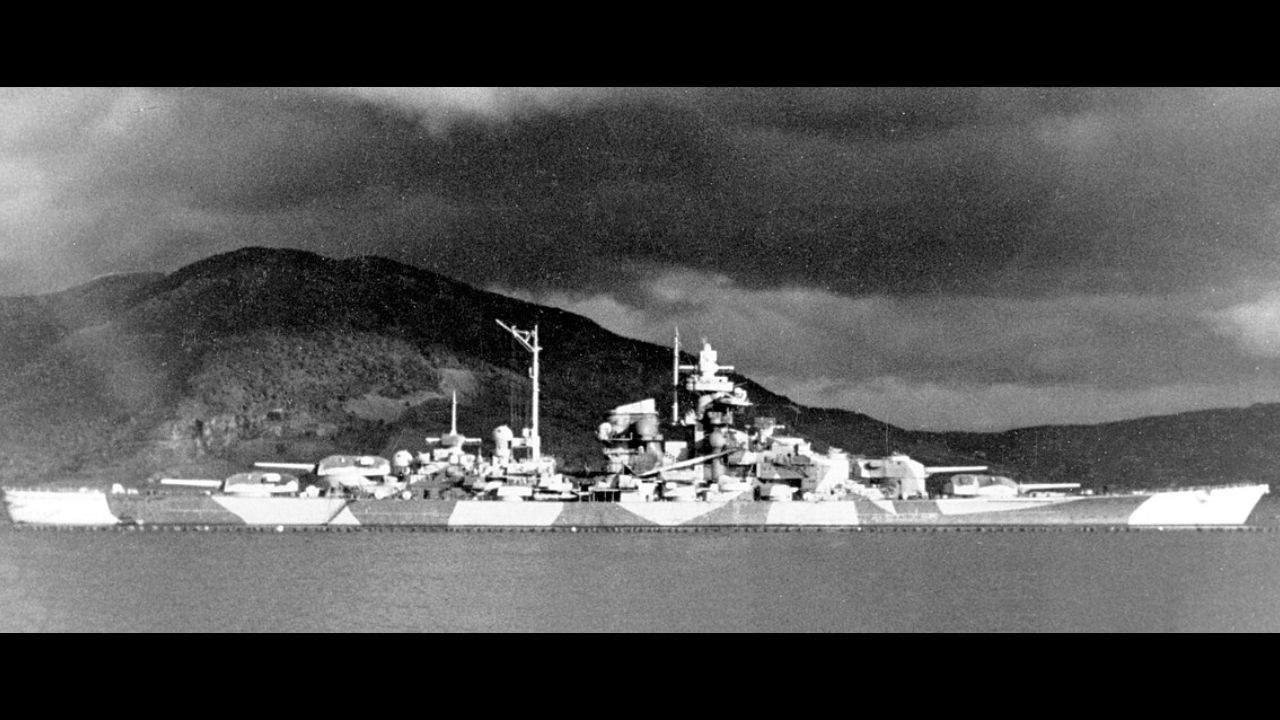
For much of World War II, the German battleship Tirpitz was less a ship that fought and more a strategic problem the Allies could not ignore. As summarized in the U.S. Naval Institute’s Naval History Magazine account of the long campaign, she functioned as a classic “fleet in being” from 1941 to 1944: based in Norway, she represented a worst-case threat that Allied planners had to take seriously even when she was not at sea. That is the core hook. One hull, positioned well, could shape escort plans, air coverage, and strike priorities out of proportion to her actual sorties.
The broad sequence of operations is commonly laid out in Wikipedia’s Tirpitz article, and it helps explain why this became a years-long effort rather than a single decisive moment. The caution is equally important: sweeping claims about exactly “how much” Allied force was diverted are widely repeated but hard to anchor to one primary document. The safer, supportable point is that her presence created real strategic friction—while the precise magnitude is often disputable.
German battleship Tirpitz (Bismarck-class), 1941–1944 “fleet in being”
Tirpitz mattered because she represented a high-end threat to Arctic and North Atlantic planning while benefiting from Norwegian geography and German defensive preparation. USNI’s overview frames the Allied approach as a sustained campaign because planners could not assume she would remain inactive. Wikipedia’s operation-by-operation framing reinforces the same arc: repeated strikes, repairs, shifts in basing, and tactical adaptation—more campaign than duel.
The point is not that the ship constantly fought; it is that she forced the enemy to plan as if she might. A “fleet in being” does not have to win battles to impose costs. It only needs to remain a credible risk at the wrong moment.
Operation Tungsten (Royal Navy Fleet Air Arm carrier raid), 3 April 1944
Operation Tungsten, the Royal Navy Fleet Air Arm carrier raid on 3 April 1944, showed both what was possible and what still fell short. Wikipedia’s “Operation Tungsten” page and the Tirpitz article describe a major strike that damaged Tirpitz without eliminating her, and USNI places it within the longer pattern of attempts to solve the “Tirpitz problem.” The lesson was not that airpower was irrelevant; it was that converting damage into a kill against a defended, sheltered capital ship was difficult.
Tungsten also helps explain why the eventual “kill mission” shifted toward RAF heavy bombers. The context points to practical obstacles that blunted follow-on carrier-style attacks: fjord terrain, layered anti-aircraft defenses, and smoke tactics that improved after earlier raids. Because damage assessments vary, it is better to describe results in careful terms—“damaged” or “temporarily out of action”—rather than assume that damage automatically meant “combat ineffective.”
Tallboy “earthquake” bomb — 12,000 lb class (“six-ton”), designed by Barnes Wallis; carried by modified Avro Lancasters
The RAF’s eventual answer centered on a specific weapon: the Tallboy. As described in Wikipedia’s Tallboy article and the Australian War Memorial’s summary, it was a 12,000 lb “earthquake” bomb—often rounded in popular accounts to “six-ton”—designed by Barnes Wallis to defeat hardened targets through penetration and shock effects, including the destructive potential of a near miss. Using “12,000 lb Tallboy” keeps the story precise and avoids confusion over how different “ton” measures get used in popular retellings.
Tallboy also required changes to the delivery platform. The context notes that its size drove modified Avro Lancasters, including bomb-bay changes. This matters to the larger narrative: sinking Tirpitz was not simply a matter of trying harder. It became a weapon-and-aircraft problem that had to be solved in a way that could overcome armor, defensive fire, and the complications of attacking a target often protected by terrain and concealment.
Operation Paravane — 15 September 1944 (RAF heavy bombers staging via northern Russia to hit at Kaafjord)
Operation Paravane on 15 September 1944 marked the first operational use of Tallboys against Tirpitz and underlined why the campaign dragged on: even reaching the ship could require extraordinary logistics. Wikipedia’s “Operation Paravane” entry notes RAF heavy bombers staging via northern Russia to attack Tirpitz at Kaafjord—a mission profile defined by range, basing, and coordination before the first bomb was even released.
Accounts of Paravane’s impact are often described as severe, and some sources go further by calling the damage “irreparable” or arguing that Tirpitz was “no longer combat effective.” The context flags that phrasing as interpretive unless it is tied to a specific technical assessment. What is clear in the provided framing is the consequence: Paravane forced a relocation that reshaped the endgame and changed where the next attacks could be launched.
Move to the Tromsø area; Operation Obviate — 29 October 1944
After Paravane, Tirpitz moved to the Tromsø area. Wikipedia’s “Operation Obviate” and “Operation Catechism” pages, along with a RAF Museum blog outlining the sequence, describe how that shift enabled more direct Scotland-based RAF strikes. The move did not remove the difficulty of the task, but it did change the operational geometry and made further heavy-bomber attempts more feasible.
Operation Obviate on 29 October 1944 demonstrated the limits of even an improved approach. The context emphasizes that weather and targeting problems constrained results, and it cautions that precise hit-versus-near-miss tallies are easy to misstate without mission reports. The takeaway is straightforward: the Allies still had to keep coming back, and success could hinge on conditions beyond planning and courage.
Operation Catechism — 12 November 1944 (RAF Nos. 9 and 617 Squadrons with Tallboys)
Operation Catechism on 12 November 1944 delivered the outcome years of effort had been building toward. RAF Nos. 9 and 617 Squadrons attacked with Tallboys, and Tirpitz capsized at Tromsø. Wikipedia’s “Operation Catechism” page provides the outline of the raid, and the International Bomber Command Centre (IBCC) archive entry corroborates that Bomber Command sank Tirpitz using 12,000 lb bombs.
Popular histories often disagree on how many Tallboys were direct hits versus near misses, and the context explicitly flags that point as disputed unless anchored to primary after-action reporting. What the story can support, without over-claiming, is the operational logic of the outcome: Tallboy’s design meant that either a successful penetration or a sufficiently close detonation could produce shock effects and flooding severe enough to overwhelm a heavily damaged ship in a constrained setting. In practical terms, Catechism ended the “fleet in being” problem in a single morning.
Technical damage framing: “Naval A/C Attack on TIRPITZ” / CB-3081(20) (referenced via kbismarck.com)
The technical framing helps explain why Tallboy achieved what earlier methods often could not. The context points to “Naval A/C Attack on TIRPITZ” / CB-3081(20), a report commonly referenced in secondary compilations, and notes that kbismarck.com hosts a reproduction/summary discussing Tallboy drop effects and the rapid capsize timeline. Because kbismarck.com is a secondary hosting site, any specific timings or figures taken from it should be handled cautiously and, where possible, traced to an archive scan or published primary document.
Even with that sourcing caveat, the value of the engineering lens is clear. Tallboy’s effectiveness was not a simplistic “one hit sinks battleship” tale; it was a combination of shock loading, structural failure, and flooding progression—effects that could be decisive even when defenses, terrain, and smoke made ideal aiming conditions rare. That is why the long campaign can look paradoxical: the Allies did not lack intent, but they needed the right mix of access, conditions, aircraft modification, and weapon effects to make the outcome reliable.
Context guardrail: Grand Slam (22,000 lb “10-ton”) was not the Tirpitz weapon—Tallboy was
The “earthquake bomb” story invites a common mix-up, and the context sets a clear guardrail. Grand Slam, the 22,000 lb “10-ton” weapon, is not the bomb associated with sinking Tirpitz. The Tirpitz story here is about Tallboy—12,000 lb class—delivered by modified Lancasters in the culminating RAF operations. Keeping that distinction straight is essential to keeping the narrative accurate.
Seen as a whole, the campaign’s logic becomes consistent. Tungsten showed the limits of carrier air attack against a fjord-sheltered, heavily defended target; Paravane proved Tallboy could change the ship’s prospects and drive a relocation; Obviate showed that even the best tools could be blunted by conditions; and Catechism—outlined by Wikipedia and corroborated by IBCC—ended the problem. The throughline is simple: one ship mattered for years because she imposed years of planning constraints, until a specialized weapon and the right operational setup finally removed her from the board.