
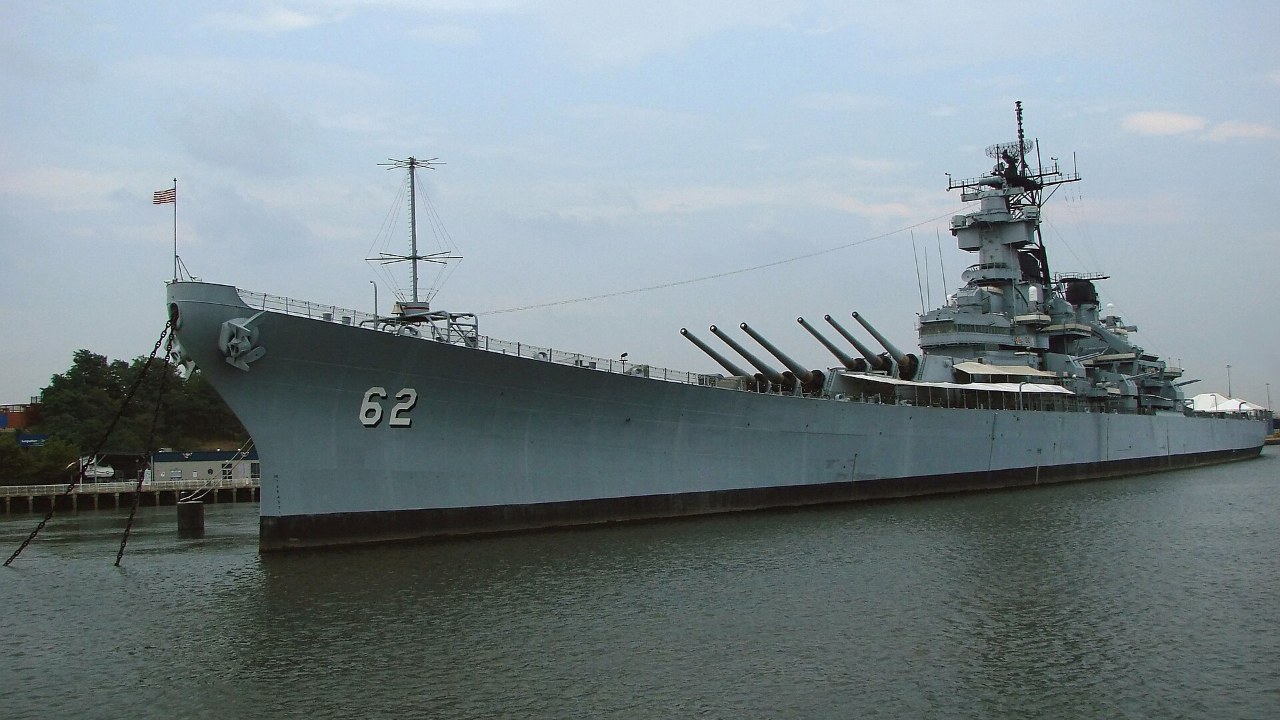
Across the Delaware River from Philadelphia, the city whose navy yard built her, the battleship New Jersey now sits as a museum in Camden. Her service record spans four commissions, from World War II to the Persian Gulf, and the museum that keeps her makes a strong claim for it: no American battleship earned more decorations.
The record is worth walking through because of how often she came back. Launched for World War II, she was put in reserve three times and recalled three times, the last time with cruise missiles bolted onto a 1940s hull.
The Battleship New Jersey Museum & Memorial’s history of the ship opens with the superlative: “USS New Jersey (BB-62) is the most decorated battleship in Navy history.” The museum adds that she was built at the Philadelphia Naval Shipyard and launched Dec. 7, 1942, one year to the day after Pearl Harbor.
Commissioned in 1943
The Navy’s own record agrees on the start. The Naval History and Heritage Command’s entry for New Jersey in the Dictionary of American Naval Fighting Ships says she was “commissioned at Philadelphia 23 May 1943, Captain Carl F. Holden in command.” Her main battery was nine 16-inch/50-caliber Mark 7 guns in three triple turrets, according to the museum.
In the Pacific she carried the flags of two admirals the museum calls “America’s greatest fighting admirals.” Adm. Raymond Spruance used her as his flagship until April 10, 1944, and Adm. William F. “Bull” Halsey Jr. commanded the Third Fleet from her deck “from August 24, 1944 until January 27, 1945,” the museum says. No other ship served as flagship for both, according to the museum.
She was decommissioned at Bayonne, N.J., on June 30, 1948, and assigned to the Atlantic Reserve Fleet, according to the NHHC entry.
Korea and Vietnam
The reserve fleet did not hold her long. New Jersey “was recommissioned at Bayonne 21 November 1950,” the NHHC says, and the museum notes she “was the first battleship reactivated for the Korean War.” She went back into reserve at Bayonne on Aug. 21, 1957.
Her third commission began April 6, 1968, at the Philadelphia Naval Shipyard, according to the NHHC, and it sent her to Vietnam as “the only battleship to serve in the Vietnam War,” in the museum’s words. The Navy’s account of that tour is specific: “In her first two months on the gun line, New Jersey directed nearly ten thousand rounds of ammunition at Communist targets,” and “over 3,000 of these shells were 16-inch projectiles.” The museum puts the whole deployment at “nearly twelve million pounds of shells in six months off Vietnam.”
The NHHC entry records that she “earned the Navy Unit Commendation for Vietnam service.” Her colors came down on Dec. 17, 1969, when she entered the inactive fleet, the entry says.
Missiles on a 1940s hull
The fourth commission was the most unusual. The museum says she was recommissioned in 1982 and refitted to make room for Tomahawk cruise missile and Harpoon anti-ship missile batteries. Its history credits her with several firsts from that period, including “the first battleship to fire a Harpoon missile” and “the first battleship to enter the Persian Gulf.”
Her 16-inch guns went back to work off Lebanon. “For six months, the New Jersey supported the beleaguered Marines in Lebanon,” the museum says, and it notes that she alone among the four Iowa-class battleships served in both Vietnam and Lebanon.
The last decommissioning
New Jersey was “decommissioned for the fourth and final time on February 8, 1991 in Long Beach, California,” according to the museum. Four years later, the museum says, “She was officially stricken from the Navy list on February 12, 1995.” Congress then ordered her reinstated as a mobilization asset, and “On January 4, 1999 NEW JERSEY was again stricken from the Navy list,” with USS Iowa taking her place in reserve.
She had spent those years in mothballs at Bremerton, Wash. In September 1999 she began what the museum calls her final voyage home, and on Nov. 11 that year she arrived at the Philadelphia Naval Shipyard, where her career began.
A note on the count
The “most decorated” claim belongs to the museum, and the two records do not count her awards the same way. The NHHC entry, which ends with the 1969 inactivation, lists battle stars for World War II, Korea and Vietnam, while the museum gives its own total for her career. Readers comparing the two will find different numbers, which is why the claim here is the museum’s, in its own words.
What both records agree on is the arc: commissioned May 23, 1943, called back for Korea, Vietnam and the 1980s, and retired for good in 1991. “The Battleship New Jersey opened as a Museum and Memorial in October 2001,” the museum says, and she has been open to visitors in Camden since.