
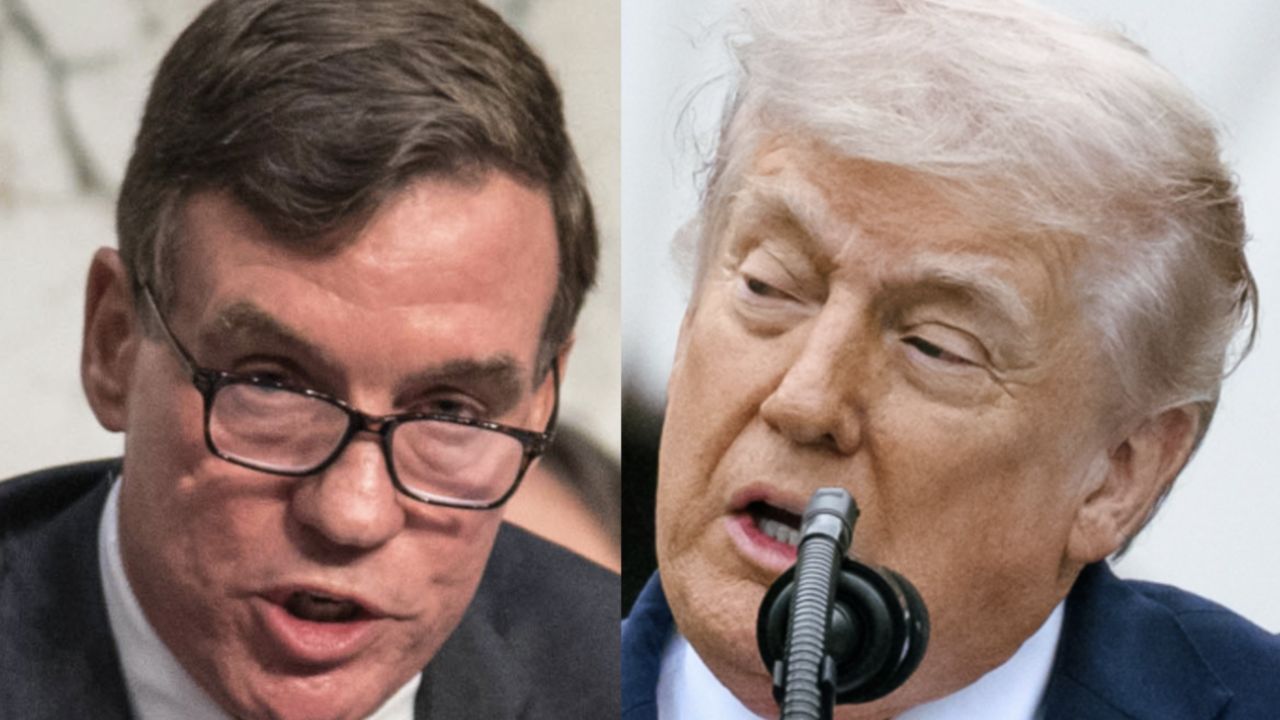
Senator Mark Warner accused President Donald Trump of increasing financial pressure on American households through the war with Iran and his tariff policies while simultaneously reducing access to federal food assistance. In a November 20 statement, the Virginia Democrat cited declining SNAP participation, a proposed federal rule that could remove another 6.3 million people from the program and a reported $3 million National Park Service project to reset bricks in Lafayette Square near the White House. Warner’s criticism follows months of opposition to the administration’s military campaign, trade policies and reductions in food assistance.
Warner published the following statement on X:
While his war and tariffs raise costs at the grocery store, Donald Trump has already thrown 5 million Americans off SNAP… and is now plotting to kick 6.3 million more off.
All this while he spends $3 million taxpayer dollars reseting the bricks in a White House park.
Warner’s first argument concerns the economic consequences of the Iran war and Trump’s tariffs. He has repeatedly argued that the administration’s policies are increasing costs for consumers, businesses and households. His criticism of the military campaign has focused on the disruption of global energy markets, rising fuel prices and the financial consequences of a conflict he says was launched without a sufficiently clear strategy.
On February 28, 2026, Warner issued a statement following the administration’s military strikes against Iran. He acknowledged Iran’s history of supporting terrorism and destabilizing the region but argued that those concerns did not eliminate the president’s obligation to act within the law and consult Congress. He warned that the operation risked drawing the United States into a prolonged Middle Eastern conflict and demanded a clear military objective, an escalation strategy and a defined end state.
Warner continued raising those concerns on April 1, 2026, following a presidential address about the conflict. He argued that the administration had offered shifting explanations for the war without demonstrating sufficient preparation for its consequences. He specifically identified increased gasoline, diesel, fertilizer and aluminum prices as economic pressures already affecting American households. He also raised questions about the administration’s handling of Iranian nuclear material, ballistic missile capabilities and the continued disruption of the Strait of Hormuz.
The senator subsequently brought the economic consequences of the conflict to the Senate floor. In a March 25 speech, Warner described the war as a conflict without a clear endgame and highlighted the disruption of international energy supplies following the closure of the Strait of Hormuz. He cited the International Energy Agency’s assessment of the disruption and discussed rising gasoline prices and the impact on consumers. His remarks established an ongoing connection between the administration’s military decisions and the cost of living.
Warner has also challenged the administration over the financial and military costs of the conflict. In September 2026, he joined 45 senators in demanding that Defense Secretary Pete Hegseth provide a full accounting of the war’s expenses. The senators criticized the Pentagon for withholding basic budget information while casualties and taxpayer expenditures continued to increase. Their letter also raised concerns about extended military deployments and the number of American troops stationed in the region.
The senator’s criticism of Trump’s tariffs also predates the current statement. On February 1, 2025, Warner warned that the administration’s tariffs on imports from Canada, Mexico and China could increase the cost of everyday products, including vehicles, phones, groceries and gasoline. He argued that broad tariffs would function as a tax on American families rather than a targeted response to unfair trade practices.
Warner continued that criticism when Trump announced broader tariffs on April 2, 2025. The senator described the measures as an enormous tax increase on American consumers, warning that higher import costs would affect groceries, electronics, clothing and cars. He also called for Congress to reassert its authority over trade policy, arguing that tariff decisions should be targeted rather than imposed broadly on imported goods.
In September 2026, Warner joined Senator Tim Kaine and other Democratic senators in introducing the End Trump’s Tariff Tax Act. The legislation was intended to revoke and refund the administration’s latest tariffs and restrict the presidential authorities used to impose them. Warner’s office said the measure was designed to address the financial impact of the trade policies on American households and businesses. The legislation represents a direct legislative extension of the concerns he raised in his November statement.
The second major part of Warner’s statement concerns SNAP, the Supplemental Nutrition Assistance Program. His reference to approximately 5 million Americans losing food assistance relates to the decline in program participation following the enactment of the 2025 Republican reconciliation law, Public Law 119-21. An October 2026 analysis by the Center on Budget and Policy Priorities, using USDA and state program data, estimated that approximately 5.5 million people had left SNAP between the law’s enactment in July 2025 and July 2026. That represented a decline of approximately 13% in participation.
The underlying legislation changed several aspects of SNAP, including eligibility rules, work requirements and the distribution of administrative costs between the federal government and states. The Congressional Research Service’s analysis of Public Law 119-21 explained that the law was expected to reduce federal spending on food assistance and make it more difficult for some individuals to qualify for benefits. The law was enacted on July 4, 2025, and its provisions have been implemented through subsequent federal rules and state-level changes.
Warner’s reference to another 6.3 million people comes from a separate USDA proposal published on November 10, 2026. The administration proposed restricting broad-based categorical eligibility, a policy that currently allows households receiving certain benefits funded through Temporary Assistance for Needy Families programs to qualify for SNAP without having to meet the usual federal income thresholds. USDA estimated that approximately 6.3 million individuals could lose SNAP eligibility under the proposed changes when they reach their full projected effect in fiscal year 2029.
The proposed rule is not the same as an already implemented reduction. It was published for public comment, with a December 10, 2026 deadline. The USDA’s stated rationale is to narrow categorical eligibility to households receiving qualifying TANF assistance. The agency argues that the change would better target assistance to eligible households. The 6.3 million figure represents the department’s projected impact, not a count of people who have already lost benefits because of that particular proposal.
The projected reduction follows the earlier decline in SNAP participation associated with the 2025 reconciliation law. Reuters reported that more than 5.5 million people had already left the program before the new proposal was announced. The November proposal would therefore create a separate potential reduction on top of the participation decline that had already occurred. The distinction is important because the 5 million figure concerns an observed change in participation, while the 6.3 million figure concerns a future projection under a proposed rule.
The final issue in Warner’s statement concerns approximately $3 million in taxpayer spending to reset bricks in Lafayette Square, the public park located directly across Pennsylvania Avenue from the White House. The project was reported as part of the administration’s broader renovations of White House grounds and nearby public spaces. The Washington Post reported on November 17 that the National Park Service was expected to spend approximately $3 million on the brick-resetting project, with the agency set to cover the cost. The reporting was based on documents reviewed by the newspaper and officials familiar with the plans.
The Lafayette Square project is separate from the White House ballroom and other renovation work associated with Trump’s broader construction plans. The park is a federally maintained public space, and the reported project involves resetting existing bricks rather than constructing a new presidential building. The distinction matters because Warner’s criticism is specifically about federal spending on park maintenance and renovation while the administration is implementing reductions in food assistance. The $3 million figure has been reported publicly, but the available reporting does not establish that the project was personally ordered or paid for by Trump.
Warner’s broader criticism is that the administration is imposing financial burdens on households through military and trade policies while reducing access to food assistance and directing federal resources toward other projects. His record includes repeated statements about the economic effects of the Iran war, opposition to broad tariffs, legislation challenging the administration’s trade authority and congressional demands for greater transparency over military spending. His November statement brings those issues together through the contrast between rising household costs, declining SNAP participation and federal spending on the White House grounds.
The central distinction in Warner’s claims is between costs already experienced by Americans and policy changes that remain proposed. The decline of approximately 5.5 million SNAP participants is based on observed program data, while the additional 6.3 million figure comes from USDA’s projected effects of a proposed rule. The Lafayette Square expenditure is a reported federal project, and the connection between the war, tariffs and grocery prices reflects Warner’s documented political and economic criticism. Together, the three issues form the basis of his latest challenge to the administration’s spending and economic priorities.