
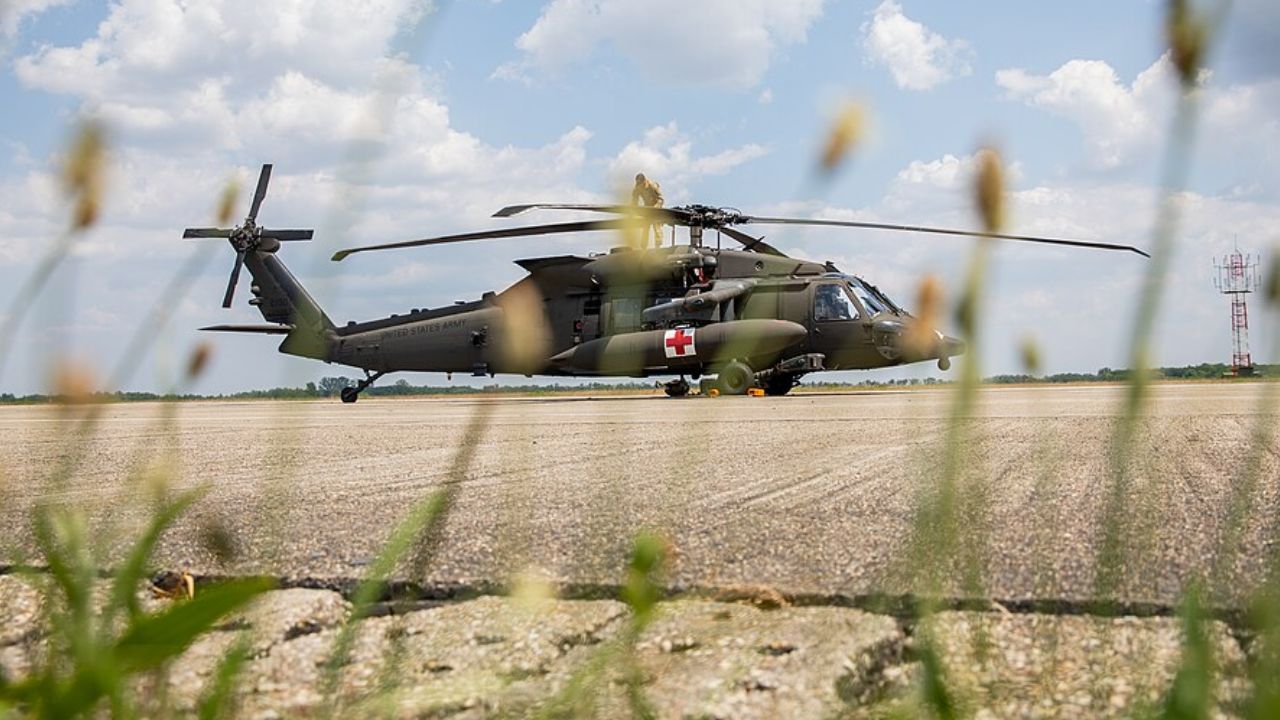
Modern ground warfare didn’t just get faster with better trucks and radios—it gained a new axis. Military helicopters gave armies the ability to move infantry, ammunition, and medical teams over rivers, mountains, minefields, and predictable ambush routes, then set them down where ground forces could exploit time and surprise. That shift—air assault, armed escort, rapid resupply, and MEDEVAC—changed how commanders plan around distance, terrain, and tempo.
The logic is straightforward: if you can move combat power vertically, you can bypass obstacles that would otherwise dictate an operation’s pace. In practice, helicopters became the link between dispersed units, the enablers of raids and rapid reinforcement, and the fastest way to move wounded off the battlefield. But the same low-altitude flight that makes rotorcraft useful also exposes them to modern threats, from MANPADS and radar-guided short-range air defenses to drones and electronic warfare.
The “third dimension” becomes doctrine
Helicopters mattered before they were iconic. Early air-mobile concepts showed that small units could be repositioned quickly, supplied away from major roads, and extracted under pressure—missions that can be slow or impractical when routes are limited or contested. Over time, those ideas solidified into doctrine: vertical envelopment to get around an enemy’s front and air assault to concentrate forces quickly for a local advantage.
U.S. Army and Marine Corps experience, especially in the Vietnam era, became a defining reference point for modern airmobility. The UH-1 “Huey” made helicopter lift a routine part of operations—moving troops, shuttling supplies, and carrying casualties away from the point of injury. The lasting change was not just what helicopters could do, but how often commanders could reasonably plan to use them.
Iconic airframes, practical roles
If the UH-1 became the symbol of air assault and battlefield medicine, it also highlighted a hard lesson: transport helicopters are vulnerable when landing zones are contested. The response was a dedicated attack and escort role—pairing lift with suppressive fire to reduce risk during insertions and extractions. Platforms like the AH-1 Cobra and later the AH-64 Apache helped define attack helicopters as purpose-built systems for supporting ground forces, not simply utility aircraft with added weapons.
Heavy lift applied the same concept at larger scale. CH-47 Chinooks and CH-53s made it possible to move bulk ammunition, fuel, and heavier equipment without relying entirely on roads, bridges, or long convoys. That translates into operational reach: the ability to sustain and reposition units even when infrastructure is damaged, terrain is restrictive, or adversaries target supply lines.
Other militaries built their own approaches around similar problems. Soviet/Russian forces relied on workhorses like the Mi-8 for transport and fielded Mi-24 variants that combined troop-carrying capacity with attack capability—an approach that emphasized moving infantry with integral fire support. Across NATO and partner nations, a mix of U.S. and European fleets has supported comparable missions, with employment adapted to local geography, readiness levels, and threat environments.
What helicopters changed for ground forces
Helicopters compressed time and stretched maneuver space. A unit that might take hours to reach a ridgeline, river crossing, or urban edge by ground movement could arrive far faster by air, changing the sequence of an engagement and forcing an adversary to defend more directions. For commanders, that meant more usable options: quick reinforcement, rapid repositioning, and the ability to act on time-sensitive information.
They also reshaped sustainment. Rotary-wing resupply can keep small teams operating forward without pushing every gallon of fuel and every case of ammunition through predictable ground routes. In practical terms, that matters because sustainment is combat power: a force that can be kept fed, fueled, and supplied can stay in contact longer and keep pressure on the enemy.
MEDEVAC is one of the most consistent impacts. Using utility helicopters to move casualties reduced the time between injury and medical care and turned evacuation into a standard planning assumption rather than an improvised solution. That expectation influences morale and operational tempo: units operate differently when they trust that wounded personnel can be moved quickly.
Sensors, night operations, and precision
As avionics improved, helicopters became less confined to daytime and good weather. Night-vision, improved navigation, and more capable sensors expanded the window for raids, resupply, and armed reconnaissance. Better communications and networking also strengthened integration with ground units and other aircraft, reducing the delay between spotting a threat and responding to it.
Precision weapons further broadened the attack helicopter’s role in close support. Modernized attack fleets could engage from more tactically flexible positions instead of relying only on close-range strafing or rocket runs, often coordinating with troops on the ground. These advances did not remove risk, but they increased how often helicopters could be used effectively and how quickly they could contribute once a target was identified.
The survivability problem: low and exposed in a lethal sky
Helicopters face a structural dilemma: many of their most valuable missions require them to fly low, slow, and close to the fight. That places them within reach of MANPADS, radar-guided SHORAD, heavy machine guns, and other battlefield fires—and today it also means operating under persistent observation from drones and other sensors. In a sensor-saturated environment, large helicopter movements can be harder to conceal, track, or deconflict without drawing attention.
Recent combat reporting from conflicts such as Ukraine and fighting in parts of the Middle East underscores both sides of the ledger. Helicopters remain useful for rapid movement and responsive fires, but they can be punished when air defenses are dense, cueing is fast, and electronic warfare disrupts navigation or communications. The point is not that helicopters have become irrelevant; it is that survivability has moved to the center of how they must be designed, trained, and employed.
Mitigation options exist, but they come with tradeoffs. Terrain masking, smarter routing, decoys, electronic warfare, and stand-off weapons can reduce exposure, yet they add complexity, cost, and training demands. Unmanned teaming—using drones for scouting, decoying, or target handoff—may add another layer of protection and awareness, but it also brings its own burdens in control, bandwidth, and coordination.
Who shapes the next phase
On the user side, the U.S. Army and Marine Corps remain central because their doctrine and force structure treat rotary-wing aviation as integral to maneuver and sustainment. NATO users and partners, operating mixed fleets and facing different terrain and threat sets, are modernizing while also reconsidering how close to the forward edge helicopters should routinely operate in a high-end fight. Russia’s continued reliance on Mi-8 and Mi-24 variants points to the same underlying reality: rotary-wing lift and responsive fire support still fill needs that are difficult to replace.
Industry will shape what is possible, but it will not be a simple story of a “new model” solving every problem. Major manufacturers—Sikorsky (Lockheed Martin), Boeing, Bell, Airbus Helicopters, and Russian Helicopters—support fleets that depend on constant sustainment and periodic upgrades. Readiness hinges on parts, maintenance capacity, and trained maintainers as much as it does on airframe age, and those factors now weigh heavily on procurement choices.
Modernization versus replacement
Keeping helicopter fleets effective is costly, and those costs compete with other priorities such as air defense, drones, and long-range fires. Upgrades can be the quickest path to improved capability, but they may also preserve designs that were not built with today’s threat environment in mind. Replacement can bring better performance and digital integration, yet it introduces its own risks: production ramps, training pipelines, and the gap between initial fielding and mature readiness.
Next-generation efforts such as the U.S. Future Vertical Lift and the FLRAA track—often associated in public discussion with the Bell V-280—signal the direction many planners want to move: greater speed, longer reach, and deeper network integration. These programs are best understood as attempts to address operational constraints, not as guarantees of survivability in the face of modern air defenses. Even a more advanced aircraft still has to approach a landing zone, coordinate under jamming, and operate in a battlespace where detection can be rapid and persistent.
What comes next on the battlefield
Tactically, the debate is shifting toward how helicopters are used rather than whether they are used. That can mean operating farther from the front line, relying more on stand-off effects, integrating more tightly with unmanned systems, and practicing disciplined emissions control to reduce detectability. It can also mean that heavy lift and MEDEVAC remain indispensable even as certain high-risk missions are adjusted—or avoided—based on the air defense picture.
Strategically, helicopters will continue to matter because armies still have to move people and supplies through terrain that punishes ground mobility. The question is how much risk commanders can accept in contested airspace, and what they must invest in training, electronic warfare, decoys, tactics, and sustainment to keep rotorcraft viable. Helicopters reshaped modern ground warfare by making time and terrain more negotiable; the next era will be defined by whether they can still do that under constant observation and persistent threat.