
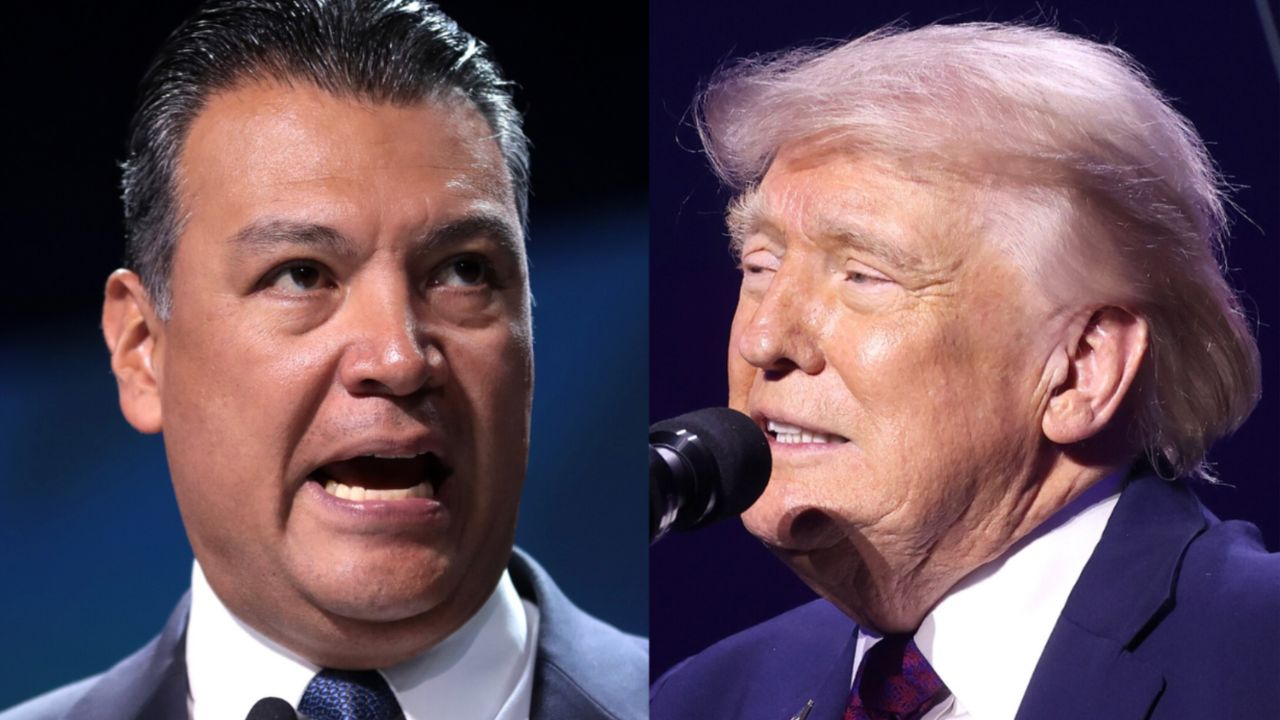
Senator Alex Padilla rejected the White House account of President Donald Trump’s rally remarks on Los Angeles and San Diego, asking, “Do they think we’re stupid?” The White House said Trump was describing a nuclear threat the Iran war was meant to stop, not inviting an attack on the two cities.
Padilla, a California Democrat, wrote that line Wednesday in a post on X. He was quoting the White House rapid-response account. He did not add a further statement, and his office site did not carry a separate release on the remarks.
The account he was answering had written, “No, he didn’t, you buffoons. He was saying the U.S. is fighting to STOP Iran from having the ability to take out LA and San Diego with a nuclear weapon — which they would if they had the chance,” in a post on Tuesday. That post was a reply to a Los Angeles Times headline.
Trump made the remarks Monday at a campaign rally in Grand Island, Nebraska. Speaking about the war and prices he tied to it, he said: “It’s a small price to pay for keeping the world safe, keeping our country safe. They can take out a city. Let ’em take out Los Angeles, let ’em take out San Diego. This is a very small price to pay, and it’s going to be over with very soon.” He said the higher prices were “just artificial” and “a little bit high,” and that the war was “essentially almost over with” but would “end very soon, and it’s going to end one way or the other.”
White House communications director Steven Cheung gave the same reading as the rapid-response account. “The media freakout over President Trump’s comments is not rooted in reality,” he wrote in a post on X. “He was clearly stating U.S. cities would have been threatened if a nuclear Iran hadn’t been stopped. America is safer because of the President. Iran has no nuclear, no navy, no air force, and no money.”
Padilla’s question treats that explanation as an insult to the plain wording. The White House posts treat the city names as the threat a nuclear Iran would have posed, not as a suggestion that those cities be struck. The rally remarks use “a small price to pay” first for the prices and again immediately after Los Angeles and San Diego.
Both cities host major military installations. Naval Base San Diego, which the Navy calls its premier Pacific Fleet surface installation, supports 54 homeported ships and more than 150 tenant commands. Naval Base Coronado includes Naval Amphibious Base Coronado and supports aircraft carriers, helicopter squadrons and SEAL teams.
Other California officials had already rejected the White House reading. Governor Gavin Newsom wrote that Trump was “saying our foreign enemies should ‘take out’ Los Angeles and San Diego” and called him “deranged and dangerous,” in a post. On the official governor’s account, he later called the remarks “dangerous — if not treasonous” and said he was directing the State Threat Assessment Center to monitor for any reading of them as an invitation to target the state.
Los Angeles Mayor Karen Bass wrote that Trump “suggested that a foreign government attack Los Angeles” and that the statements were “dangerous and could potentially compromise our safety,” in a post on X. Padilla’s post does not repeat those charges. It answers only the White House claim that critics had misheard the president.
In a July 30 Statement of Administration Policy, the White House said the president ordered a ceasefire on April 7, that the United States and Iran signed a memorandum of understanding on June 17, and that Iran attacked neutral-flagged commercial ships in the Strait of Hormuz on July 6 and 7. It said U.S. forces began strikes inside Iran on July 7, and described those operations as separate from earlier ones. That document does not mention Los Angeles or San Diego.