
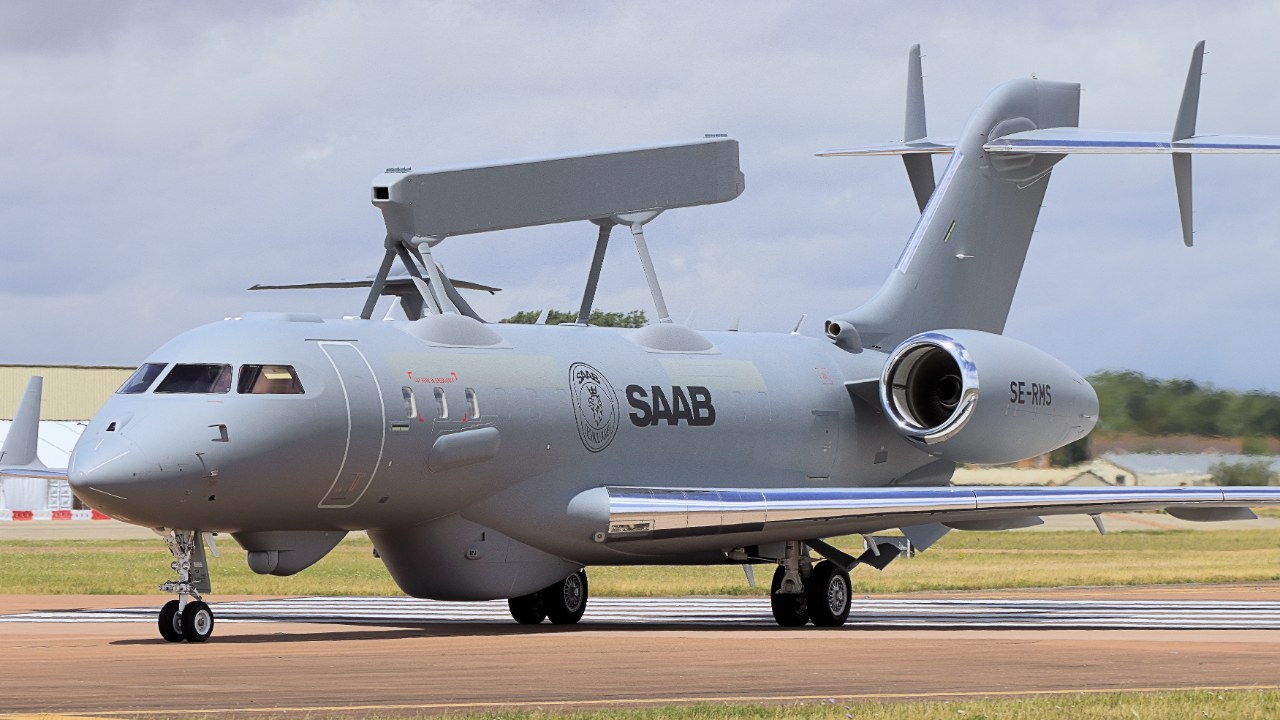
Sweden’s first GlobalEye has had its unveiling. Saab presented the airborne early warning and control aircraft, the first of three Sweden has on order, on Oct. 15, 2026. The jet has not flown yet; testing and verification come next.
This is the step from contract paperwork to a real airframe for the Swedish Air Force, four years after the first two jets were ordered. It is also the start of the part of any program where the aircraft has to show it can do what its maker says it can.
Saab announced the milestone in an Oct. 15, 2026 press release. The company says it “has presented the first GlobalEye airborne early warning and control (AEW&C) aircraft,” ordered by the Swedish Defence Materiel Administration, known as FMV, for the Swedish Air Force. “The aircraft will now enter a phase of testing and verification ahead of its first flight,” the release says, with delivery to the customer to follow.
Micael Johansson, Saab’s president and CEO, put it in program terms.
“The presentation of Sweden’s first GlobalEye marks an important milestone for both Saab and the Swedish Armed Forces.”
The release does not say where the presentation took place, and it gives no date for the first flight or the handover.
Three aircraft, two contracts
“Sweden has ordered three GlobalEye aircraft from Saab,” the 2026 release says. “The first two aircraft were contracted by the Swedish Defence Materiel Administration (FMV) in 2022,” it adds, “and a third GlobalEye was ordered in 2024.”
The paperwork behind those numbers is on Saab’s own record. In a June 30, 2022 release, Saab said FMV had ordered two GlobalEye in a deal worth approximately SEK 7.3 billion, with “deliveries planned during 2027.” That contract included options that would let FMV order up to two more aircraft.
FMV used one of them two years later. Saab’s June 27, 2024 release announced a contract for a third GlobalEye valued at approximately SEK 2.6 billion, with a delivery period of 2024–2029. “We are proud to contribute to Sweden’s defence with another GlobalEye aircraft,” Johansson said at the time.
What the aircraft carries
Saab’s 2022 release says the system’s sensors and command and control system are integrated into the Global 6000 aircraft, and that its main sensor is the Erieye Extended Range radar, with a range of more than 550 kilometers.
The 2026 release describes it as “an advanced multi-domain AEW&C solution with an array of active and passive sensors.” Saab says it is meant to give Sweden long-range surveillance and a broad operating picture across air, land and sea, feeding real-time information to air forces, armies and navies so threats can be detected early.
That multi-domain claim is the company’s description of the design. The test phase announced on Oct. 15 is where the Swedish customer starts checking it against the aircraft in front of them.
From presentation to delivery
Johansson’s statement looks ahead to the handover. As the program moves toward delivery, he said in the 2026 release, GlobalEye “will provide Sweden with a powerful capability.”
The verified sequence is short. The first Swedish GlobalEye has been presented. Testing and verification come before its first flight, and the first flight comes before delivery to FMV and the Swedish Air Force, per Saab. The 2022 contract set deliveries of the first two aircraft during 2027, and the 2024 contract gave a delivery period of 2024–2029. Neither release puts a date on the first flight, and Saab has not announced one.
Top image: A Saab GlobalEye airborne early-warning aircraft, photographed in July 2023; not the Swedish aircraft presented in October. Image Credit: Airwolfhound — CC BY-SA 2.0 / Wikimedia Commons