
A physicist at a Navy test station wanted a cheap missile that could find an enemy jet by the heat of its engine. He started it as a side project. The weapon he and his team built, the Sidewinder, is the one the Office of Naval Research now calls “the world’s most widely used air-to-air missile.”
It is also still flying. By ONR’s count, the Sidewinder has stayed in active service for more than 70 years.
ONR tells the story in a one-page history of the Sidewinder. The document says the missile “began as a side project.” In the early 1950s, according to ONR, “physicist William B. McLean,” working with ONR at the Naval Ordnance Test Station, developed “a low-cost, heat-seeking missile” that needed no external guidance. “More than 70 years later,” the document says, the Sidewinder remains in active service.
McLean at Inyokern
The Naval History and Heritage Command fills in the man behind it. Its history of the dry cargo ship William McLean (T-AKE-12), named for him, says McLean was born in Portland, Oregon, on May 21, 1914, and earned three degrees at the California Institute of Technology, finishing with a Ph.D. in 1939.
“McLean arrived there on 5 July 1945,” the NHHC history says of the Naval Ordnance Test Station at Inyokern, Calif. “While at NOTS, he led the project team that developed the AIM-9 Sidewinder heat-seeking air-to-air missile,” it continues. In April 1954 he was appointed technical director, the senior civilian post at the station.
The design philosophy is the part that lasted. “McLean stressed simplicity and ease of maintenance in the design,” the NHHC history says. It also records a habit that fits the side-project origin: “McLean’s boundless curiosity propelled him to build a shop in his home where he often worked on additional projects.”
The Navy noticed. According to NHHC, Adm. Arleigh A. Burke, the Chief of Naval Operations, presented McLean a Navy award of $25,000 two years after his 1954 appointment, along with a plaque from President Dwight D. Eisenhower recognizing his Sidewinder work. McLean died on Aug. 25, 1976, the history says, and the ship bearing his name was placed in service with the Military Sealift Command on Sept. 28, 2011.
From first shot to fleet service
The Navy’s own fact file sets the early dates. “A prototype of the Sidewinder, the AIM-9A, was first fired successfully in September 1953,” according to the Navy’s AIM-9X Sidewinder fact file, last updated Sept. 23, 2021. “The initial production version, designated AIM-9B, entered operational use in 1956,” it says.
ONR’s history describes where the missile went next: U.S. Navy engagements during the Cold War, “from the Taiwan Strait to Iraq.” It credits “Sidewinder’s simplicity, reliability and effectiveness” for the reputation the weapon earned. ONR also notes that it was the first infrared-guided missile.
The Navy fact file describes the AIM-9 as “one of the oldest, least expensive, and most successful missiles in the U.S. weapons inventory.” It says “The Sidewinder has been integrated onto all U.S. fighter aircraft,” and that the missile “is currently in use by more than 40 nations throughout the world.”
Seventy years of variants
A missile does not stay in service for seven decades unchanged. ONR says modern variants were developed through its Air Warfare and Weapons Department, adding digital guidance, advanced countermeasures features and adaptability to multiple platforms.
The Navy’s fact file traces the line in dates. “The L model was the first Sidewinder with the ability to attack from all angles, including head-on,” it says. AIM-9M deliveries began in 1983. The AIM-9X Block I reached initial operational capability in late 2003 and was approved for full-rate production in May 2004. Block II followed in 2011, and Block II+ entered production in 2019, according to the fact file.
That is the record behind ONR’s claim. A low-cost side project became a missile integrated onto every U.S. fighter, per the Navy, and its newest version was still entering production 66 years after the first successful prototype shot.
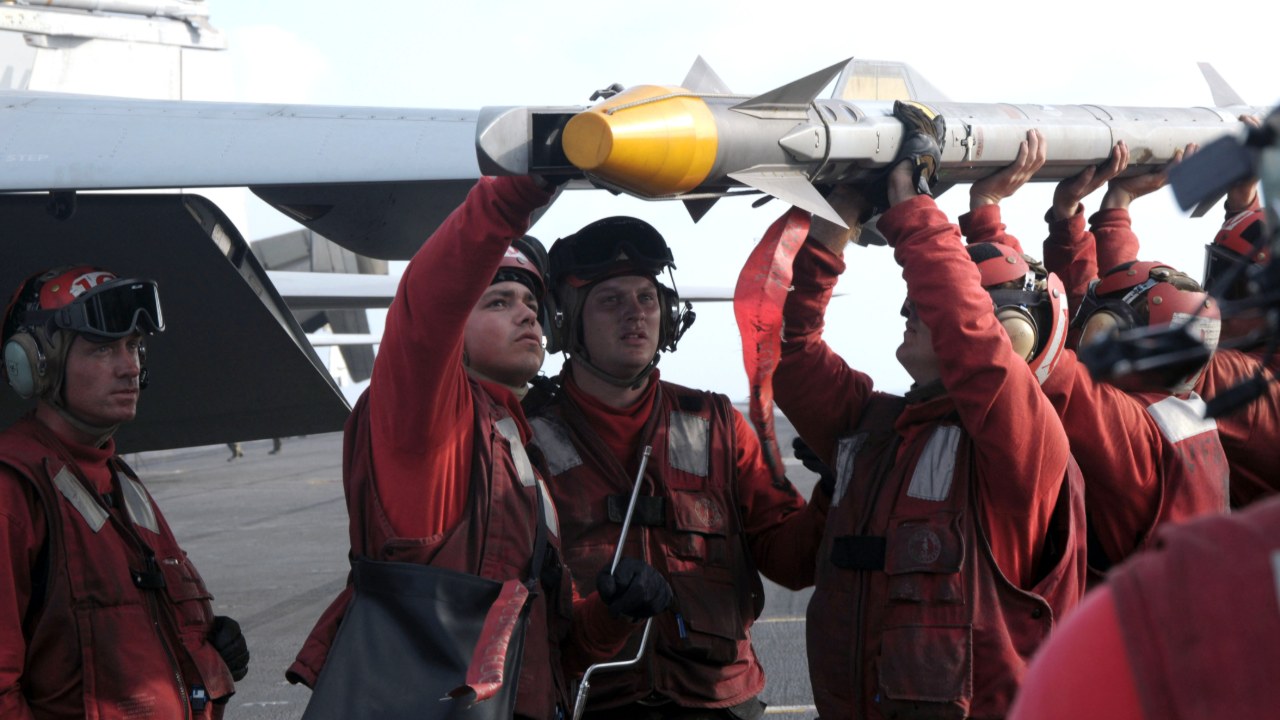
Top image: Aviation ordnancemen from Strike Fighter Squadron (VFA) 41 handle an AIM-9X Sidewinder, September 2009. Image Credit: U.S. Navy photo by Mass Communication Specialist 3rd Class John Philip Wagner Jr. — Public domain / Wikimedia Commons