
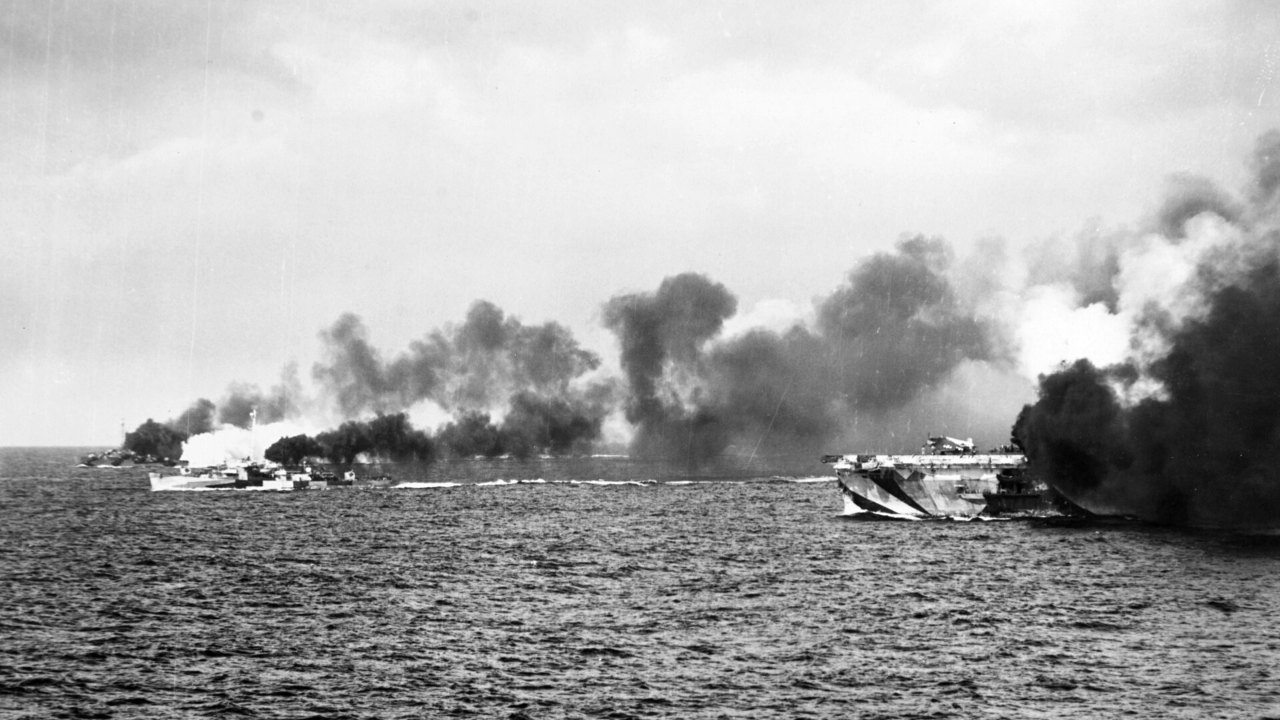
Thirteen thin-skinned ships stood between Japan’s Center Force and the landing beaches at Leyte Gulf on the morning of Oct. 25, 1944. The escort carriers, destroyers and destroyer escorts of Task Unit 77.4.3, known as Taffy 3, were not meant to trade fire with battleships. Off Samar, they did.
The fight lasted roughly an hour and a half. It cost Taffy 3 five ships, and it ended with the Japanese admiral turning his force away.
The Naval History and Heritage Command records the action in “The Battle off Samar: The Sacrifice of ‘Taffy 3,'” by Carsten Fries of NHHC’s Communication and Outreach Division, dated August 2019. NHHC describes Rear Adm. Clifton A. F. Sprague’s unit as “made up of six small escort carriers, three destroyers, and four destroyer escorts,” facing “four Japanese battleships (among them Yamato with her 18-inch main guns), six heavy cruisers, two light cruisers, and 11 destroyers.”
Center Force through San Bernardino Strait
The meeting came out of a larger Japanese plan. According to NHHC, Japan had launched Operation Shō, “a last-ditch attempt to engage Allied naval forces” off Leyte. Vice Adm. Takeo Kurita’s Center Force “broke out of the San Bernardino Strait north of Samar,” while the Japanese Northern Force “had drawn Admiral William F. Halsey’s U.S. Third Fleet to the north,” the history says.
That left the escort carriers. NHHC records that at 0623, shortly after sunrise, Yamato made radar contact with U.S. aircraft, and at 0650 the Japanese sighted “what appeared to them to be a large U.S. task force.” Taffy 3’s sister units, Taffy 1 and Taffy 2, were roughly 25 nautical miles to the southeast, per NHHC.
Smoke and torpedoes from the screen
Sprague brought his carriers about, onto an initial southeasterly course, per NHHC, and put his escorts to work. “His destroyers generated a smoke screen and, Johnston in the lead, began firing at their pursuers,” NHHC says. “At 0716, and again at 0742, Sprague ordered his screen to carry out torpedo attacks.”
“The three destroyers, Johnston (in the lead), Heerman, and Hoel carried out the first,” according to NHHC, and Johnston damaged the heavy cruiser Kumano with a torpedo hit. On the second, the destroyer escorts joined in: “Samuel B. Roberts joined Heerman and the badly damaged Hoel; Dennis, John C. Butler, and Raymond followed, attacking individually.” The history notes that the attacks fed “Kurita’s erroneous assessment that he was facing a strong carrier task force.”
The carriers fought back with what they had. “Kalinin Bay and White Plains were actually able to score hits on the Japanese heavy cruisers,” NHHC records. Sprague also launched fighters and bombers, and Taffy 1 and Taffy 2 sent aircraft against Kurita’s force; NHHC says Center Force “would remain under relatively uncoordinated, but heavy, U.S. air attack throughout the engagement.” Taffy 2, under Rear Adm. Felix B. Stump, “closed the distance to Sprague’s task unit and was able to launch three strikes during the battle’s roughly 90-minute duration,” the history says.
Five ships lost
The price was heavy, and NHHC logs it ship by ship. Gambier Bay, on the exposed port flank, began taking hits at 0810, “including from Kongo”; she was dead in the water and sinking by 0840 and was ordered abandoned ten minutes later. Hoel went dead in the water at 0830. “All power and communications were lost, and Samuel B. Roberts was abandoned at 0910,” the history says.
Johnston, limping on one engine, took more hits as Japanese destroyers concentrated on her. “Johnston was dead in the water at 0945 and was ordered abandoned five minutes later,” per NHHC. Her commanding officer, Cmdr. Ernest E. Evans, did not survive her sinking and was awarded the Medal of Honor posthumously.
The last loss came from the air. NHHC says land-based kamikaze aircraft attacked Taffy 3 just before 1100, and one plane, already damaged by White Plains’ antiaircraft fire, dove into St. Lo. “St. Lo sank in less than 30 minutes after the attack,” the history records.
Kurita breaks off
By then the surface battle was over. “After his last remaining scout aircraft was shot down shortly after 0900, and unaware of the proximity of his weakened and outnumbered opponent, Kurita decided to break off the surface action,” NHHC says. Center Force, “still under air attack, began to retrace its course toward the northwest.”
The Japanese did not leave whole. NHHC says Taffy 2 and Taffy 3 aircraft contributed to the sinking of the heavy cruisers Chokai, Chikuma and Suzuya, “all of which had received some degree of damage from surface action.”
The history’s own verdict credits a mix of causes. “The initiative, aggressiveness, and outright heroism demonstrated by Taffy 3, combined with determined U.S. naval air attacks, limited Japanese situational awareness, and pure dumb luck of the Americans had stymied Vice Admiral Kurita’s intent to destroy U.S. landing forces in the Leyte Gulf,” it says.
A Presidential Unit Citation for 13 ships
The Navy recognized the whole unit. NHHC’s page on Taffy 3’s Presidential Unit Citation and other awards reproduces the citation, signed for the President by Secretary of the Navy James Forrestal, for “extraordinary heroism in action against powerful units of the Japanese Fleet” off Samar on Oct. 25, 1944. It lists Fanshaw Bay, Gambier Bay, Kalinin Bay, Kitkun Bay, Saint Lo and White Plains with their composite squadrons, along with Hoel, Johnston, Heermann, Samuel B. Roberts, Raymond, Dennis and John C. Butler.
Individual awards followed the unit’s. Besides Evans’ Medal of Honor, NHHC counts 22 Navy Crosses for Taffy 3 officers and sailors. The Samar history notes that Samuel B. Roberts’ commanding officer, Lt. Cmdr. Robert W. Copeland, USNR, was awarded the Navy Cross.
The larger result is written into the same record. Along with the actions in the Sibuyan Sea, Surigao Strait and off Cape Engaño, NHHC says, Samar turned Japan’s surviving surface forces into a “fleet in being,” “a concern for Allied commanders, but never again the threat it had still posed into early 1944.”