
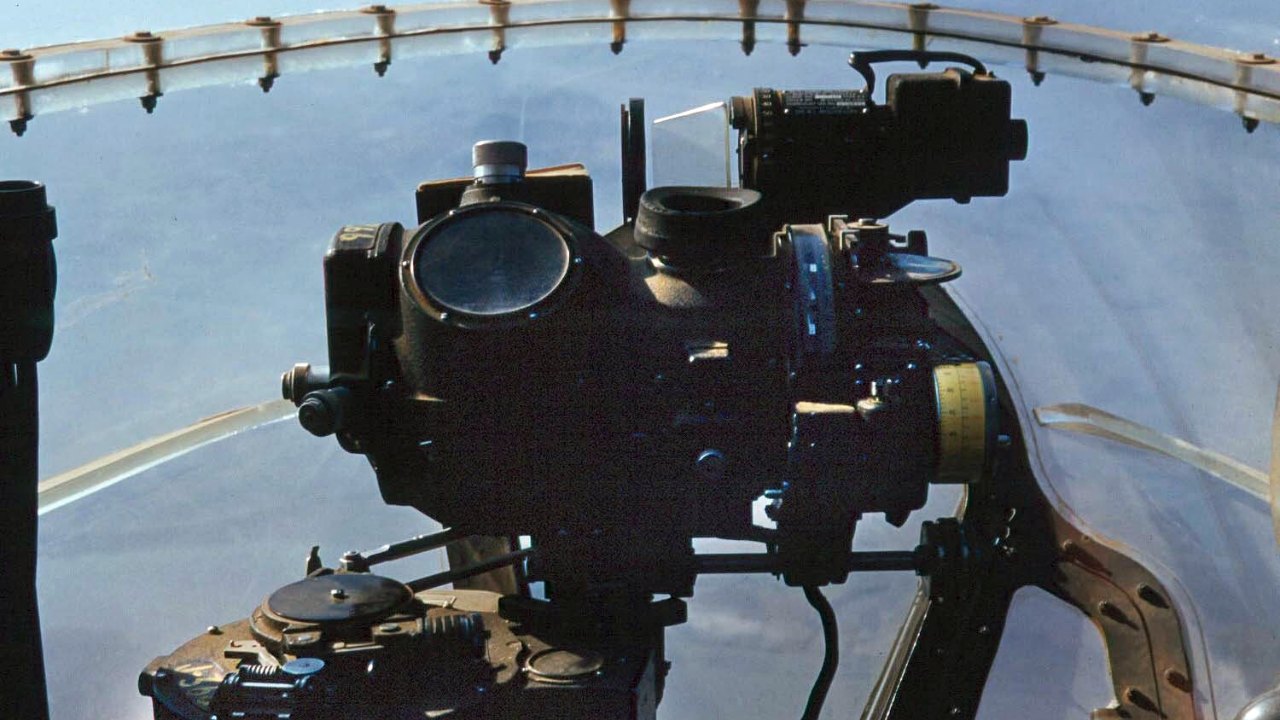
The Norden bombsight went to war with a reputation that no machine could have lived up to. Wartime newspapers said it was accurate enough to put a bomb into a pickle barrel, and the National Museum of the U.S. Air Force still quotes the boast on its fact sheet for the Norden M-9.
The same fact sheet then sets that claim against a raid. Over the ball-bearing factories at Schweinfurt in October 1943, the museum says, only one bomb in every 10 fell within 500 feet of the target. The gap between those two lines is the story the museum tells about the Norden.
The museum’s fact sheet on the Norden M-9 Bombsight puts it plainly: “Newspapers at the time claimed it was so accurate that it could ‘drop a bomb into a pickle barrel.'” At Schweinfurt, it says, “only one of every 10 of their bombs landed within 500 feet of their target.”
A Navy design that went to the Air Corps
The sight was “initially developed by Carl Norden for the U.S. Navy,” according to the museum, and the Army Air Corps acquired its first Norden bombsight in 1932. It was kept secret. “Highly classified, it gave American forces bombing accuracy unmatched by any other nation at the time,” the fact sheet says.
Supply was the problem early in the war. The museum says Norden production could not keep up with the rapid expansion of the Army Air Forces, so crews used the “less accurate Sperry S-1 bombsight” in the meantime. “By 1943, however, enough Norden bombsights had become available, and production of the S-1 ended,” the fact sheet says.
How the sight worked
The Norden did its arithmetic mechanically. According to the museum, “the bombardier entered data about wind direction, airspeed and altitude into the bombsight’s analog computer,” which then worked out wind drift and the point at which to aim.
Holding a telescope steady at high altitude was its own engineering problem. “An internal gyroscope provided the stability necessary for using the telescopic sight at high altitudes,” the fact sheet says. Linked to an autopilot, the museum adds, the Norden “provided unprecedented accuracy.”
Black Thursday, Oct. 14, 1943
The raid the museum uses as its test case is the Eighth Air Force’s attack on Schweinfurt that became known as Black Thursday. The museum’s separate fact sheet on Black Thursday dates it to Oct. 14, 1943, and names the target as the ball bearing factories at Schweinfurt.
The bombers flew the deepest part of that mission without escort. “After friendly fighters turned back at the German border,” the museum says, the formations were left to face the Luftwaffe on their own. The Norden fact sheet notes that the raid did not destroy the factories completely.
The result changed how the air war was fought for a time. After Schweinfurt and heavy losses in the preceding months, “USAAF leaders suspended strikes against targets beyond the range of fighter escort,” according to the Black Thursday fact sheet.
From hundreds of bombers to one airplane
The museum closes its Norden fact sheet by measuring the sight against what replaced it. In its words, “modern precision guided munitions are accurate to within a few feet,” it says, “making a single airplane more effective than the hundreds of bombers of WWII.”
That is the record as the Air Force museum keeps it: a sight good enough to be classified and boasted about, and a raid in October 1943 where nine of every 10 bombs fell outside 500 feet of the target.