
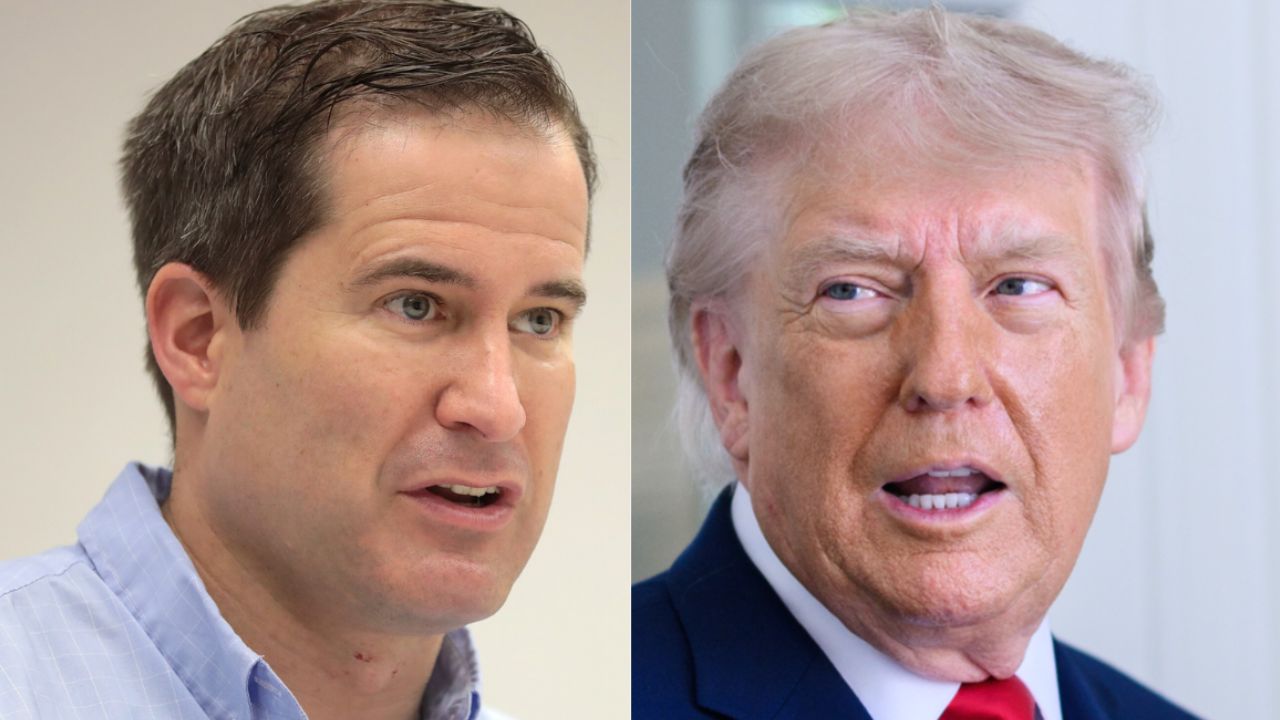
Massachusetts Congressman Seth Moulton is challenging President Donald Trump’s federal spending priorities, arguing that the administration has billions of dollars remaining for immigration enforcement while seeking another $50 billion from Congress to overhaul the nation’s air traffic control system. In a November 21 statement, Moulton connected the administration’s substantial unspent Immigration and Customs Enforcement funding to the recent nationwide Federal Aviation Administration ground stop, questioning why resources remain available for an expanded immigration enforcement operation while America’s aviation infrastructure faces demands for additional federal investment.
Moulton’s full November 21 statement:
“Trump has $91B in unspent ICE funds for inflicting cruelty across the US yet he can’t find $50B for air traffic control? It’s costly, disruptive, and embarrassing to have a nationwide ground stop over preventable issues while ICE sits on a war chest just to terrorize communities.”
The $91 billion figure refers to funding remaining from two major immigration enforcement funding packages enacted during Trump’s second administration. A November 17 analysis by the American Immigration Council, using federal budget execution documents published by the Office of Management and Budget, calculated that ICE had approximately $91 billion in remaining funding from the One Big Beautiful Bill Act of 2025 and the Secure America Act of 2026. The figure represents funding available for future obligations and expenditures, not money sitting in a single unrestricted account. The analysis calculated approximately $57.6 billion remaining from the first law and another $33.4 billion from the second as of September 30, 2026.
The funding originated in legislation that dramatically expanded the resources available to federal immigration enforcement agencies. The One Big Beautiful Bill Act, signed by Trump in July 2025, provided ICE with approximately $75 billion, including funding for immigration enforcement, hiring and detention. The Secure America Act, signed in June 2026, provided another $69.5 billion for ICE and portions of Customs and Border Protection. Those multiyear appropriations extended through September 2029, leaving substantial balances available beyond the immediate fiscal year.
Moulton’s criticism of ICE funding is consistent with a series of actions he has taken throughout 2026. On January 14, he introduced the Healthcare Reinvestment Act, legislation designed to rescind the additional ICE funding enacted through the 2025 reconciliation law and redirect the money toward extending Affordable Care Act premium tax credits. The proposal would have restored ICE funding to approximately its fiscal year 2024 level of $10 billion annually. Moulton argued that the government should prioritize affordable health coverage rather than substantially expanding immigration enforcement.
His position became even more explicit on February 3, when Moulton voted against a federal funding package that included a temporary Department of Homeland Security appropriations measure. He said Congress should use its leverage to address abuses by ICE and Customs and Border Protection, declaring that “ICE should not receive further funding.” He also called for accountability over enforcement operations, alleged violations of the law and the treatment of communities affected by federal immigration activity.
In July, Moulton expanded his criticism beyond ICE’s enforcement activities to the use of federal resources across national security agencies. On July 14, he joined Representatives Raja Krishnamoorthi and Yassamin Ansari in leading a letter to Homeland Security Secretary Markwayne Mullin and Acting Attorney General Todd Blanche. The lawmakers sought answers about reports that DHS and the Justice Department were diverting personnel, funding and operational attention away from counterterrorism, transnational crime and other public safety responsibilities in favor of large-scale civil immigration enforcement. The letter questioned whether federal resources were being used consistently with the agencies’ statutory responsibilities.
His criticism has also extended to oversight of immigration detention and the ability of families and attorneys to locate people held by federal authorities. In June, Moulton became an original cosponsor of the Find Our Families Act, which would require DHS to maintain an accurate online locator system covering individuals detained by ICE and CBP. He argued that families and lawyers should not have to spend days or weeks trying to establish where someone is being held, describing transparency and due process as fundamental requirements for federal enforcement agencies.
The second half of Moulton’s November 21 statement addresses the Trump administration’s request for $50 billion to modernize the nation’s air traffic control system. The request followed a nationwide ground stop on November 13, when the FAA temporarily halted departures across the United States after telecommunications problems disrupted the stability of systems used by air traffic controllers. The administration subsequently argued that the incident demonstrated the need for a much broader modernization effort, with Transportation Secretary Sean Duffy and FAA Administrator Bryan Bedford seeking additional congressional funding.
The FAA’s subsequent explanation identified instability in its telecommunications network after data began flooding the system at a rate of approximately 1,000 connection attempts every four to five seconds. The initial investigation identified potential problems involving a radar site in Amarillo, Texas, and a radio communications site in El Dorado, Arkansas. The agency said work involving a new router at the Arkansas location was part of the circumstances under investigation. The ground stop was issued as a precaution while officials isolated the affected equipment and assessed the stability of communications and radar feeds.
The disruption began at approximately 3:30 p.m. Eastern on November 13, and the FAA lifted the nationwide ground stop at 8:15 p.m. The agency reported instability at 17 of its 22 Air Route Traffic Control Centers, with problems spreading into several Terminal Radar Approach Control facilities. Approximately 12,462 flights were canceled following the telecommunications failure, including cancellations that occurred during the broader recovery period. The FAA said safety procedures remained in place throughout the disruption, aircraft landed safely and critical military, law enforcement and life-saving flights continued operating.
Moulton had already questioned the administration’s handling of the incident before publishing his November 21 criticism. In an interview with NBC Boston on November 14, he said lawmakers had “a lot of questions” for the transportation secretary and other administration officials. He specifically demanded an explanation of what happened, what steps were being taken to prevent another disruption and why the incident had apparently caught the administration by surprise. His comments challenged the administration’s emphasis on obtaining new equipment before fully explaining the circumstances behind the failure.
In that interview, Moulton also questioned the expectation that American taxpayers should shoulder the cost of the proposed modernization effort. He compared the administration’s request with the upgrades required of private railroads, arguing that those companies had been required to finance their own next-generation train control systems. His comparison highlighted a disagreement over who should bear responsibility for major infrastructure improvements, particularly when the federal government had already provided substantial funding for aviation modernization.
The $50 billion request also came after Congress had approved $12.5 billion for air traffic control modernization through the 2025 reconciliation legislation. The administration argued that the earlier allocation was insufficient to complete a comprehensive replacement of aging infrastructure. In its November 17 request, the Transportation Department sought $50.1 billion, including money for modernization of air traffic control systems, telecommunications, facilities and airport safety improvements. The proposal was an additional funding request requiring congressional action, not an appropriation that had already been approved.
Moulton’s background on aviation issues also includes his work on the House Transportation and Infrastructure Committee. In 2023, he outlined his involvement in the FAA reauthorization process, including support for stronger passenger protections, improved airline responses to cancellations and delays, and measures addressing aviation noise and airport planning. That record establishes previous involvement in federal aviation policy, although his November 14 comments provide the clearest documented evidence of his specific position on the current $50 billion modernization request and the recent nationwide ground stop.
In his November 21 statement, Moulton ultimately brings the two funding debates together to challenge what he considers a contradiction in the administration’s priorities. His argument is not simply that ICE has received substantial funding or that the FAA needs modernization. He is questioning why the administration continues to have access to tens of billions of dollars for immigration enforcement while asking Congress for another $50 billion after a nationwide aviation disruption. His repeated efforts to restrict ICE funding, redirect immigration enforcement resources and demand explanations from transportation officials establish a documented record behind both sides of his latest criticism.