
The Royal Moroccan Air Force’s first F-16 Block 72 is in the air. Lockheed Martin announced on Oct. 6, 2026, from Greenville, South Carolina, that the jet had completed its first flight, a milestone the company said comes as the aircraft works through flight testing toward first delivery. The release did not give a separate date for the flight itself.
Morocco’s order covers 25 Block 72 jets in single-seat F-16C and two-seat F-16D form. The Block 72 differs from its Block 70 sibling mainly in the engine: Pratt & Whitney instead of General Electric. The first flight moves that order from paperwork to flight test.
In its Oct. 6, 2026 announcement, Lockheed Martin described the F-16 Block 72 as “the newest and most advanced variant of the Fighting Falcon,” with modernized avionics, advanced sensors, improved mission systems, and enhanced safety and reliability features. Mike Shoemaker, vice president and general manager of the company’s Integrated Fighter Group, said in the release:
“This first flight reflects meaningful progress on Morocco’s F‑16 Block 72 program and is a critical step in strengthening Morocco’s future airpower.”
A two-seat F-16D out of Greenville
The War Zone’s Thomas Newdick, reporting on Oct. 6, 2026, said the jet “completed its maiden flight at Lockheed Martin’s facility in Greenville, South Carolina,” and that the first Moroccan Block 72 to fly was a two-seat F-16D. Lockheed Martin’s own release does not specify the seating configuration.
Greenville is home to Lockheed Martin’s F-16 facility. The company’s F-16 program page credits the work there with more than $1.3 billion in direct and indirect economic impact in Greenville, and describes the Block 70/72 as “the most advanced 4th generation fighter ever built.” That is the manufacturer’s characterization of its own product.
Twenty-five jets and 29 engines
The order dates to 2019. The U.S. government’s arms sales notification for Morocco, Transmittal No. 19-09, filed for publication in the Federal Register on June 13, 2019, covers “Twenty-five (25) F-16C/D Block 72 Aircraft.” The same notification lists 29 Pratt & Whitney F100-229 engines, four of them spares, and 26 APG-83 Active Electronically Scanned Array radars.
The notification put the estimated value at $3.787 billion: $2.987 billion in major defense equipment and $0.800 billion in other items.
The engine is the dividing line between the two current production blocks. According to The War Zone, “The Block 70 uses General Electric’s F110-GE-129, while the Block 72 uses Pratt & Whitney’s F100-PW-229, providing fractionally more power.” The same report said that among other customers for the latest F-16 standard, “so far, only Block 70s have been ordered,” though the Block 72 has been offered.
Radar and airframe life on the Block 70/72
The APG-83 radar named in the 2019 notification is built by Northrop Grumman. Lockheed Martin’s program page says the radar “provides the Block 70/72 with 5th Generation fighter radar capabilities,” again a company claim about its own aircraft rather than a test result.
The airframe is built to last longer than earlier F-16s. Lockheed Martin says the Block 70/72 “has an industry-leading extended structural life to 12,000 hours – more than 50 percent beyond that of previous production F-16 aircraft.” For an air force buying fighters it expects to fly for decades, structural life is one of the specifications that determines how long the fleet stays on the flight line before major rework.
Five decades of Lockheed hardware in Morocco
The F-16 is not Morocco’s first Lockheed Martin aircraft. The company said in its Oct. 6 release that its relationship with the country spans more than five decades, beginning with a C-130H delivery in 1974. The Royal Moroccan Armed Forces currently fly F-16s, C-130s and Black Hawks and operate the company’s radar systems, according to the release, which also said HIMARS rocket launchers are to follow.
The release also pointed to industrial work in Morocco. Through Maintenance Aero Maroc, a maintenance, repair and overhaul facility at Benslimane covering more than 8,000 square meters is planned to perform heavy maintenance and modernization on C-130 Hercules aircraft, with the company saying it expects to expand that work to the F-16.
The next step on the record is the one Lockheed Martin named in its announcement: completing flight testing on the first Moroccan Block 72 ahead of first delivery to the Royal Moroccan Air Force. The company did not give a delivery date.
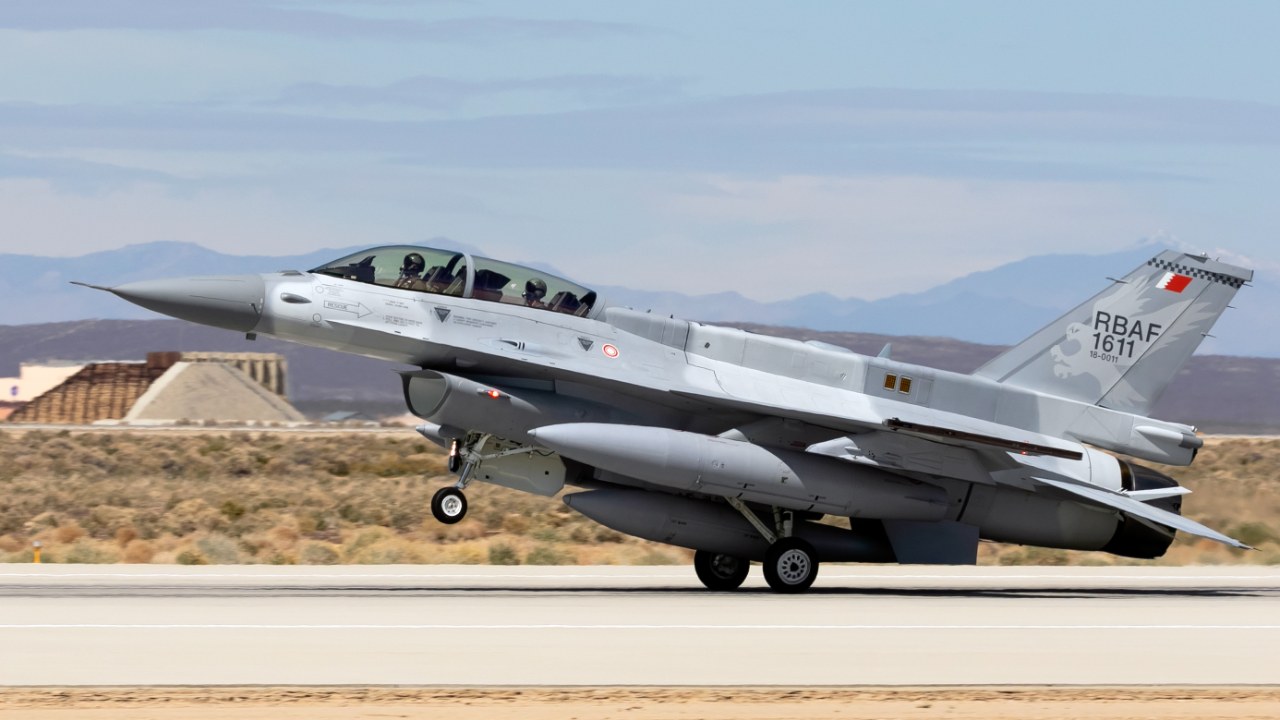
Top image: The first Royal Bahraini Air Force F-16 Block 70, a sister variant of Morocco’s Block 72, lands at Edwards Air Force Base, California, on March 28, 2023, for flight testing. Image Credit: U.S. Air Force photo — Public domain / Wikimedia Commons
This article was produced with the assistance of AI and reviewed by Combat Rated editors prior to publication.