
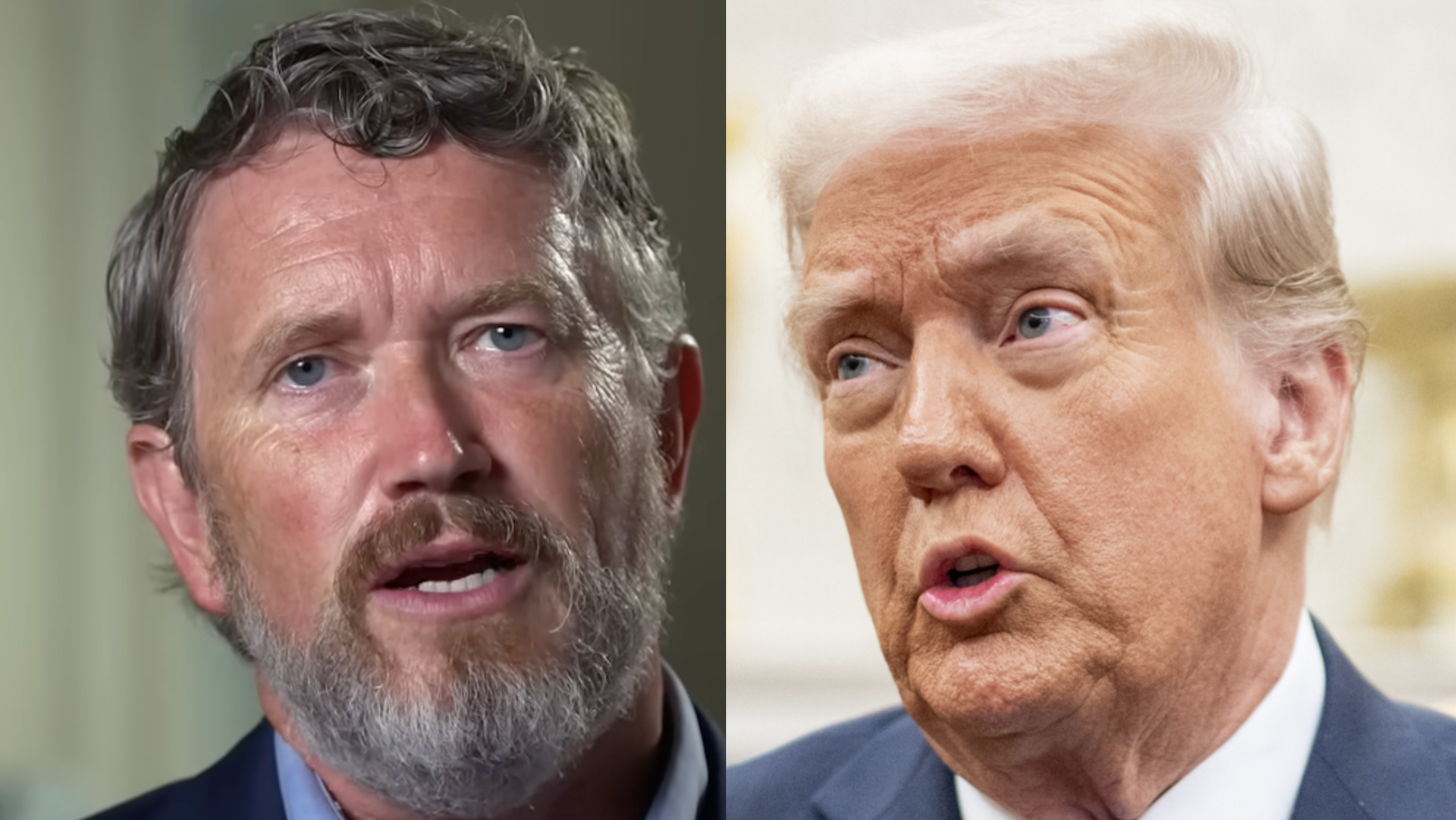
Rep. Thomas Massie (R-Ky.) said Thursday that the ongoing U.S. war with Iran is both unconstitutional and illegal, arguing in a post on X that American taxpayers will ultimately help cover a $300 billion commitment tied to the conflict’s resolution, even as the Trump administration insists no U.S. government money will go directly to Tehran.
“The war with Iran is UNCONSTITUTIONAL. It’s also ILLEGAL under the 1973 WPA. Here’s how much of the $300 billion will come from American taxpayers: The U.S. will give foreign aid, military assistance, tariff exemptions, etc to countries that will in turn provide money to Iran,” Massie wrote on X at 7:24 a.m. on June 25, 2026.
Massie Lays Out the Funding Mechanism
In his post, Massie described what he characterized as an indirect pipeline for U.S. taxpayer dollars to reach Iran. Rather than a direct payment from Washington to Tehran, Massie’s post suggested the United States would extend foreign aid, military assistance, and tariff exemptions to other countries, which would then funnel money to Iran as part of the $300 billion reconstruction commitment outlined in the Islamabad memorandum of understanding signed between Trump and Iranian President Masoud Pezeshkian.
Massie’s claim arrives amid weeks of dispute in Washington over who will actually finance the $300 billion fund referenced in the MOU. The agreement states that the U.S. “undertakes with regional partners to develop a definitive, mutually agreed plan with at least $300 billion for the reconstruction and economic development” of Iran, with implementation mechanics to be finalized within 60 days. Vice President JD Vance has said the money would come from a “Gulf coast coalition” and not from American taxpayers, while Trump has dismissed the $300 billion figure outright on Truth Social, calling it “Fake News, put out by the Dumocrats!!!”
A Follow-Up Post Calls the Sum “a Bargain”
Eight minutes after his initial post, at 7:32 a.m., Massie replied to his own thread with a follow-up that softened his framing of the dollar figure while sharpening his criticism of the war itself. “With that said, $300 billion would be a bargain to get out of this terrible mistake and avoid countless deaths and years of weakening our military. Consumers have already incurred $60 billion in increased fuel costs due to this foolhardy war,” Massie wrote.
The follow-up suggests Massie’s objection is not solely about the price tag attached to ending the conflict, but about the legality of having entered the war in the first place. By framing $300 billion as comparatively cheap relative to the war’s broader costs — in lives, military readiness, and consumer fuel prices — Massie positioned his criticism as one rooted in opposition to the war’s constitutional standing rather than opposition to reconstruction spending alone.
A Pattern of Public Opposition Since the War Began
Thursday’s posts are the latest in a sustained, monthslong record of public statements from Massie opposing U.S. military involvement in Iran. Massie has repeatedly invoked Article I of the Constitution, which vests the power to declare war in Congress, not the executive branch.
The Kentucky Republican’s opposition predates the outbreak of hostilities. In June 2025, Massie and Rep. Ro Khanna (D-Calif.) introduced a bipartisan War Powers Resolution to prohibit “United States Armed Forces from unauthorized hostilities in the Islamic Republic of Iran.” In the official press release announcing the legislation, Massie said, “The Constitution does not permit the executive branch to unilaterally commit an act of war against a sovereign nation that hasn’t attacked the United States. Congress has the sole power to declare war against Iran. The ongoing war between Israel and Iran is not our war. Even if it were, Congress must decide such matters according to our Constitution.”
When the United States launched direct strikes on Iranian nuclear sites at Fordow, Natanz, and Isfahan, Massie again took to X, writing simply, “This is not Constitutional.” He reiterated that position on the House floor ahead of a subsequent war powers vote, warning that the conflict “will radicalize new generations of terrorists” and pointing to the cumulative $8 trillion in debt the United States incurred from prior wars and regime-change efforts in Iraq, Libya, Syria, and Afghanistan. “A sustained war with Iran will not stabilize the region. It’s already ignited the region,” Massie said at the time, adding that the conflict “will send more swarms of refugees into Europe and the United States.”
The June 3 House Vote and Its Aftermath
Massie’s opposition translated into one of the few successful bipartisan rebukes of the administration’s Iran policy on Capitol Hill. On June 3, 2026, the House passed a war powers resolution directing Trump to end hostilities with Iran by a vote of 215-208, with Massie joined by three other Republicans — Brian Fitzpatrick of Pennsylvania, Tom Barrett of Michigan, and Warren Davidson of Ohio — in crossing party lines to support it. The measure, introduced by Rep. Gregory Meeks (D-N.Y.), was largely symbolic, directing the president to remove U.S. forces from hostilities with Iran absent a formal declaration of war or specific congressional authorization.
Following the vote, Massie connected the war’s domestic economic toll directly to his constituents in Kentucky. “People are tired of this. They’re tired of $5 gallon gas and $6 gallon diesel, and fertilizer we can’t afford to put on our fields in Kentucky,” Massie said. He added that the vote “sends a good message that the people’s House, which represents the people, is tired of this war.” On social media after the vote, Massie wrote, “The Iran War Powers Resolution that I cosponsored (opposing the war) just passed the House of Representatives. The People’s House is sending a message: end this war.”
Massie’s Earlier Criticism of the $300 Billion Figure
Thursday’s posts also build on criticism Massie leveled at the $300 billion reconstruction fund when it first emerged as a point of contention following the Islamabad MOU signing. Massie previously compared the size of the commitment to domestic spending priorities, writing on X that “$300 billion is 5X as much as Congress spends on our roads & bridges annually.” That comparison placed him alongside a small number of Republicans, including Sen. Roger Wicker, who said the sum would make “Iran’s payoff under President Obama’s 2015 deal look like a pittance by comparison,” referencing the roughly $55 billion in frozen assets released to Iran under the 2015 Joint Comprehensive Plan of Action.
Broader Stance on Trump Administration Policy
Massie’s Thursday statement is consistent with a broader pattern of public friction with the Trump administration over military and foreign policy matters throughout 2026. Beyond Iran, Massie has worked to constrain what he has described as unauthorized military action in Venezuela and has criticized the administration’s rhetoric regarding Greenland. He has also pursued legislative efforts on government transparency and foreign influence, including introducing the “Americans Insist on Political Agent Clarity Act” to require foreign lobbyists to register under the Foreign Agents Registration Act, and a bill to remove the United States from NATO.
Massie’s continued opposition to the war has come at a political cost. He lost his Republican primary in Kentucky’s 4th District to Trump-backed challenger Ed Gallrein after the president actively campaigned against him, citing Massie’s votes against the administration’s Iran policy among his grievances. Massie will not return to Congress in the next term, but his record of public statements — culminating in Thursday’s posts laying out his view of how the $300 billion commitment to Iran could ultimately reach American taxpayers’ wallets — has remained a consistent thread throughout the four-month conflict and its diplomatic aftermath.