
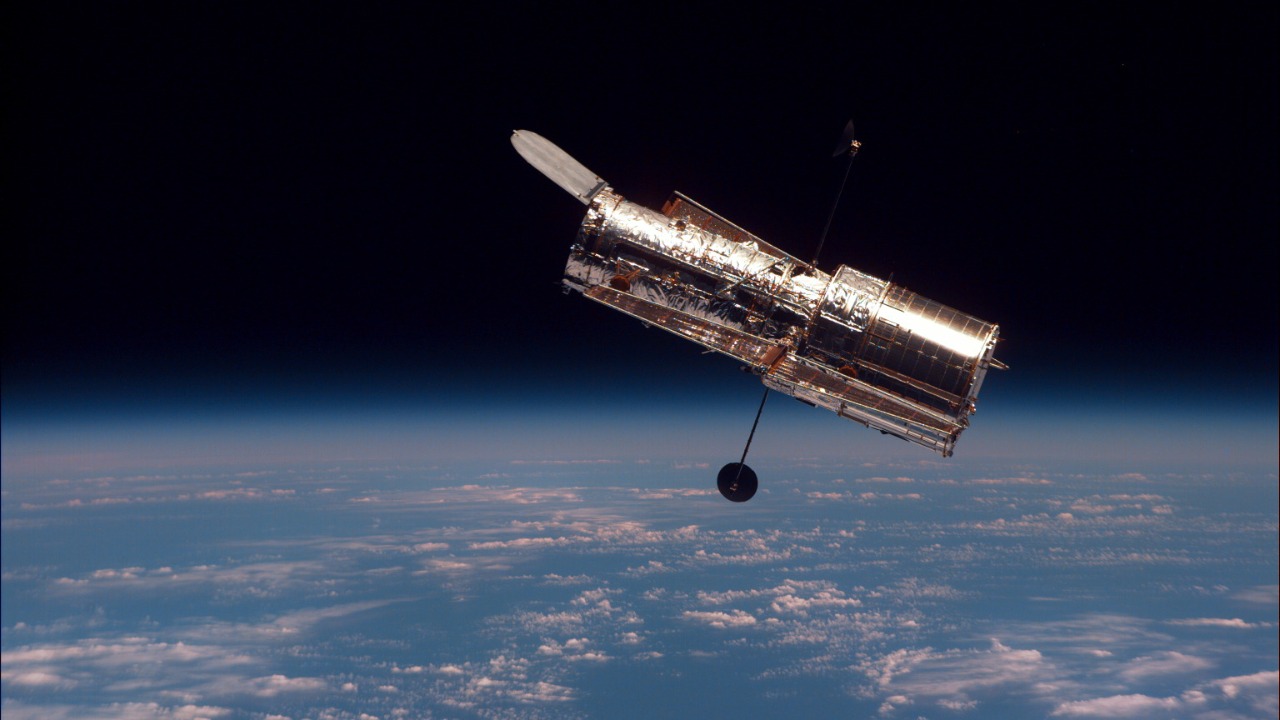
The Hubble Space Telescope is entering a precarious final phase, with new analyses suggesting it could fall back through Earth’s atmosphere years earlier than planners once assumed. Instead of a distant, abstract concern, the timing and manner of Hubble’s reentry are now active engineering and policy questions that will shape how this mission ends and what risks it poses on the way down.
I see this moment as a test of how we handle aging space infrastructure that was never built for a graceful retirement, balancing scientific nostalgia with hard calculations about safety, cost, and technological priorities on the ground.
Why Hubble’s orbit is decaying faster than expected
The core problem is simple physics: Hubble circles Earth low enough that atmospheric drag is slowly pulling it down, and recent solar behavior is thickening that upper atmosphere faster than models anticipated. A change in solar activity has increased the current solar flux levels, which in turn boosts drag and raises the possibility of Hubble reentering Earth’s atmosphere within the next five to six years instead of coasting well into the 2030s. That shift compresses the timeline for any intervention and makes the spacecraft’s natural fall a near term scenario rather than a remote one.
Specialists tracking the orbit now frame the future in stark terms, with a best case in which the observatory might survive in space for about 15 more years, around 2040, and a worst case in which it could come down in roughly 4 years, around 2030, according to one dedicated Hubble reentry tracker. Earlier this year, another study warned that the Hubble Space Telescope could crash down to Earth sooner than expected, stressing that it was not designed for controlled reentry and that engineers must now assess the probability of casualty as its altitude continues to drop toward Earth.
Risk years, solar cycles, and NASA’s safety calculus
As the numbers tighten, NASA is being pushed to treat reentry as a concrete risk management problem rather than a distant epilogue to a famous mission. Experts now highlight 2029 as a pivotal Risk Year, a point when the current solar cycle and Hubble’s decaying orbit could intersect in ways that sharply increase the chance of an uncontrolled fall. The same analysis notes that NASA’s Hubble May Face an Early End as these solar cycles, which repeat roughly every 11 years, amplify atmospheric drag and accelerate orbital decay.
What unsettles me most is that the Sun is not behaving as quietly as some forecasts assumed, which means the safety margins are thinner than planners hoped. There has been an unexpected surge in the current solar flux levels, with Solar activities described as more intense and more elevated than predicted, a pattern that could strip away the extra few years of spatial orbiting that engineers once counted on for But cautious planning. In that context, NASA officials have stressed that, as one recent technical assessment put it, “Accurately predicting when this reentry will occur and assessing potential risks to the public are critical concerns for NASA,” underscoring that the agency must now weigh both scientific value and public safety in every decision.
Aging hardware, shrinking margins, and the science at stake
Even as gravity tightens its grip, Hubble’s internal systems are also showing their age, which narrows the window for any complex rescue or reboost mission. Earlier this year, mission managers shifted the observatory into a new one gyro observing mode, a configuration that allows continued science but acknowledges that some of the original hardware has failed, even as Hubble remains an icon of modern astronomy whose Legacy was cemented after the corrective optics of After COSTAR were installed. Engineers still expect it to operate for several more years, but the margin for error is shrinking as each subsystem ages without the prospect of another Space Shuttle style servicing mission.
From a scientific perspective, the stakes are emotional as well as technical, because The Hubble Space Telescope has been our most reliable eye in the sky, allowing us to peer deep into the inky cosmic void like never before, even as its main antagonist right now is gravity. Since its launch in 1990, Hubble has transformed fields from cosmology to planetary science, and some astronomers now warn that the telescope could be effectively dead in about three years, with a silver lining that a privately funded alternative with a larger mirror and enhanced capabilities might eventually step in to fill part of the gap Since that original launch. For now, though, the mission is in what one commentator aptly described as a Final Countdown, as the Hubble Telescope edges toward the verge of its final years and prompts the question, Could It Disappear Sooner Than Expected as Hubble Telescope operations become more fragile.
Uncontrolled reentry, casualty risk, and what comes next
The most sobering aspect of the current debate is that the spacecraft was never built with a clean, guided descent in mind. The Hubble Space Telescope was originally designed for periodic servicing and eventual retrieval, not for a controlled reentry, and recent analysis bluntly notes that Hubble was “not designed for controlled reentry,” which forces engineers to model how its massive structure might break up and to assess the probability of casualty if large fragments survive to reach Hubble Space Telescope. Those same studies warn that the Hubble Space Telescope could crash down to Earth sooner than expected, and that any mitigation plan must grapple with the fact that the HST is both iconic and physically large, which complicates disposal strategies for HST.