
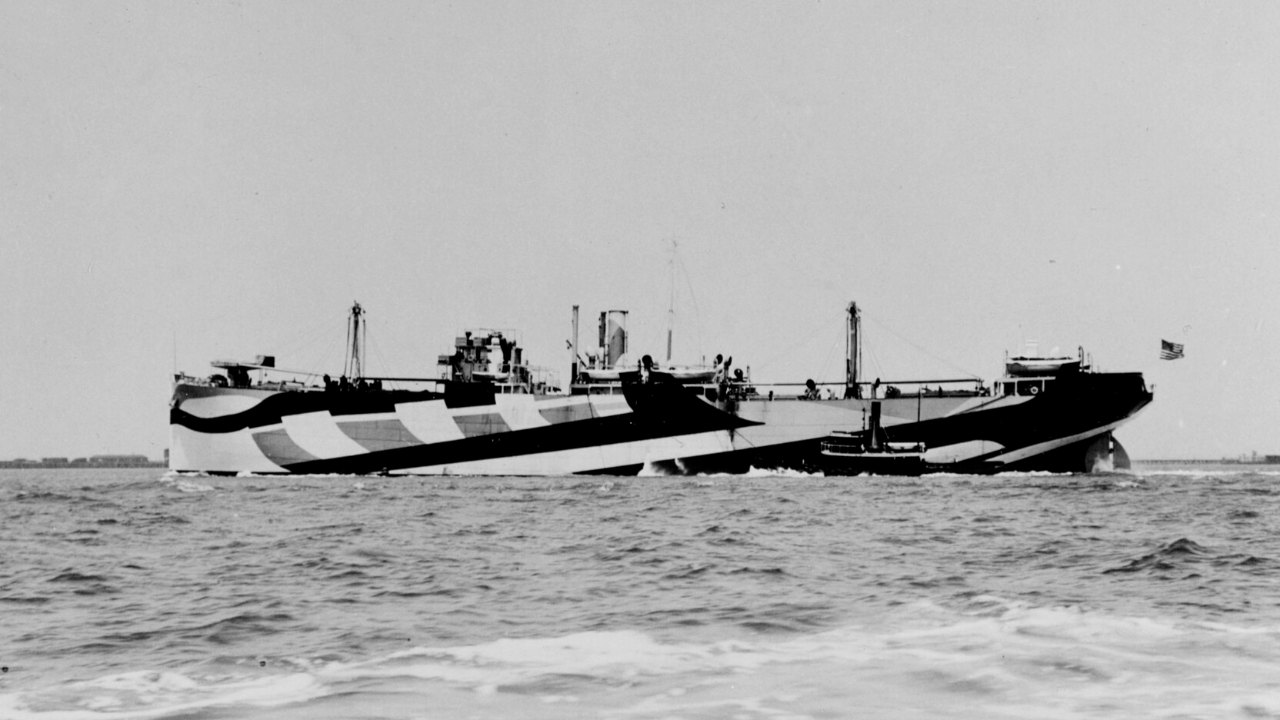
In April 1917, nearly one in every five ships coming to Britain was sunk, according to the Imperial War Museums. A ship at sea could not be hidden from a submarine, so a British marine artist proposed the opposite of hiding: paint it so loudly that the man at the periscope could not read it.
The result was dazzle camouflage, the jagged stripes and clashing blocks of color carried by British merchant ships and troopships through the last part of the First World War. The idea was not invisibility. It was confusion about where a ship was going and how fast.
The Imperial War Museums’ page on Edward Wadsworth’s dazzle ship prints credits the concept to the artist Norman Wilkinson in 1917. “His idea was to use brightly coloured, asymmetric patterns to create optical illusions” that, painted on ships, “would obscure their speed and direction,” IWM says. “Under Wadsworth’s supervision, over two thousand British ships were painted in ‘dazzle camouflage’ in Bristol and Liverpool,” according to the same page.
Norman Wilkinson’s answer to the U-boat
Wilkinson was both a painter and a sailor. IWM describes him as a British marine artist and naval officer, and its account of camouflage in the First World War states that “the concept was invented in 1917 by Norman Wilkinson,” with the aim of reducing the number of British merchant ships lost to German submarines.
Large ships, that page notes, could not be concealed the way a gun or a vehicle could be on land. So Wilkinson “sought to use bold shapes and lines as well as contrasting colours to distort a ship’s physical form,” IWM says. The intent, in the museum’s words, was to make it difficult for submarine commanders “to assess a ship’s size, shape, course and range.”
The British formed a Dazzle Section under Wilkinson and began painting ships in the summer of 1917, according to IWM. The designs went onto merchant and troop ships for the rest of the war, the Wadsworth page says.
How a pattern was meant to fool a periscope
A torpedo shot depended on the submarine captain’s reading of his target, and that reading was what dazzle went after. IWM’s learning resource on dazzle, “How to Hide a Warship,” explains that Wilkinson believed confusion would follow “if ships were painted in ‘violent colour contrast’ in a carefully thought-out pattern,” leaving the captain wrong about the ship’s length, size, speed and heading, and his torpedo calculations wrong with them.
The two sides of a ship did not match. A captain who moved to attack from a different angle, IWM says, “would find a totally different Dazzle Design facing him on the other side,” and would have to start his calculations again.
Each scheme was tested before it reached a hull. Designs were first “painted onto small wooden models of the real ships,” according to IWM, and examined through small periscopes against a seascape. A design that passed this “screen test,” in IWM’s phrase, went to a draftsman for the final plans.
Artists in uniform
Dazzle drew artists into naval work. Wadsworth, IWM notes, served as “an Intelligence Officer for the Royal Naval Volunteer Reserve during World War I,” and his supervision of the painting in Bristol and Liverpool later fed a series of woodcut prints now held by the Walker Art Gallery’s collections, according to the museum’s page.
The marine painter John Everett recorded the ships as a painter rather than a designer. Royal Museums Greenwich says the Ministry of Information commissioned Everett to depict London river scenes, and that he painted dazzle-painted ships at the docks. Wilkinson’s designs did not stay British, either: IWM says they “were taken up in the United States, France and Italy.”
What the record says about results
The museums are careful on the question of whether it worked. “Shipping losses declined after Dazzle was introduced, but this was largely due to the introduction of the convoy system,” IWM’s camouflage history states, adding that dazzle “did boost morale.”
The learning resource reaches the same caution from the other direction, noting that “there is a debate amongst historians” over how much credit dazzle can take. What the record does establish is the scale of the effort: more than two thousand British ships painted under Wadsworth’s supervision in Bristol and Liverpool, by IWM’s count.