
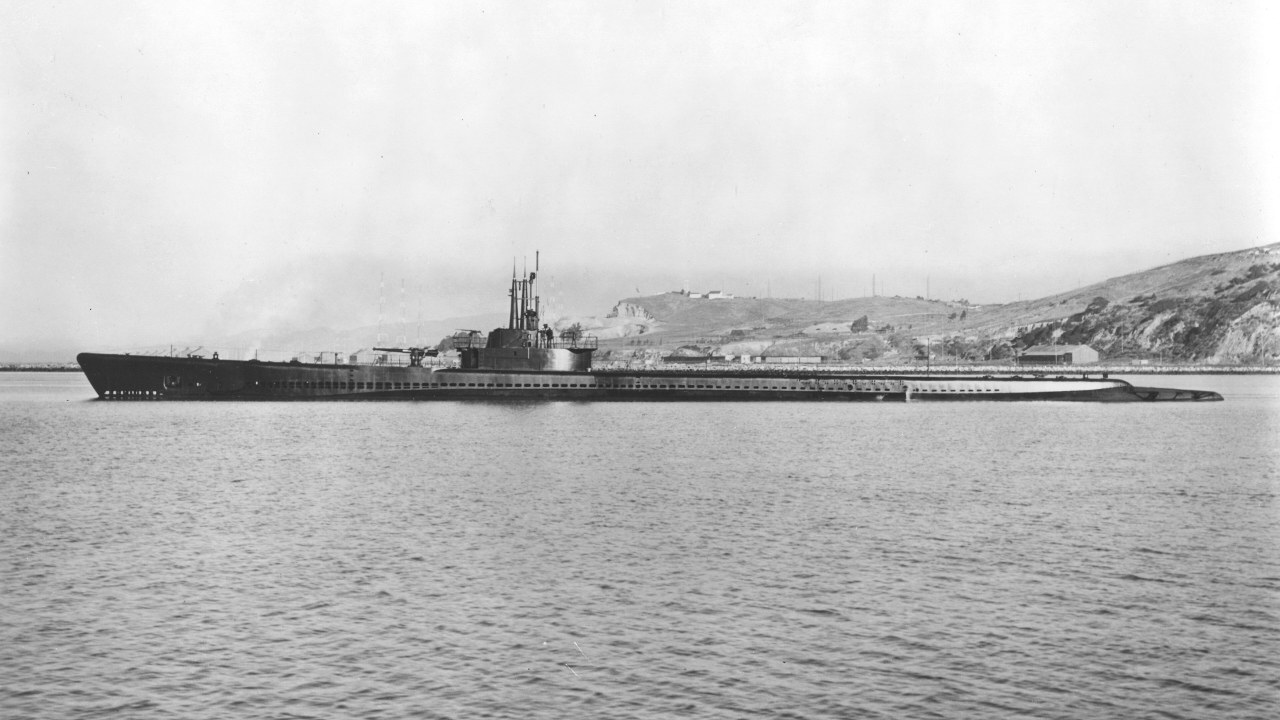
The last torpedo USS Tang (SS-306) fired on her fifth war patrol did not run true. It turned back toward the submarine, struck her stern on the night of Oct. 24, 1944, and sent her to the bottom. Nine of her crew survived, among them her commanding officer, Cmdr. Richard H. O’Kane, and by then the Navy credited Tang with 31 ships sunk across five patrols.
Tang had been in commission for just over a year. She was laid down Jan. 15, 1943, at the Mare Island Navy Yard in Vallejo, Calif., and commissioned Oct. 15, 1943, with Lt. Cmdr. O’Kane in command, according to the Navy’s Dictionary of American Naval Fighting Ships.
The Naval History and Heritage Command’s United States Submarine Losses entry for Tang sets out the wartime credit: “In her five patrols, Tang is credited with sinking 31 ships, totaling 227,800 tons and damaging two for 4,100 tons.” The same entry adds a line of its own: “This record is unexcelled among American submarines.”
Five patrols from Pearl Harbor
The NHHC loss record traces how the total was built. On her first patrol, in February 1944 west of Truk and Saipan, Tang was credited with three freighters, a large tanker and a submarine tender.
Her second patrol, west of Palau, east of Davao and at Truk, produced no contacts worth attacking. It produced something else instead: Tang “rescued twenty-two Navy airmen during a carrier based strike at Truk on 30 April-1 May 1944,” per the NHHC entry.
On the third patrol, in the East China and Yellow Seas, the record credits her with six freighters, a tanker and a large aircraft transport. Off southern Honshu in August 1944, she was credited with a freighter, a large transport, a tanker and two patrol craft, and with damaging another freighter and a small craft.
The fifth patrol and the circular run
Tang left Pearl Harbor on Sept. 24, 1944, and refueled at Midway on Sept. 27, the NHHC entry says. Her assigned area lay northwest of Formosa and along the China coast. Rather than join a group led by Cmdr. Coye in USS Silversides, with Trigger and Salmon, she elected to pass north of Formosa alone. Nothing was heard from her after she left Midway.
On that patrol alone, the loss record credits Tang with 13 vessels sunk, totaling 107,324 tons.
On the night of Oct. 24, Tang launched a surface attack against a transport that had been stopped in an earlier attack. The Dictionary of American Naval Fighting Ships says she had surfaced at dark and headed for Turnabout Island. Of her final torpedo, the NHHC entry says: “It curved sharply to the left, broached, porpoised and circled.” In the NHHC’s account, the steps taken in response “resulted only in the torpedo striking the stern of Tang, rather than amidships,” and the submarine came to rest on the bottom at 180 feet.
The NHHC called it “a stroke of singular misfortune.” Nine men survived. According to the Navy’s ship history, they were picked up the next morning by a Japanese destroyer escort and spent the rest of the war in prison camps.
Two counts of the same career
The 31-ship figure is the credit the loss record gives. The Navy’s own ship history gives a different total, reflecting what it calls a “postwar examination of Japanese records.” The Dictionary of American Naval Fighting Ships entry for Tang says: “During her brief career, Tang accounted for 30 Japanese ships for a total of 100, 491 tons.”
Both records agree on the honors. Tang received two Presidential Unit Citations and four battle stars for her World War II service, and “her commanding officer received the Medal of Honor for Tang’s final action,” the ship history states.
The NHHC loss entry closes with Tang’s crew roster. The names of the men who survived to be held as prisoners of war, O’Kane’s among them, are marked with an asterisk.
Top image: USS Tang (SS-306) off Mare Island Naval Shipyard, California, on Dec. 2, 1943. Image Credit: U.S. Navy (NH 42273) — Public domain / Wikimedia Commons
This article was produced with the assistance of AI and reviewed by Combat Rated editors prior to publication.