
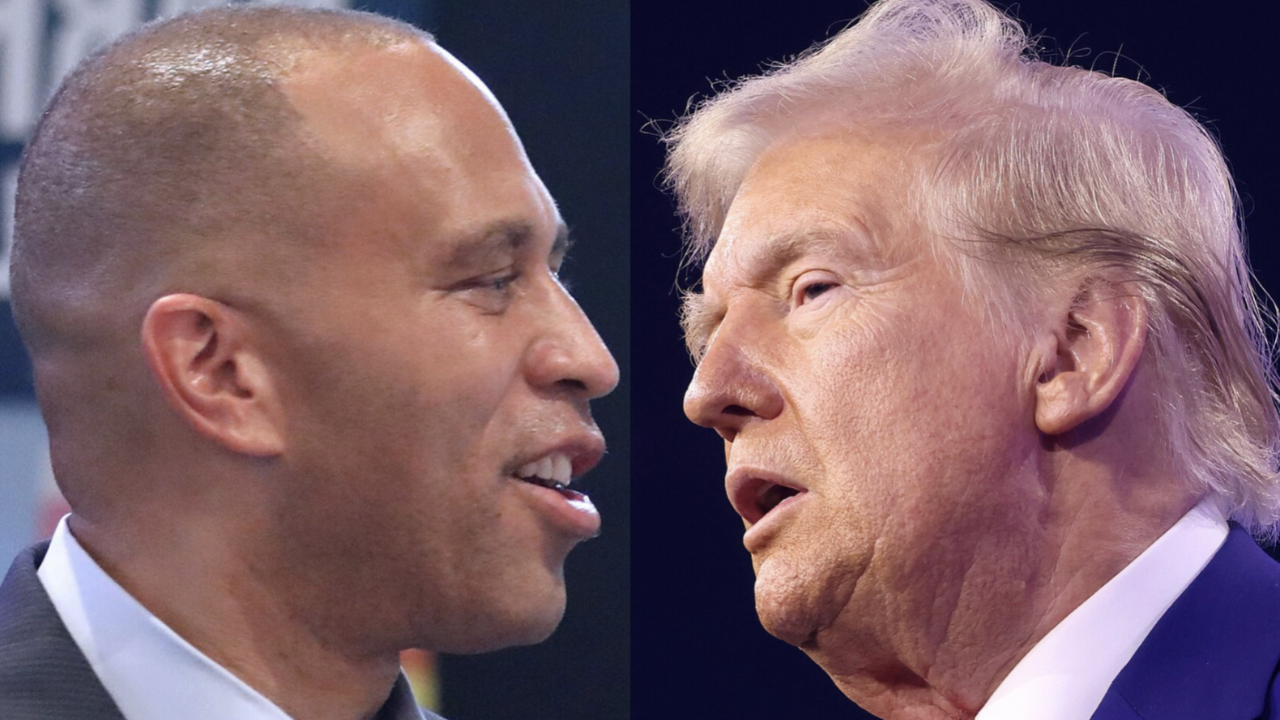
U.S. House Democratic leader Hakeem Jeffries said on Friday that “dramatic change is coming to the United States Congress,” posting a clip from a rally in Southern California in which he listed what he said a Democratic House majority would fight for, from reversing Medicaid cuts and ending tariffs to banning lawmakers’ stock trading.
Jeffries shared the 80-second clip with that caption in a post on X from his campaign account on Oct. 23, less than two weeks before the Nov. 3 midterm elections.
“A Democratic majority is going to fight to make your life more affordable. A Democratic majority is going to fight to reverse the Medicaid cuts. A Democratic majority is going to fight to fix our broken health care system. A Democratic majority is going to fight to end the Trump tariffs,” Jeffries said in the clip. He added that a Democratic majority would fight “to put a stop to this reckless war of choice over in Iran.”
“A Democratic majority is going to make sure that members of Congress are no longer able to trade stocks,” Jeffries said, adding that Democrats would work to get special interest money out of politics “by fighting hard to end Citizens United.” He said “one of the more important things that we’ll do in the next Congress is to pass the John Robert Lewis Voting Rights Advancement Act so we can end the era of voter suppression once and for all.”
The remarks came on Thursday evening in Buena Park, California, where Jeffries spoke at a reelection rally for Democratic Representative Derek Tran, according to C-SPAN, which recorded the event. Tran, who flipped California’s 45th District in 2024, is seeking a second term. In the clip, Jeffries speaks at a lectern in front of the emblem of the International Union of Operating Engineers.
The Medicaid changes Jeffries referred to were enacted in the Republican budget reconciliation law that President Donald Trump signed on July 4, 2025. The Congressional Budget Office estimated that the law’s health provisions would cut federal spending by $1.1 trillion over 10 years and increase the number of people without health insurance by 10 million in 2034, according to a Congressional Research Service report. The White House has rejected that characterization. “As the President has said numerous times, there will be no cuts to Medicaid,” the White House said in a June 2025 release while the bill was pending, saying it targets “waste, fraud, and abuse” and applies work requirements only to “able-bodied adults without young children.”
On tariffs, the Supreme Court ruled on Feb. 20 that the International Emergency Economic Powers Act does not authorize the president to impose tariffs, striking down Trump’s worldwide and drug-trafficking tariffs, according to a CRS legal analysis. Trump then proclaimed new tariffs under a separate trade law, and the ruling did not address tariffs imposed under other statutes, such as those on steel, aluminum and autos, the analysis said.
The United States and Israel began striking Iran on Feb. 28, according to the Congressional Research Service. U.S. strikes resumed on July 7 after a ceasefire, and Trump told Congress in a July 10 War Powers letter that the strikes were “limited, measured” and “defensive” and that he acted under his “constitutional authority as Commander in Chief.” On Sept. 24, the Senate rejected by 49-50 a concurrent resolution, H.Con.Res. 89, directing the removal of U.S. forces from hostilities with Iran, according to the Senate roll call.
On stock trading, the Republican-led House passed the Stop Insider Trading Act, H.R. 7008, by 232-198 on July 22, with 218 Republicans and 13 Democrats in favor, House roll-call records show. Jeffries and 197 other Democrats voted no. Some Democrats said the bill left loopholes, did not cover the president and included voter identification rules. Democratic Representative Seth Moulton called it “a sham piece of legislation full of loopholes for politicians and the President to take advantage of” in a statement explaining his vote. The Senate fell short of the 60 votes needed to take up the bill on Sept. 30, voting 53-47, according to the Senate floor log.
The voting rights bill Jeffries named, H.R. 14 in the current Congress, was introduced by Democratic Representative Terri Sewell of Alabama on March 5, 2025, and was referred to the House Judiciary Committee, where it has not advanced. Citizens United is the Supreme Court’s 2010 campaign finance ruling. Jeffries did not say in the clip how Democrats would seek to end it.
No direct response to the clip from House Republican leaders or from Tran’s Republican opponent could be found by Saturday. The National Republican Congressional Committee, the party’s House campaign arm, wrote in a separate post on X about two hours after Jeffries’ post that the top donor to Jeffries’ political action committee was “bankrolled by billionaire Reid Hoffman.” The post did not mention the rally.
The descriptions of the Iran conflict as a “reckless war of choice” and of “voter suppression” are Jeffries’. The administration calls the Iran strikes defensive, and the White House says the 2025 law does not cut Medicaid, while the CBO projects lower federal Medicaid spending and higher numbers of uninsured. Jeffries voted against the House’s Republican stock-trading bill, which Democratic opponents said fell short of a real ban, and no stock-trading ban for lawmakers has become law. Republicans had not publicly answered the specific pledges in the clip as of Saturday.