
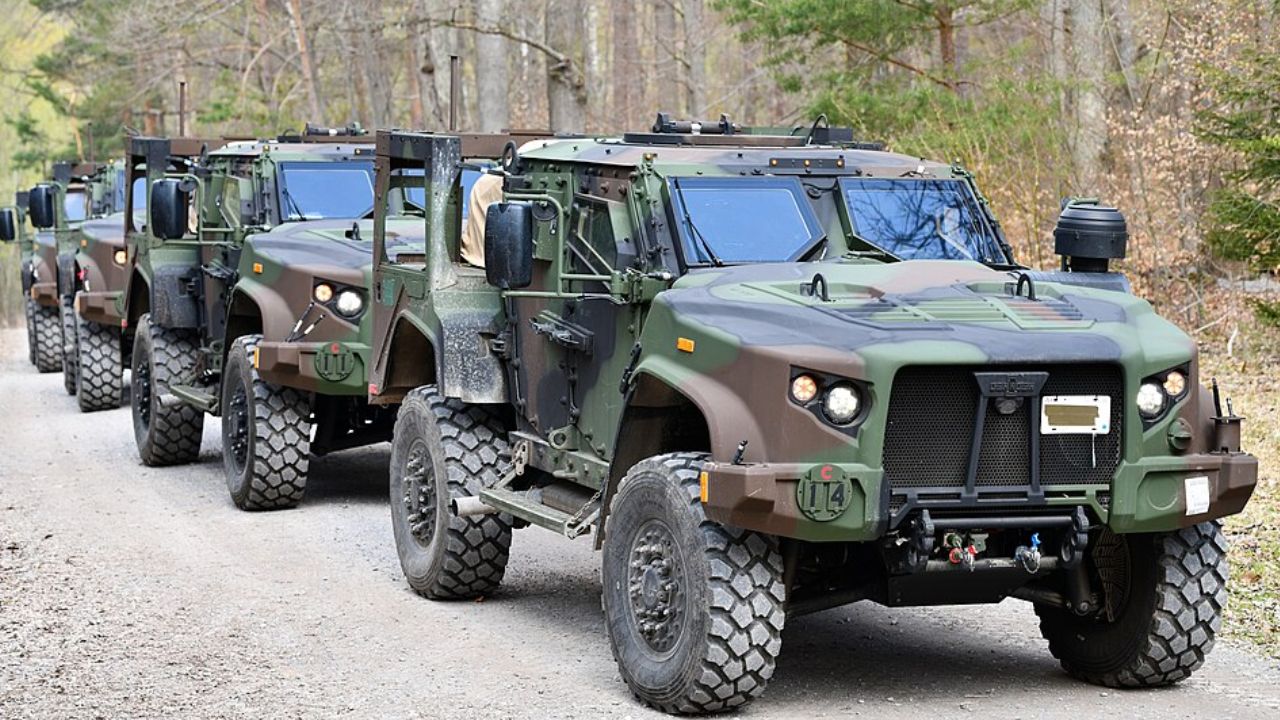
The Joint Light Tactical Vehicle (JLTV) was built to address a problem the U.S. military learned in Iraq and Afghanistan: the Humvee could be fast and flexible, or it could be better protected, but in IED-heavy fighting it struggled to be both at once. As the Army and Marine Corps added armor to keep crews alive, Humvees gained weight, suffered more mechanical strain, and lost performance margin. MRAPs delivered major survivability improvements, but their size and weight didn’t always suit the missions traditionally handled by “light” tactical vehicles.
JLTV is the Department of Defense’s attempt to turn that operational experience into a purpose-built vehicle for higher-risk tactical use—aiming to sit between up-armored Humvees and heavier MRAPs in the trade space. The program’s significance isn’t that it replaces the Humvee everywhere; it’s that it is intended to assume more of the front-line roles where protection, payload, and reliability matter most, while Humvees continue in training and support duties. Put simply: the Pentagon wanted a light truck that could move with tactical units, carry modern mission equipment, and improve crew survivability without forcing every task into heavy-vehicle logistics.
Why the Humvee wasn’t enough for the front line
The Humvee was created as a mobile workhorse, not as a vehicle optimized from the start for blast and ballistic protection. Iraq and Afghanistan changed what “routine risk” looked like as ambushes and IEDs became persistent threats across wide areas, pushing light vehicles into frequent contact with hazards that had once been associated with more defined front lines.
The services responded by adding armor, but that approach had limits because the platform wasn’t originally engineered around the added weight and stress. That mismatch shaped the JLTV’s basic requirement logic: protection had to be designed in, not treated as an afterthought. At the same time, the vehicle still had to function as a light tactical truck—able to move off-road, operate with dispersed units, and remain practical to deploy and sustain.
The design brief: survivability, mobility, and a realistic trade space
JLTV’s central design challenge was balancing survivability and mobility in a way up-armored Humvees increasingly struggled to maintain. The goal was not to promise invulnerability—no vehicle can—but to provide better protection and capacity than up-armored light trucks while avoiding the full weight and footprint of heavier protected vehicles for every mission.
Public discussion often collapses the comparison into a binary—“MRAP-level” versus “Humvee-level”—but the program was built around a more practical middle ground. The experience of IED wars helped drive requirements, but planners also had to account for evolving threats and changing operating concepts. JLTV reflects that shift: a light tactical vehicle designed with modern battlefield risk in mind, without claiming to eliminate that risk.
Modularity and variants: one platform, many roles
Another pillar of the JLTV concept is modularity: fielding a family of configurations rather than treating every mission as a separate vehicle program. The Army and Marine Corps use light tactical vehicles for a wide range of tasks—general transport, command-and-control, and weapon-carrying roles—and those roles change as units reorganize and technology evolves.
A modular approach also supports upgrades over time, which matters when radios, networking gear, and mission equipment can change faster than vehicle fleets can be replaced. In principle, this reduces pressure for bespoke solutions and encourages reuse of common components. The payoff, if executed well, is simpler training and sustainment across units even when their JLTVs are configured differently.
Designed around the network: power, radios, and electronic warfare
JLTV also reflects how expectations for light tactical vehicles expanded after years of counterinsurgency and into an era of contested communications. Vehicles are no longer judged only by what they can carry and where they can drive; they also need to support radios, sensors, and—depending on the mission—electronic warfare equipment. That puts electrical architecture and growth capacity near the center of the design brief, not on the margins.
This matters because modern operations increasingly depend on smaller elements operating separated by distance but linked by communications. In that context, vehicles become network nodes. A platform that can’t reliably host and power mission systems becomes a constraint on the unit, even if its mobility and protection are otherwise strong.
Testing and procurement: proving performance and sustainment
JLTV was pursued as a competed program, with industry teams asked to meet demanding requirements and demonstrate performance through testing. Oshkosh Defense is widely known as the primary manufacturer, and public reporting has at times referenced alternate production arrangements, but the central acquisition point is broader than any single contractor: the services wanted a design that could be produced at scale and supported across the joint force.
Testing and evaluation were not just administrative steps; they were meant to reduce the risk of repeating the experience of pushing a legacy platform beyond what it was built to handle. Reliability, maintainability, and parts support matter because a vehicle that performs in trials but struggles in units becomes a readiness burden. The program’s focus on manufacturability and sustainment reflects an unglamorous but decisive question: can the fleet deliver improved capability without eroding availability through maintenance and supply friction?
Who’s involved, and how Army and Marine needs shape the result
The U.S. Army and U.S. Marine Corps are the primary users, and their shared interest reflects overlapping needs: protected mobility for tactical forces that may operate under persistent threat. But the services do not employ light vehicles in identical ways, and that shapes what “good enough” looks like in practice.
The result is a set of requirements built around compromise rather than optimization for one scenario. A vehicle that grows too heavy can be harder to deploy and sustain; a vehicle that stays too light can limit survivability and payload in real missions. JLTV is meant to sit in that middle space—credible for higher-risk tasks, flexible enough for multiple formations, and structured for upgrades as requirements evolve.
What JLTV changes next: readiness, roles, and the Humvee’s second life
The near-term shift is not a clean, instantaneous swap, but a gradual rebalancing of roles. JLTV is intended to take on more of the missions where higher protection and payload are needed, while Humvees remain widely used in lower-risk support roles, training, and other tasks where the added weight and cost of a more protected vehicle may not be necessary.
That “nuanced replacement” has readiness implications. Fielding JLTV adds capability, but it also adds another vehicle type to train, maintain, and supply—especially while mixed fleets persist. The promise of commonality and maintainability matters here because sustainment discipline is what determines whether new capability shows up consistently in day-to-day operations.
Strategic significance: keeping IED lessons while preparing for tougher fights
JLTV is often explained through the lens of Iraq and Afghanistan, and that history is central to why the program exists. The larger strategic story, however, is adaptation: retaining the survivability lessons of IED-rich environments while preparing for peer competition, where units must operate under wider surveillance, more precise fires, and greater pressure on communications and logistics.
In plain terms, JLTV reflects a recognition that risk is distributed and the “front line” is not always a clean boundary on a map. It is not a claim that heavier protected vehicles are obsolete, nor that Humvees are suddenly irrelevant. It is an attempt to field a more survivable, more mission-capable light tactical platform for the roles where the Humvee was asked to do too much for too long.