
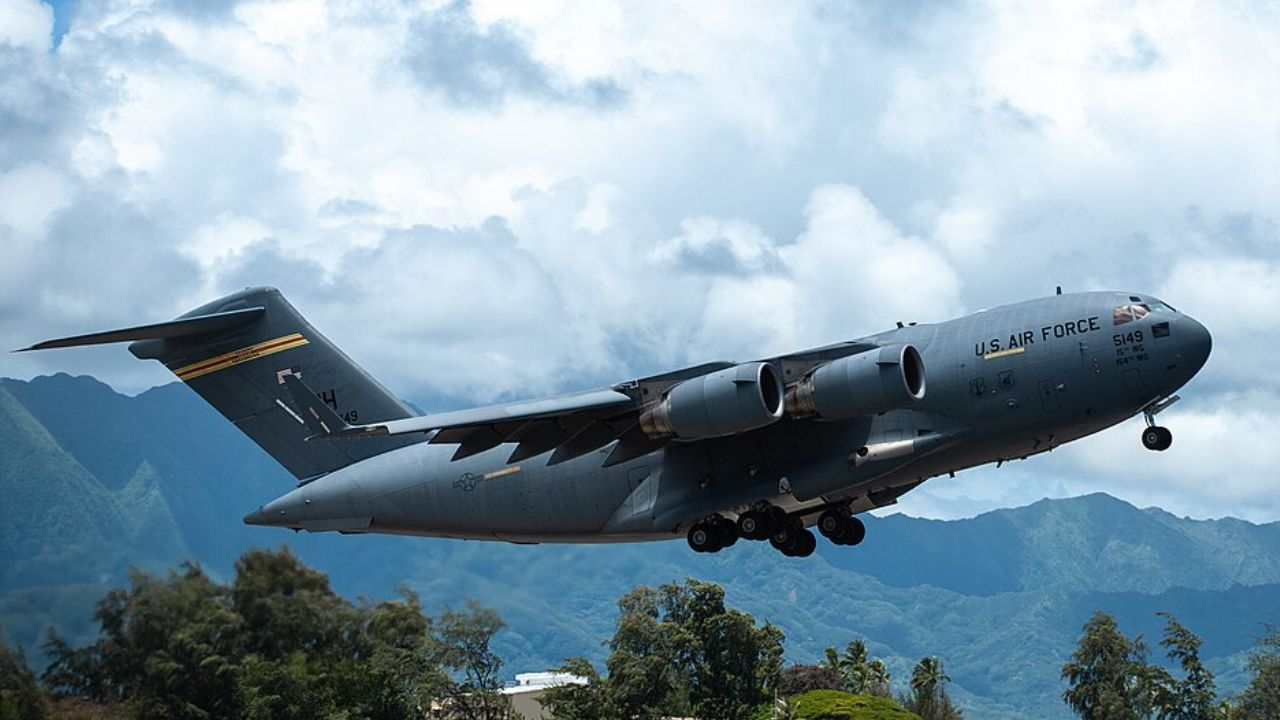
In the decades after the Cold War, the Boeing C-17 Globemaster III helped turn “rapid response” from a concept into routine practice. It entered an airlift enterprise that often treated strategic and tactical lift as separate lanes: long-range moves between major hubs on one end, and shorter, more constrained “last-mile” delivery on the other. The C-17’s lasting impact is how it narrowed that divide—moving heavy cargo and troops over global distances while remaining useful at the difficult end of the route, where runways can be limited, schedules shift quickly, and ground support may be scarce.
That mattered because U.S. operations increasingly relied on expeditionary movement: deploying on short notice, sustaining forces far from home, and responding to crises with limited warning. Airlift rarely gets top billing, but it underpins deterrence, reinforcement, and disaster response. Within that system, the C-17 became a central platform for the U.S. Air Force airlift enterprise under Air Mobility Command, and an important capability for several allies that purchased the aircraft or gained access through cooperative arrangements.
From a two-tier airlift model to more adaptable routing
Earlier airlifters each excelled in specific roles, but they also reinforced a division of labor. Larger strategic aircraft were best suited to established airfields and predictable support, while smaller tactical transports were built for tighter operating conditions, typically trading payload or range to do it. The C-17 changed planning assumptions by offering a more flexible “bridge” between those roles, giving commanders another option when speed, access, and cargo requirements pulled in different directions.
In practical terms, that flexibility could reduce reliance on multi-step delivery chains. Instead of defaulting to “strategic aircraft to a hub, then tactical aircraft onward,” planners could sometimes move cargo with fewer handoffs—when airfield access, permissions, tanker support, and maintenance capacity made it feasible. This did not render other airlifters obsolete, but it expanded the menu of workable solutions alongside legacy platforms such as the C-141, C-5, and C-130 families.
Why it mattered in expeditionary wars and crisis response
The C-17’s value became especially visible during decades marked by frequent deployments, evacuations, and rapid reinforcement tasks. These missions reward aircraft that can move meaningful loads quickly without assuming ideal conditions on arrival. When airfields are crowded, infrastructure is limited, and timelines are compressed, an aircraft that can combine long-range delivery with practical “arrival-end” utility can speed up the entire operation.
That same advantage carries into humanitarian assistance and disaster relief. Relief missions tend to collide with damaged infrastructure, overloaded airports, and urgent demand signals. In those scenarios, the C-17’s impact is less about any single performance metric and more about reliability and adaptability—helping the U.S. and partners deliver people, supplies, and equipment quickly when surface transport is too slow and the situation on the ground is changing by the hour.
The strategic consequence: airlift as an enabler of deterrence and power projection
At the strategic level, the C-17 helped the United States move and sustain military capability in places where large, fully supported bases are not guaranteed. That matters for deterrence because credibility is shaped by how fast reinforcements can arrive and how effectively they can be sustained once in theater. It also matters for coalitions: shared access to capable airlift can shorten response times and broaden what partner nations can contribute.
None of this removes the fundamentals that govern air mobility. Airlift still depends on airfield access, basing rights, and diplomatic clearances. It still hinges on tanker support when distances, routing, or operational requirements demand it. And the threat environment remains decisive: in a high-end conflict, survivability and sortie generation constraints can sharply limit how freely large transports can operate near contested areas.
The allied angle: shared capacity and coalition logistics
The C-17’s influence extends beyond U.S. service because multiple allied and partner nations operate the aircraft, and some have pooled capacity through cooperative frameworks. That matters strategically because it supports more interoperable procedures and gives smaller nations access to substantial lift without each having to maintain a large national fleet. In practice, shared access can also make multinational responses more coherent by reducing dependence on a single country’s availability.
Even so, cooperative lift is not frictionless. Competing national priorities, readiness cycles, and route and destination permissions still shape what aircraft can do on a given day. The C-17’s contribution is that it increases the number of viable options when governments need to move meaningful cargo quickly and cannot wait for ideal conditions.
Not a cure-all: access, sustainment, and contested logistics
It is easy to treat a capable aircraft as a universal solution. The C-17’s real impact is more grounded: it improved flexibility, but it still requires suitable airfields, dependable maintenance, and an operating environment that can be managed as threats rise. In today’s contested logistics debates, that distinction is critical. Resilience is not just owning aircraft—it is having the basing, repair capacity, protection, and operational freedom to use them consistently.
This is why the C-17 is best understood as an enabler within a larger mobility architecture. Airlift is fast, but it does not replace sealift or prepositioning, which move mass over time and support sustained operations. The C-17 can reduce the time to respond and reinforce, but longer campaigns still depend on the broader system that feeds, maintains, and protects forces once they arrive.
Industrial reality: production ended, readiness remains
With the C-17 production line closed, the center of gravity has shifted from buying aircraft to sustaining and updating the fleet. For operators, that puts pressure on parts availability, supply-chain health, and modernization choices that affect day-to-day readiness. When a mature platform becomes central to operations, the ability to keep it mission-capable can matter as much as its original design.
High operational demand also has predictable costs: components wear out, depot capacity becomes a bottleneck, and experienced maintainers are a finite resource. The key question is not only what the aircraft can do on paper, but how reliably it can be generated—especially during surges, when maintenance timelines compress and the supporting enterprise is stressed.
What comes next: capability measured by resilience
The C-17 reshaped U.S. military airlift by providing a practical bridge between strategic reach and tactical usefulness, and by proving its worth in sustained, high-tempo operations. The next chapter is less about inventing new roles and more about preserving availability: sustaining a mature fleet, modernizing where it makes sense, and keeping training and maintenance pipelines aligned with demand. As access becomes less certain and bases can be constrained, the C-17’s continuing value will increasingly be judged by how well it fits into dispersed operations and how consistently it can support rapid shifts of combat power.
For Air Mobility Command and allied users, the takeaway is simple: airlift is a system, not a single aircraft. The C-17 expanded what that system could do and reduced some of the friction between “global” and “local” lift tasks. Keeping that advantage will depend on the unglamorous fundamentals—parts, depots, permissions, tanking, and protection—that determine whether the workhorse can keep working when the next crisis arrives.