
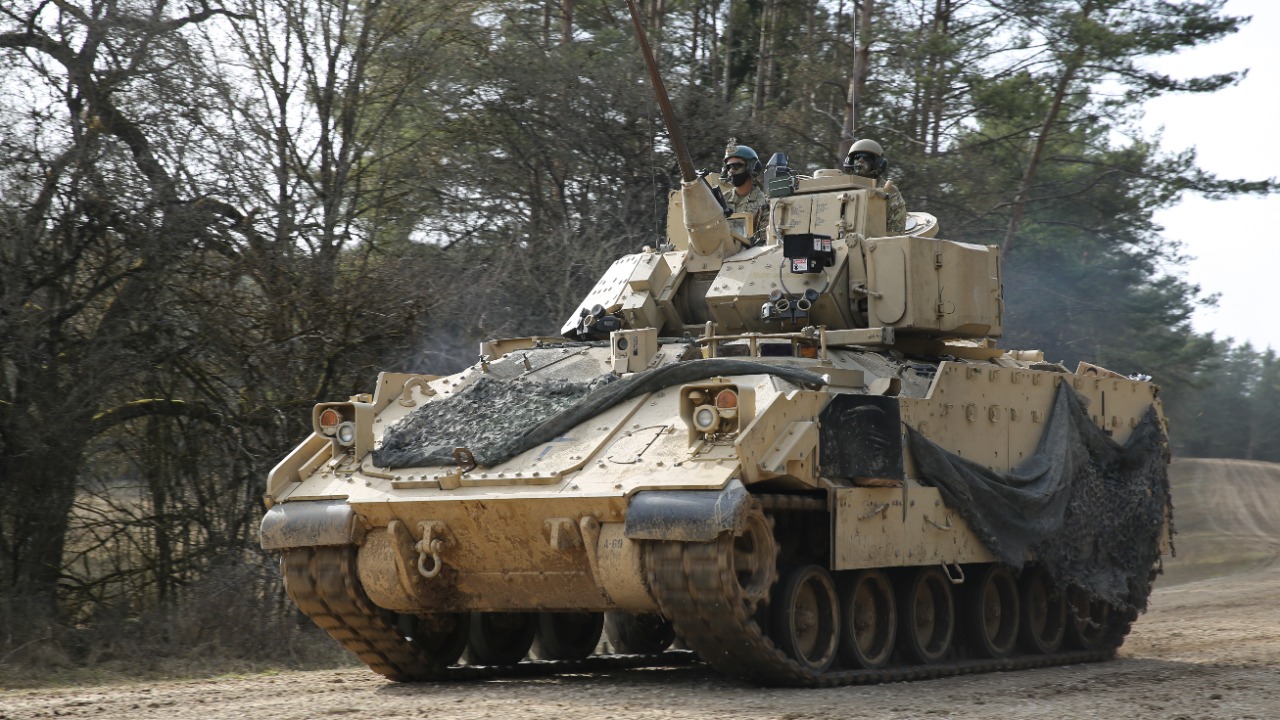
The M2/M3 Bradley Fighting Vehicle didn’t just give the U.S. Army a new way to move infantry and scouts—it helped shape how American mechanized units think about fighting as a team. Built for Cold War mechanized infantry and cavalry formations, the Bradley addressed a familiar problem: tanks can move fast and hit hard, but they can’t do everything alone, and dismounted infantry can’t keep up across open ground without protection. The result was a vehicle that supported a more integrated approach—tanks, infantry, and supporting fires working in closer coordination and at a higher tempo.
That influence is receiving fresh attention as modern threats raise old questions in sharper form. Drones, top-attack munitions, and widespread surveillance pressure every legacy IFV, including Bradley, and they also highlight what the platform was meant to enable: protected mobility, rapid troop delivery, and crews that can fight while moving. Recent use by partner forces has likewise made the Bradley a current reference point—not as a guarantee of survivability, but as a lens for what mechanized infantry can and cannot do under persistent observation.
A Tactical Choice Bradley Made Harder to Avoid: When to Stay Mounted
Mechanized infantry has always wrestled with a basic decision: ride close to the fight and risk being caught in a vulnerable posture, or dismount early and give up speed. Bradley made it more practical to ride farther and dismount with clearer intent by combining armored mobility with the ability to detect and engage threats while maneuvering. That, in turn, encouraged habits built around timing—arriving near decisive terrain, dismounting under cover, and using vehicle fire alongside nearby tanks to support movement.
Just as important, Bradley did not replace dismounted infantry; it clarified when dismounting matters most. Doctrine and training increasingly treated the vehicle as a delivery and fighting platform that helps preserve infantry combat power for the moment the mission or terrain demands boots on the ground. The emphasis shifted toward synchronized action—tanks and Bradleys moving together, infantry dismounting to clear, screen, or secure key points—rather than infantry simply “riding along” until contact.
Bridging Tanks and Infantry in Practice
Bradley’s lasting impact on U.S. mechanized infantry tactics is how it helped narrow the gap between armored shock and infantry staying power. It gave commanders a platform that could keep pace with tanks, contribute to finding and engaging threats, and still deliver troops quickly. In practical terms, that made it easier to maintain momentum without forcing formations into separate tank and infantry timelines.
This mattered because U.S. ground combat thinking has long prioritized coordination and tempo—finding the enemy, fixing them, and finishing the fight with combined effects. A formation where tanks, IFVs, and infantry can maneuver together is less likely to stall at first contact and better positioned to adapt when plans break down. In mechanized infantry and cavalry roles—where scouting, contact, and rapid repositioning are routine—the Bradley reinforced that approach as a daily pattern of work.
Seeing, Sharing, and Engaging: Crews as Part of the Reconnaissance Effort
The Bradley era also reinforced a broader shift in mechanized combat: outcomes depend as much on sensing and decision-making as on armor thickness alone. In practice, that means crews are not just drivers and gunners; they contribute to reconnaissance-by-fire, target handoff, and fast engagement decisions within a combined-arms team. The vehicle’s use in cavalry variants and armored formations helped normalize the expectation that “finding” and “reporting” are inseparable from fighting.
That focus aligns with the Army’s emphasis on execution over platform-centric thinking. Working alongside tanks, dismounted infantry, and supporting fires, Bradley crews trained to switch quickly between movement and engagement without losing control of spacing, sectors, and reporting. The lesson was not that an IFV makes risk disappear, but that an IFV enables a faster cycle of observe-decide-act—if crews and leaders stay disciplined about positioning and coordination.
Combat Experience—And the Limits of Easy Conclusions
Bradley’s combat record has been widely discussed from the Gulf War era onward and through later operations. Those experiences are often cited to illustrate what U.S. mechanized teams can achieve when vehicles, troops, and fires are integrated and led well. They also reinforce a more useful takeaway: IFVs deliver their best value as part of a combined-arms system, not as stand-alone solutions.
They also highlight what not to overlearn. Survivability is never just a function of a vehicle; it depends on tactics, spacing, supporting fires, air defense, and the ability to reduce exposure in the first place. Recent partner-force battlefield use adds timely observations, but it also underscores the same constraint: under dense surveillance and precision threats, no legacy IFV is immune. Results depend heavily on how the vehicle is employed and what supports it.
Modernization as an Operational Habit
One reason Bradley influenced tactics for so long is that it remained a core mechanized platform through upgrades rather than being treated as a fixed Cold War artifact. Continued investment—commonly associated today with BAE Systems and the broader U.S. defense-industrial base—helped keep the fleet aligned with changing requirements for protection, awareness, and lethality. Doctrinally, that continuity matters: units can refine tactics around a familiar workhorse while incorporating improvements as they arrive.
Modernization also shapes readiness in ways that are easy to overlook. Keeping an existing fleet viable preserves force structure and training continuity, but it also demands sustainment capacity, parts availability, and maintenance expertise. Those realities affect how many vehicles are available on any given day and how confidently commanders can plan and execute mechanized operations.
Tradeoffs Bradley Kept in View: Protection, Mobility, and Troop Delivery
Bradley did not erase the classic tradeoffs of mechanized warfare—it kept them front and center. More protection can improve survivability but can complicate mobility and maintenance; more mobility can expand tactical options but can also increase exposure when reconnaissance and air defense are insufficient. The platform’s long service life meant the Army repeatedly had to rebalance those tensions as threats evolved.
It also kept attention on a core measure of an IFV’s usefulness: how reliably it delivers infantry to the right place, at the right time, ready to fight. The question is not only what an IFV can shoot, but how well it supports the dismount plan. Bradley’s influence on tactics is visible in those practical drills—when to stay mounted, when to dismount, and how to transition quickly without losing momentum or cohesion.
Comparisons to Other IFVs: What Design Choices Encourage
Comparisons with Soviet/Russian IFVs and modern Western counterparts are useful when they stay grounded in what they reveal: different design choices push armies toward different behaviors. The Bradley’s role in U.S. doctrine reflects a preference for closely integrated combined arms—infantry, armor, and supporting fires woven together to manage risk while keeping pressure on the enemy.
The takeaway is not that one vehicle “solved” mechanized combat. It is that platforms influence habits: how far forward units push, how they scout, how they time dismounts, and how they accept risk. Bradley’s strengths supported disciplined combined-arms teams—and they also made poor positioning and weak coordination easier for an enemy to punish.
What Changes Next: Drones, Ubiquitous Sensors, and Replacement Efforts
Today’s battlefield is saturated with sensors, and threats increasingly arrive from above. That environment pressures legacy IFVs to adapt through better situational awareness, tighter integration with air defense and counter-drone efforts, and tactics that reduce detectability and exposure. It also pushes dispersion, deception, and rapid repositioning—skills that match Bradley’s long-standing emphasis on tempo, but now under constant observation.
At the same time, the Army’s ongoing replacement efforts raise a broader institutional question: how much of Bradley’s tactical legacy should carry forward, and what must change to stay effective. A next-generation platform may bring new tools, but doctrine and training still determine whether mechanized infantry can fight mounted and dismounted alongside tanks without becoming an easy target. Bradley’s enduring influence is less about the vehicle itself than the template it reinforced: combined arms as a daily practice, with platforms shaping tactics—and tactics shaping how platforms survive.