
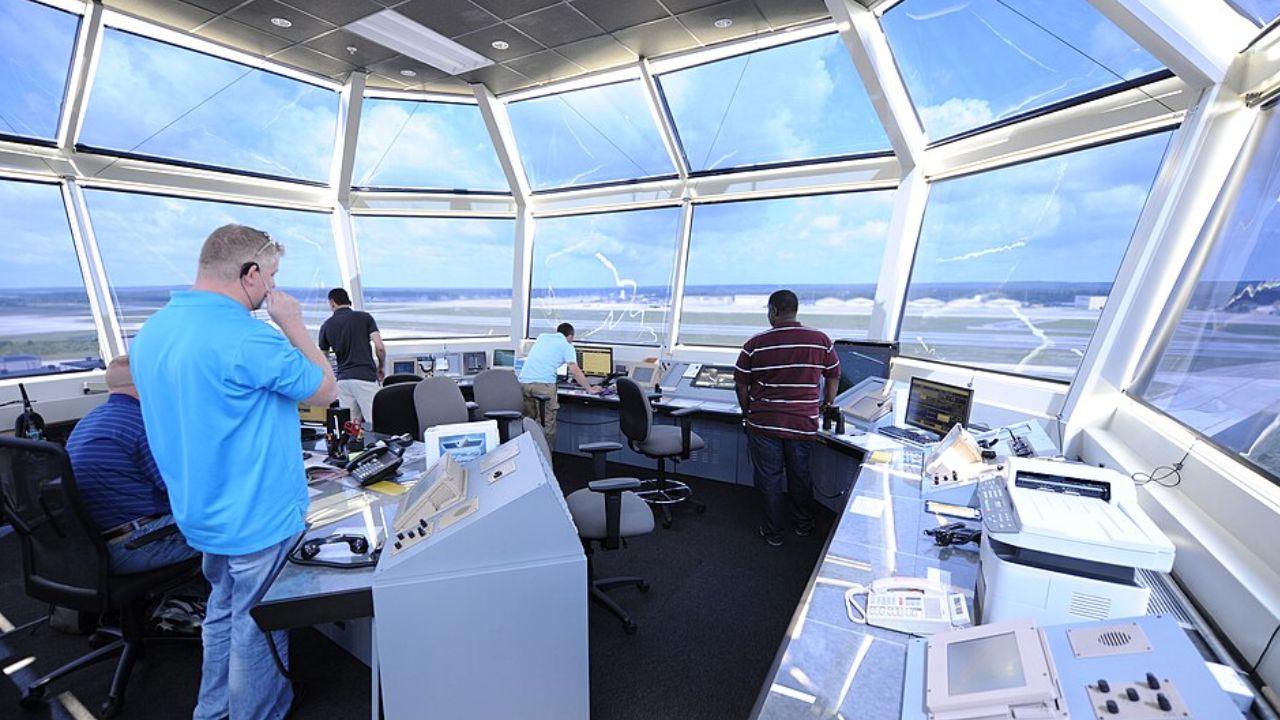
Modern air traffic control (ATC) can look like a purely civilian discipline: calm voices, standardized phraseology, and a global rulebook built around safety. But many of the habits that make high-tempo airspace manageable were refined in a different setting—wartime and Cold War air defense—where time pressure was severe, communications were fragile, and mistakes in identification could carry extreme consequences. The point is not that military networks “created” ATC. It’s that air-defense communications and command-and-control practices helped shape procedures and operational expectations that later proved useful for civil control of busy skies.
The through-line is communication under stress: air-ground voice radio, radar-based coordination, shared responsibilities across multiple positions, and a disciplined way of issuing and confirming instructions. In the U.S. and across NATO and Western Europe—alongside the UK’s early warning tradition—civil controlled airspace matured in proximity to air-defense networks built to detect, identify, and, if necessary, intercept. As civil aviation scaled, the most transferable lessons were often procedural and architectural rather than a direct migration of specific military hardware.
From scramble orders to structured communication
Air defense highlighted a reality that still shapes ATC: voice is essential, but it is also a constraint. Early air-defense organizations had to coordinate radar sites, command centers, and aircraft quickly, often with limited bandwidth and the constant risk of stepped-on transmissions or misunderstood instructions. Under that pressure, disciplined radio habits mattered—short, consistent instructions; clear acknowledgement; and an unambiguous understanding of who is responsible for directing an aircraft at any given moment.
Those habits map cleanly onto civil ATC’s core mechanics. When a controller issues a clearance, the requirement for precise phrasing and confirmation is a practical response to the same human-factors problem: high workload, time pressure, and little tolerance for ambiguity. The mission is different, but the communications discipline is familiar.
Ground-controlled intercept and the logic of sectors and handoffs
One of the clearest procedural parallels is ground-controlled intercept (GCI), where ground personnel use radar to guide aircraft in response to a track. GCI required a tightly managed division of labor: people who track, people who communicate, and people who make decisions, all synchronized in real time. That structure encouraged air-defense organizations to break responsibilities into manageable pieces and to make transfers of responsibility explicit.
Civil ATC’s sectorization and handoff logic follows the same operational logic. Controlled airspace is divided to keep workload bounded and to ensure continuous responsibility for separation services. A handoff is not just administrative; it is an operational commitment that tracking, communications, and authority move together and that nothing critical is lost in the transition.
Identification: separating “where it is” from “what it is”
Air defense also reinforced an idea that remains relevant in civil operations: knowing an aircraft’s position is not the same as being confident about its identity or intent. Military practice around identification friend or foe (IFF) and radar/identification coordination made “positive identification” a core expectation, and it paired that expectation with procedures for what to do when certainty is missing.
Civil ATC does not function as a combat identification system, and it does not simply import military methods. But the operational mindset carries over: identification must be maintained, uncertainties must be resolved quickly, and coordination becomes more structured when identity is in question. In both worlds, ambiguity is a risk that grows the longer it persists.
Interoperability as a requirement, not an aspiration
NATO’s Cold War posture placed a premium on making different national forces work together: compatible communications, coordinated radar pictures, and agreed procedures for who controls which airspace under routine conditions and during heightened readiness. That experience reinforced the value of shared phraseology and standardized coordination steps—the basics that let complex systems scale across borders and organizations.
In civil aviation, the International Civil Aviation Organization (ICAO) has been central to standard-setting, and commercial avionics and airline operations shaped what could be deployed broadly. Even so, the military experience underscored a point that civil standards also embody: airspace management becomes more reliable when communications and procedures are portable, predictable, and practiced across communities.
Data links: conceptual influence without a direct transfer
As air-defense command networks evolved, voice remained critical but was increasingly supplemented by data links intended to reduce congestion and help participants share a common operational picture. Publicly known examples include Link 11 and Link 16, which are emblematic of a broader shift toward networked command-and-control. The relevance to civil ATC is not that airline operations adopted these military links, but that they illustrate an operational logic that became more common across aviation: shared track data, standardized message formats, and procedures built around a networked picture.
Civil airspace management has moved along a parallel path, relying more on networked surveillance and digital coordination while keeping voice as the universal fallback. As systems become more connected, sector design, handoffs, and contingency planning increasingly reflect what the network can provide—and how operations should continue when the network degrades.
Resilience: planning for imperfect communications
Air defense typically planned for communications that might be disrupted by interference, attack, or failure. That assumption drove layered approaches: multiple paths, fallback procedures, and clear rules for operating with reduced information. The equipment changed over time, but the principle remained consistent—expect degradation and design for continuity.
Civil ATC inherited the same practical truth, even with a different threat model. Weather, outages, spectrum issues, and cyber risk can all erode services quickly. The goal is not perfection; it is graceful degradation—procedures and systems that keep traffic safe and predictable when parts of the picture go missing.
The security–safety balance in mixed civil-military airspace
Military communications often prioritize confidentiality and operational security, while civil ATC prioritizes transparency, standardization, and universal comprehension. That friction becomes practical whenever civil and military traffic share airspace, when military aircraft require special handling, or when defensive postures change during a crisis. In most cases, the balance is achieved through procedural design—who communicates with whom, on which frequencies, under what clearances—rather than by attempting to merge military security measures directly into civilian control.
This is also why civil-military coordination matters strategically. During surges—whether increased air policing, emergency movements, or other high-priority operations—civil ATC capacity and military command-and-control can become tightly coupled. Shared expectations and rehearsed coordination reduce delay, confusion, and risk when time and airspace are at a premium.
Industry and readiness: communications as infrastructure
Because communications and surveillance underpin both safety and defense tasks, the industrial base that supports military command-and-control can overlap with parts of the broader airspace ecosystem. Large suppliers in avionics, sensors, and networked communications—companies such as Raytheon, Northrop Grumman, Thales, BAE Systems, and Collins Aerospace/Honeywell—often sit near that boundary, even when civil and military products, approvals, and operating concepts remain distinct.
The readiness implication is straightforward: communications equipment is not a niche capability; it is a fleet-wide dependency. Modernization brings follow-on demands in integration, testing, training, and sustainment. Civil agencies that upgrade networked ATC services face parallel obligations: cybersecurity, spectrum management, and contingency tooling are ongoing requirements, not one-time projects.
What changes next: GNSS reliance, spectrum pressure, and contested environments
Today’s airspace relies heavily on network timing and positioning, and the operating environment is getting less forgiving. Dependence on GNSS, pressure on spectrum, electronic-warfare concerns, and cyber risk are pushing both civil and military stakeholders toward more resilient positioning, navigation, and timing (PNT) and more robust communications architectures. The air-defense lesson that systems will be stressed and degraded is increasingly relevant to civil continuity planning, even when the stressor is an outage rather than combat.
Future progress is likely to be incremental: better fallbacks, clearer civil-military coordination mechanisms, and network designs that fail in predictable, manageable ways. The deeper story is that ATC’s calm professionalism is an engineered outcome—built from decades of operational learning, some of it accelerated by air-defense communications problems with little margin for error. In an era of dense traffic and contested spectrum, that legacy is becoming operationally relevant again.