
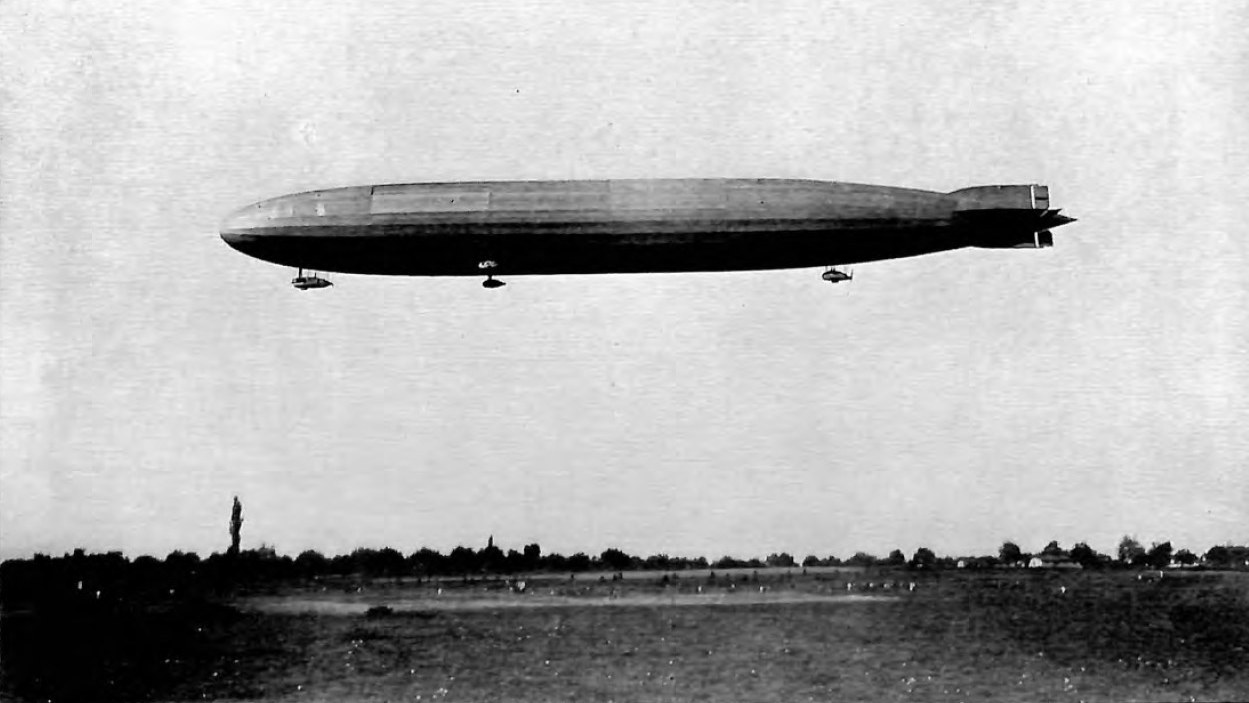
When German airships first crossed the North Sea to bomb England in January 1915, Britain’s defenses against them were, in the later judgment of the National Archives, “totally inadequate.” The airships came back raid after raid, and the archive’s record shows the British answer changing with them.
Britain did it with a layered system rather than a single weapon: more guns, more searchlights, fighter aircraft sent up after the raiders, and early warning taken from the Zeppelins’ own radio traffic.
The National Archives’ education resource on the Zeppelin raids puts the result in one figure: “77 out of the 115 German Zeppelins had been shot down or totally disabled.” It is the archive’s count across the German fleet, and it is the number that defines how the airship campaign against Britain turned out.
The machine Britain had to stop
The first raid struck Great Yarmouth and King’s Lynn in January 1915, according to the archive. It describes the Zeppelins as long airships with steel frameworks filled with hydrogen, one of them about 190 meters long, and says that in 1914 they could reach about 85 mph and carry “up to two tons of bombs.”
The archive’s own documents show local commanders working the problem raid by raid. Among them is a report by Maj. Gen. Ferrier, commander of the Humber Defences, on the Zeppelin raid on Hull in June 1915, with a separate letter of suggestions for improving the defenses, and a diary and report of action by Maj. Robert Hall, the fire commander of the Humber Defences. The files are held under the reference AIR 1/569/15/16/142.
Guns, searchlights, fighters and radio
By 1916, the archive says, Britain had more guns and searchlights and was sending fighter aircraft against the airships. It had also learned to intercept Zeppelin radio messages for early warning and had set up a central communications headquarters to manage the defense.
The airships’ great weakness was their lifting gas. The archive says Zeppelins were very vulnerable to explosive shells, which set the hydrogen alight. An airship that could be reached with the right ammunition could be destroyed outright, which is why finding and intercepting the raiders mattered so much.
One of the best-documented interceptions came over Hertfordshire. Lt. William Leefe Robinson of the Royal Flying Corps brought down the German army airship SL 11 at Cuffley on Sept. 3, 1916, according to the Imperial War Museums’ Lives of the First World War record of his service. The London Gazette announced his Victoria Cross on Sept. 5, 1916. His citation says he “attacked an enemy airship under circumstances of great difficulty and danger.” IWM describes it as “the only VC awarded for action in Britain.”
How the campaign closed
The archive’s resource dates the calling-off of the Zeppelin raids to 1917, when its 77-of-115 count applied, and notes that raids by heavier-than-air bombers continued. Airships did return over Britain after that, however. The raid record kept by Zeppelin historian Ian Castle shows a final airship raid on the night of Aug. 5-6, 1918, led by L 70, the flagship carrying Peter Strasser.
L 70 was brought down off the Norfolk coast, about eight miles off Wells-next-the-Sea, by Maj. Egbert Cadbury and Capt. Robert Leckie flying a DH.4 from Yarmouth, according to Castle’s record. Strasser was killed, and there were no survivors. Castle’s record presents it as the end of the bombing campaign against Britain.
The human cost on the ground was real and is recorded plainly by the archive: by the end of the war, more than 1,500 British citizens had been killed in air raids, a figure that includes the bomber raids as well as the airships. What remains of the defense that answered them is on paper at Kew, in the Humber reports and the files that trace how a country learned to defend itself from the air.