
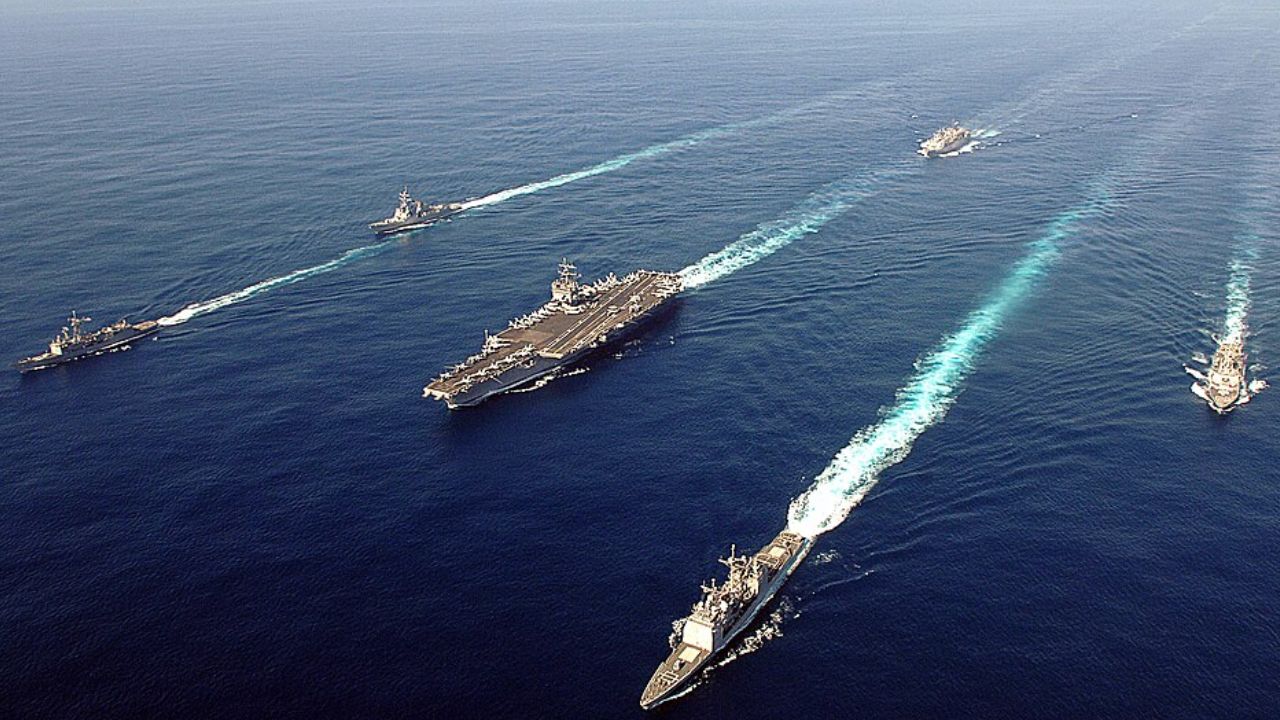
Aircraft carriers remain the U.S. military’s most recognizable instrument of power projection because they function as a mobile airfield at sea—able to move, remain on station, and generate aviation combat power without relying on a host-nation base. In practical terms, a Carrier Strike Group (CSG) can arrive near a developing crisis and begin flying missions such as combat air patrols, intelligence/surveillance/reconnaissance (ISR), and strikes, while also providing a highly visible signal of U.S. attention and intent. That visibility can reassure partners and warn adversaries, giving American leaders options that do not automatically require deploying ground forces. It also means carrier operations are closely watched and politically sensitive, making employment as much about strategy and messaging as about flight operations.
In today’s fleet, large-deck carriers—Nimitz-class and the newer Ford-class—operate as part of integrated CSGs. The carrier brings the air wing and command-and-control capacity; escorts provide layered defense and additional offensive options; and support ships sustain the formation with fuel, food, spare parts, and munitions. Carriers are neither a standalone solution nor treated as invulnerable. They are one high-end tool within a wider joint and often coalition approach, and their value depends on how well the full force is protected, supplied, and connected to broader intelligence and targeting networks.
A mobile airfield that reduces reliance on basing rights
The carrier’s strategic appeal starts with access. In peacetime competition and during crises, nearby land bases may be politically constrained, unavailable, or vulnerable. A carrier operating offshore can provide aviation presence and response options without waiting for permission to use a host nation’s airfields. Because it can reposition as conditions change, a carrier also gives decision-makers flexibility to increase or reduce pressure without the same degree of permanence associated with building up forces ashore.
This mobility matters for deterrence and crisis management. A carrier’s arrival is difficult to ignore, and that can signal resolve and reinforce commitments. At the same time, mobility complicates an adversary’s planning because the launch point for air operations is not fixed. None of this guarantees freedom of action in a contested environment, but it can expand the set of credible options available to U.S. leaders.
What a Carrier Strike Group adds—and why the group matters
A carrier’s influence is most credible when it operates as part of a CSG rather than as a lone ship. Alongside the carrier and air wing, the group typically includes cruisers and destroyers, with submarines often operating in support, and logistics ships enabling replenishment at sea. Escorts contribute layered air and missile defense, anti-submarine warfare, and additional strike capacity. The result is a formation designed to operate in higher-risk waters while protecting the carrier’s ability to launch and recover aircraft.
That protection and sustainment underpin what the carrier actually provides: sorties across multiple mission sets. In broad terms, carrier aircraft can defend the force, strike targets ashore or at sea, and collect ISR that feeds commanders’ understanding of the situation. The carrier then connects into a wider joint network for intelligence, targeting, and coordination. The key point is balance and adaptability: the air wing and escorts can be configured around the demands of a particular moment, rather than offering a single-purpose capability.
The air wing: a mix built for complex operations
Carrier aviation is often shorthand for fighters launching off the bow, but the air wing’s strength is the mix of aircraft and roles. Alongside fighters, the air wing includes electronic warfare, airborne early warning, and helicopters that support missions such as maritime security and anti-submarine warfare. That combination helps the force defend itself, find targets, and coordinate operations in crowded and contested airspace. It also supports missions that fall short of open conflict, including persistent ISR and routine presence.
Flight operations are ultimately about generating sorties, but precise sortie rates vary by scenario and many details are not fully public. What can be said generally is that carriers are built for sustained operations: the flight deck, maintenance spaces, and ordnance handling systems are designed to keep aircraft launching and recovering over time, not just for a single strike. That output depends on trained crews, maintenance capacity, spare parts, and a steady flow of supplies—areas that can be stressed when operations surge.
Sea control, deterrence, and the presence mission
Carriers are frequently discussed for their ability to strike targets ashore, but their strategic utility often begins earlier with sea control and freedom of maneuver. By maintaining a credible combat presence in key waterways and approaches, a CSG can support broader efforts to keep sea lanes open and deter coercion. In an era of great-power competition, that day-to-day presence is part of shaping: it signals that the United States intends to operate where international interests and commitments are at stake.
Because a carrier is visible and widely tracked, it is also a diplomatic instrument. That can be an advantage when reassurance and signaling are the objective, but it can also be portrayed by adversaries as escalation or used in information campaigns. As a result, carrier movements and risk decisions are often scrutinized in real time, and deploying a carrier is rarely just a military choice; it is also a political one.
How carriers connect to joint and allied power
A CSG is not a self-contained war-winning package. In operations and exercises, carrier aviation integrates with the Marine Corps and Air Force, and increasingly relies on space- and cyber-enabled capabilities that support communications, sensing, and decision-making. The carrier can add mass and flexibility to a joint air effort, while also benefiting from land-based aircraft, intelligence networks, and other naval forces. In practice, the carrier is a mobile piece of a larger system that can be scaled for routine deterrence patrols, crisis response, or early-phase strike options.
Allied interoperability is part of that system as well. Multinational exercises focus on communications, coordination in shared airspace, refueling, and maritime tactics so coalition operations are less improvised when tensions rise. For partners, operating with a U.S. carrier can provide training and a strategic signal. For the United States, allied integration can increase capacity and legitimacy, even as it adds complexity to planning and command relationships.
Humanitarian assistance and disaster relief: a secondary but real contribution
Carriers are designed for combat, but the same attributes that make them militarily useful—mobility, aviation capacity, endurance, and onboard coordination—can also support humanitarian assistance and disaster relief. When ports or airfields ashore are damaged or overwhelmed, a carrier can help deliver helicopters, provide coordination, and move supplies and personnel. These missions are not the carrier’s primary role and can compete with other operational demands, but they highlight how a mobile sea base can matter when access ashore is limited.
The hard questions: cost, risk, and adaptation
Debates about carriers often focus on two realities: they are expensive, and they are attractive targets in an era of advanced missiles and submarines. Those concerns shape how carriers are employed, including how close they can prudently operate to a hostile coastline and what levels of risk commanders accept. Public discussion sometimes swings between extremes—declaring carriers obsolete or portraying them as untouchable—when the more accurate view is conditional. Carriers remain powerful, but they are not guaranteed to operate freely in every environment, especially against sophisticated adversaries.
The Navy’s broad response has been adaptation rather than abandonment. That includes the protection provided by escorts and submarines, tactics intended to complicate an adversary’s targeting, and concepts associated with distributed maritime operations that aim to spread risk and present multiple dilemmas. It also places renewed emphasis on logistics under threat, since sustained carrier operations depend on the ability to resupply. Many details of survivability, readiness, and operational performance are not fully public, so overly precise claims should be treated cautiously without authoritative sourcing.
What the carrier’s role looks like in a contested world
The carrier’s core promise—rapid response without host-nation basing, backed by an integrated strike group—continues to shape how the United States manages crises. What is changing is the environment: contested regions, faster escalation dynamics, and adversaries investing in systems designed to hold large ships at risk. That pressure pushes carriers toward more dynamic employment, tighter integration with joint and allied networks, and sustained attention to readiness and resupply. It also elevates the importance of the broader fleet—escorts, submarines, and logistics ships—because carrier effectiveness depends on the whole system arriving and operating together.
Aircraft carriers project American power worldwide because they deliver options—military, diplomatic, and, at times, humanitarian—without waiting for access to someone else’s territory. They do not replace land-based airpower or other naval forces, and they are not a guarantee of dominance in every setting. They complement other capabilities by bringing a flexible airfield to the world’s oceans and by providing a visible, mobile form of presence. As great-power competition intensifies, the enduring question is less whether carriers matter than how to employ, protect, and sustain them wisely in the most contested theaters.