
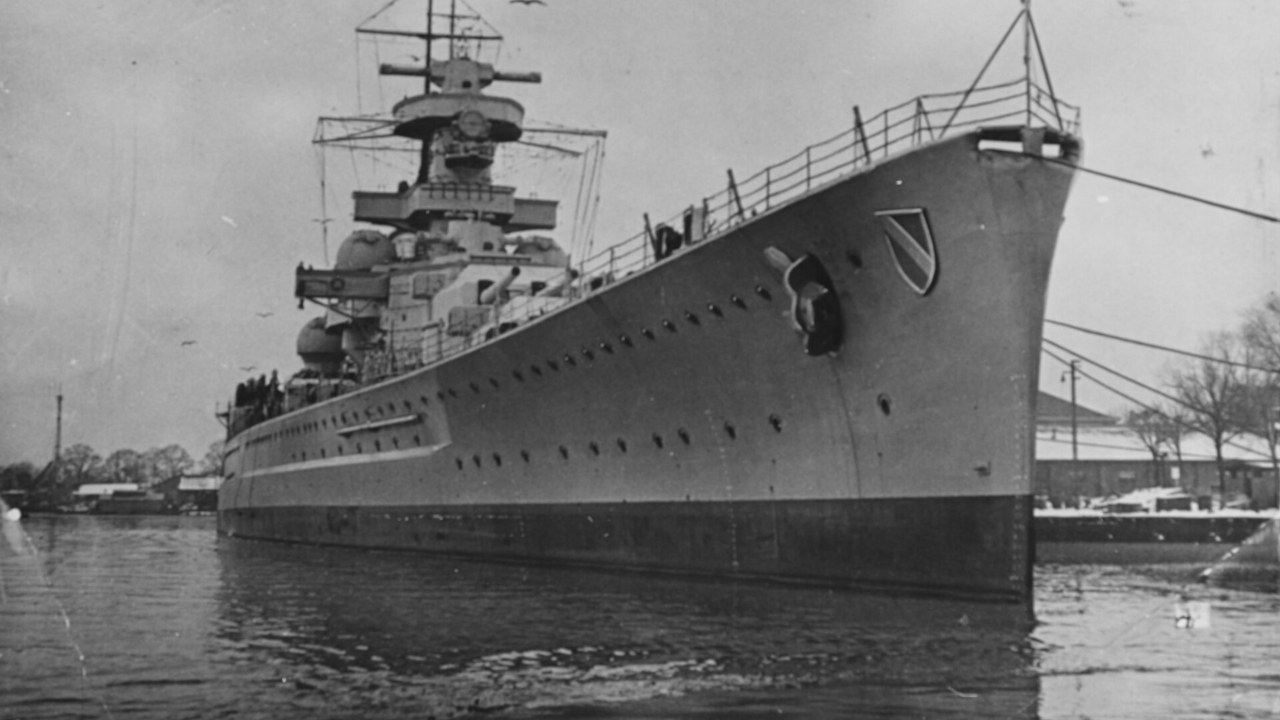
Twenty-four kilometers is the distance Guinness World Records gives for the longest successful hit one ship’s guns have scored on another vessel. The German battleship Scharnhorst set that mark on June 8, 1940, when her gunners struck the British aircraft carrier HMS Glorious in the North Atlantic.
The shot is a reminder that in 1940 a carrier could still be caught and sunk by surface gunfire. A month later, a British battleship in the Mediterranean matched it at what Guinness calls a similar range, which makes the record one that was reached twice in the summer of 1940.
The record body states the figure plainly on its “Longest range hit by a ship’s gun” page: “The greatest range at which one ship’s guns have successfully hit another vessel is 24 km (15 miles).” The page names Scharnhorst’s hit on Glorious on June 8, 1940, as one of the two occasions it happened.
The same page lists the record’s “when” field as 1941, but its own text dates both hits to 1940, and the 1940 dates are the ones History Today and Royal Museums Greenwich give for the two actions.
Glorious and her escorts
Glorious was caught while the Allies were pulling their forces out of Norway. Naval historian Philip Weir, writing in History Today on June 8, 2015, says the carrier was sunk late in the afternoon of June 8, 1940, during the evacuation, along with the destroyers HMS Ardent and HMS Acasta that were escorting her.
Weir writes that the German battleships Scharnhorst and Gneisenau sighted the British ships at 1545. Acasta made a last attack and torpedoed Scharnhorst before she too was sunk, around 1820, according to his account.
The cost was heavy. Weir puts the death toll at 1,519. The carrier’s captain, Guy D’Oyly-Hughes, a decorated First World War submariner, was among those lost, he writes.
Questions that outlasted the war
The sinking has never fully settled into the record. Weir writes that the official account published in 1946 blamed a fuel shortage that forced Glorious to sail independently on what was normally a safe route, an explanation Winston Churchill called “not convincing.”
Later writers, Weir notes, pressed other theories, including Capt. Stephen Roskill’s 1980 article portraying D’Oyly-Hughes as a difficult commander and questions over whether the carrier’s distress signal to the nearby cruiser HMS Devonshire was really corrupted. The findings of the Admiralty’s enquiry were sealed until 2041, according to Weir.
Warspite at Calabria
The second hit at that range came in the Mediterranean. Guinness says that on July 9, 1940, during the Battle of Calabria, HMS Warspite hit the Italian flagship Giulio Cesare from a similar range. The record body does not give an exact distance for Warspite’s shot.
Royal Museums Greenwich, in its catalogue entry for Rowland Langmaid’s painting of the action, describes Calabria as the first major clash between the British Mediterranean Fleet and the Italian navy. The museum says Adm. Andrew Cunningham turned his fleet to engage after learning of an Italian convoy bound for Libya, and that Warspite exchanged salvoes with Giulio Cesare, doing enough damage that the Italian force withdrew.
The museum adds that Cunningham could not turn the action into a decisive result, because his older battleships were too slow to catch the retreating Italians. Langmaid, the catalogue notes, served in the Royal Navy in both world wars and was the official Admiralty artist to the Commander-in-Chief, Mediterranean Fleet, from 1941 to 1943.
A record set by the guns, not the planes
Both hits came in a summer when aircraft were already part of the fight at sea. At Calabria, the Royal Museums Greenwich entry says, aircraft from the carrier HMS Eagle sank an Italian destroyer. Off Norway, a carrier was the target, and in the action Weir describes it was the two German battleships that sank her. On the Guinness page, the record still stands at 24 kilometers, set by Scharnhorst against Glorious and matched by Warspite at Calabria.