
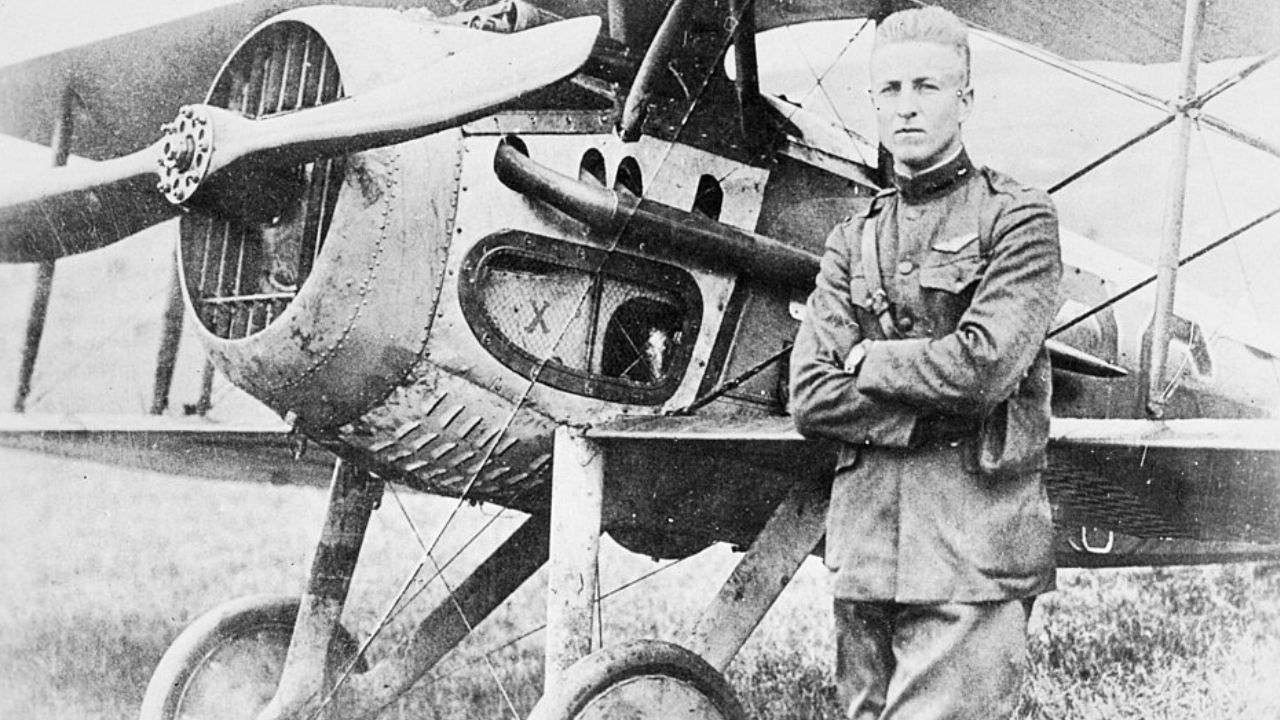
Frank Luke Jr.’s combat record is one of World War I’s most concentrated bursts of destruction—and one of its most disputed final scenes. Official U.S. Air Force history and museum material place 2nd Lt. Luke in the U.S. Army Air Service’s 27th Aero Squadron, 1st Pursuit Group, where he earned the nickname “Arizona Balloon Buster” for an extraordinary run in September 1918. In roughly 17–18 days—Sept. 12 to Sept. 29—Luke is credited with 14 German observation balloons and four airplanes, for 18 total aerial victories, before dying near Murvaux, France on his last mission.
That distinction matters because popular summaries often compress his tally into “14 aircraft.” The tighter accounting reflected in U.S. Air Force historical publications and widely repeated summaries is “14 balloons (plus 4 airplanes).” Framing the record that way also better describes the combat problem Luke took on: observation balloons were high-value battlefield sensors, and they were defended accordingly.
Luke’s streak is inseparable from the period in which it occurred. The Sept. 12–29, 1918 window sits inside the St. Mihiel / Meuse-Argonne period, a time when the pace of operations was intense and the tactical value of blinding an enemy’s observation network was immediate. His run is still cited because it shows how quickly one pilot, operating aggressively, could force a reaction around targets that mattered to ground combat.
SPAD S.XIII
Luke’s weapon for this sprint was the SPAD S.XIII fighter, an aircraft frequently associated with his service in overviews and retellings (including standard summaries). In the context of Luke’s September 1918 operations, the SPAD’s relevance is practical: it supported fast, “in-and-out” attacks against heavily defended targets. When the objective is to strike a balloon line protected by ground fire and often by fighters, speed and a clean exit path are central to the mission profile.
U.S. Air Force historical compilations emphasize just how compressed Luke’s victory window was—Sept. 12–29, 1918—when his balloon attacks accumulated at a pace rarely matched. The National Museum of the U.S. Air Force fact sheet highlights Luke as a standout in part because this kind of intensity is unusual even among WWI aces. For a defense-history audience, the point is not just personal scoring; it is what those sorties targeted: an enemy capability that directly supported artillery spotting and battlefield awareness.
German Drachen observation balloons
Luke’s primary targets were German Drachen observation balloons—tethered platforms used to observe the front and direct artillery fire. USAF historical publications and secondary summaries converge on the key statistical reality: Luke’s headline-grabbing “14” is best understood as 14 balloons, not 14 airplanes, with his full credited total during the run being 14 balloons and four airplanes. That nuance changes what readers imagine: balloon-busting was a repeated, deliberate attack on a defended battlefield sensor system.
Air & Space Forces Magazine and USAF historical material frame balloon-busting as unusually dangerous work because balloons sat inside layered defenses: anti-aircraft fire, machine guns, and frequently fighter cover. The operational effect of destroying them was local and immediate—reducing, at least temporarily, the enemy’s ability to observe and adjust fires. Luke’s September tally, concentrated into roughly 17–18 days, illustrates how repeated balloon losses could compel the enemy to allocate protection to keep those “eyes” in the air.
That broader significance is why Luke’s run is discussed as more than a personal record. Between Sept. 12 and Sept. 29, 1918—during the St. Mihiel / Meuse-Argonne period—his balloon victories accumulated quickly enough to make the “14 aircraft” shorthand a known simplification rather than a clean description. The U.S. Air Service in World War I (Vol. 1) is among the sources that anchor this time window and tally, which is why Combat Rated should keep the balloon emphasis front and center.
Luke’s final day is where the balloon story collides with the larger legend. According to the Congressional Medal of Honor Society (CMOHS) recipient page and the National Museum USAF fact sheet, on Sept. 29, 1918, near Murvaux, France, Luke is credited with destroying three German observation balloons before being brought down. That core outline—date, location, and balloon destructions—forms the most stable foundation for how his story ends.
From there, the narrative shifts from the sky to the ground, but the details require careful handling. CMOHS reproduces the Medal of Honor citation language describing Luke descending extremely low to fire on enemy troops near Murvaux after being severely wounded, crediting him with killing six and wounding more during that low-altitude attack. This “ace in a ground fight” element is a major reason Luke remains a singular case in WWI aviation history as it is commonly told in official and museum summaries.
Combat Rated readers should also be told what the sources themselves warn about: the final sequence is not cleanly documented. Wikipedia notes that Luke’s Medal of Honor citation and many secondary retellings include acknowledged errors or confusion stemming from witness accounts and later rewriting, affecting details such as the exact mechanics of his crash/landing, the precise sequence after he went down, and the exact number of enemy aircraft involved. The sound editorial posture is to treat the broad outline as well supported—Luke’s last mission, the Murvaux location, the balloon destructions, and the award—while using cautious language about the finer-grained choreography of the “final stand.”
Even with that caveat, the operational takeaway holds. Luke’s September 1918 run shows how an individual pilot, flying a SPAD S.XIII against Drachen observation balloons, could focus on a battlefield enabler rather than only air-to-air duels. And his death near Murvaux after being shot down on that last mission—immediately after a day credited with three balloon destructions—helps explain why his story remains a touchstone in USAF historical publications and museum material: it compresses speed, risk, and tactical effect into less than a month of war.