
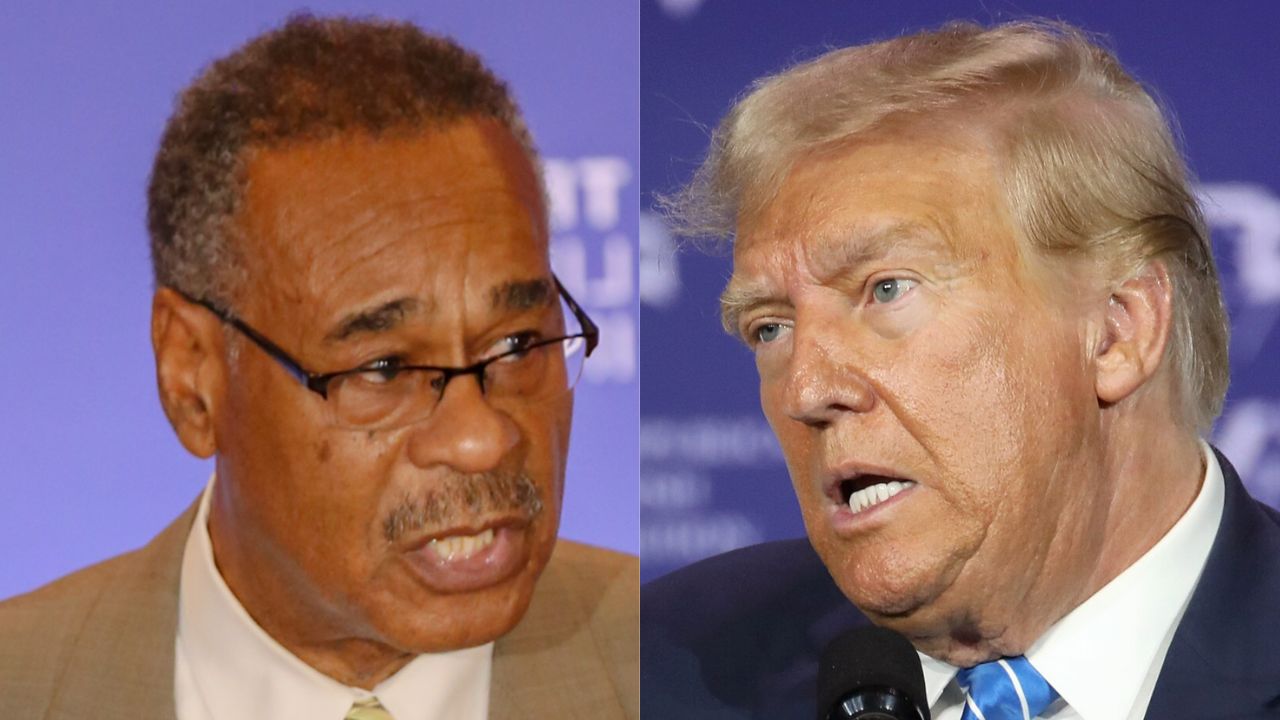
Rep. Emanuel Cleaver (D-Mo.) on Tuesday said “the corruption of this president is staggering” and that “no public official should get rich off insider information,” adding that he continues to support a stock trading ban on the president, vice president and members of Congress. He was responding to reporting that Trump has made more stock trades in his second term than all 535 members of Congress combined.
Cleaver’s complete post, published at 1:52 PM on Oct. 27, 2026, read:
“The corruption of this president is staggering.
No public official should get rich off insider information—which is why I continue to support a stock trading ban on the President, Vice President, and Members of Congress.”
The reporting Cleaver responded to is a Sept. 15 analysis headlined “Trump Has Made More Trades Than All of Congress Combined.” It found that Trump has traded more securities than every member of Congress combined since returning to office, even as he supports a stock-purchasing ban for lawmakers that would exclude him.
The analysis said Trump is the only president this century to disclose active trading of individual stocks, an average of around 80 trades every market day. It said his portfolio now contains thousands of holdings in stocks, bonds and cryptocurrencies, compared with mostly illiquid real estate and private ventures during his first term.
The House bill passed in July covers only members of Congress, their spouses and dependent children, leaving the president free to keep trading. The analysis said Trump declared in his State of the Union address that the House bill should be passed “without delay” so Congress “cannot corruptly profit from using insider information.” The White House declined to comment on Trump’s position on a presidential ban.
The White House response
White House spokesman Davis Ingle said Trump’s portfolio is independently managed by third-party institutions using computer-based model portfolios that replicate indexes like the Schwab 1000. “Neither President Trump nor any member of his family has any ability to direct, influence, or provide input regarding how the portfolio is invested or when investments are bought or sold,” Ingle said.
The analysis noted that in the first three months of the year Trump bought as much as $1.38 million of DoorDash stock. In April, he had the company deliver a McDonald’s order to the White House in an event promoting tax breaks for tipped workers. It said he has also promoted stocks of companies, including Nvidia and Tesla, within a week of purchasing stakes in them. Trump told reporters in July: “Because the stock market’s going up. Everybody’s profiting.”
Trump attacked Sen. Josh Hawley last year after Hawley introduced a bill extending the ban to the president and vice president, calling him a “pawn” who was “playing right into the dirty hands of the Democrats.” The analysis said Hawley was the only Republican to vote for the Senate bill in committee, where Republicans called it a “publicity show” and “legislative demagoguery.”
The legislative landscape
The House passed the Stop Insider Trading Act in July by 232-198, with 13 Democrats voting yes. The Senate failed to advance it on Oct. 1 by a 53-47 vote, short of the 60 needed, with every Democrat voting no. Democrats objected that it exempts the president and vice president and carries a voter ID provision. The Economist/YouGov poll in May found three-quarters of U.S. citizens say lawmakers should not trade stocks.
The bipartisan HONEST Act, led by Sens. Gary Peters and Josh Hawley, would ban members of Congress, the president and vice president from buying stocks immediately and from selling after 90 days, though the president and vice president would not have to divest until 2029. It advanced from committee 8-7 in July 2025 and has stalled on the Senate floor. The 2012 STOCK Act carries penalties that start at $200.
Kedric Payne of the Campaign Legal Center said: “Even if they’re not trading the stock on non-public information, they still create the appearance of a conflict of interest because they can still influence the value of the stock through their official duties.” He also said enforcement against a president would be hard: “it’s questionable how the DOJ would be able to effectively enforce it against the president.”
Cleaver’s record on stock trading
Cleaver co-introduced the bipartisan TRUST in Congress Act on Jan. 15, 2025, which would ban members of Congress from trading individual stocks. He joined the effort in January 2023 alongside Reps. Abigail Spanberger and Chip Roy and 34 other lawmakers, and had cosponsored it in the previous Congress.
In January 2024, Cleaver was among 26 members who signed a bipartisan letter led by Rep. Angie Craig urging Speaker Mike Johnson to bring a congressional stock trading ban to a vote.
His Tuesday post extends his stance explicitly to the president and vice president. A Democratic proposal that would ban stock trading by members of Congress, the president and the vice president has been the target of Democratic calls for a House vote, though the House Republican majority has not brought it up.
The Bloomberg analysis noted that the prospects for a stock trading ban, even one limited to Congress, “appear slim.” With the midterms days away, the issue remains unresolved heading into the next Congress.