
The Navy’s wartime construction battalions were not filled with teenagers. In the early days of World War II, the average Seabee was 37 years old, according to the Naval History and Heritage Command, and most of the first recruits arrived already skilled in a trade.
Those trades built the Navy’s road across two oceans. By the end of the war, NHHC’s history says, a third of a million men had enlisted in the Seabees, and the airfields, piers and fuel farms they left behind are counted in the hundreds.
The figures come from the Navy Department Library’s Seabee history of World War II, published by NHHC. “By the end of the war, 325,000 such men had enlisted in the Seabees,” it says. “They knew more than 60 skilled trades, not to mention the unofficial ones of souvenir making and ‘moonlight procurement.'”
Builders in uniform
The Seabees grew out of a problem Pearl Harbor made obvious. Before the United States entered the war, NHHC says, base construction in the Caribbean and the Americas “was carried out by civilian contractors.” Once the shooting started, NHHC says, “the use of civilian labor in war zones became impractical,” and “the need for a militarized Naval Construction Force to build advance bases in the war zone was self-evident.”
Rear Adm. Ben Moreell, NHHC says, “determined to activate, organize, and man Navy construction units” and won authority from the Bureau of Navigation to recruit the men. The men took their name, NHHC says, from “the initial letters of Construction Battalion,” and Moreell “personally furnished them with their official motto: Construimus, Batuimus — ‘We Build, We Fight.'”
Early Seabees volunteered. That changed at the end of 1942: “After December 1942 voluntary enlistments were halted by orders of President Franklin D. Roosevelt,” the history says, and men for the battalions “had to be obtained through the Selective Service System.” By the war’s end, according to NHHC, “the Seabees were organized into 151 regular construction battalions,” plus special battalions, detachments and maintenance units.
111 airstrips, 441 piers
The Pacific is where the numbers in NHHC’s history pile up. In the North, Central, South and Southwest Pacific, it says, the Seabees built 111 major airstrips, 441 piers and 2,558 ammunition magazines. The same list includes 700 square blocks of warehouses, hospitals to serve 70,000 patients, tanks to store 100 million gallons of gasoline and housing for 1.5 million men.
Across every theater, the history puts the total at “over 400 advanced bases,” built “at a cost of nearly $11 billion and many casualties.” It describes that work as running along “five figurative roads to victory which all had their beginnings in the continental United States”: the South Atlantic, North Atlantic, North Pacific, Central Pacific and South Pacific.
Some jobs ran on a stopwatch. On Espiritu Santo in the New Hebrides, the island closest to Japanese-held Guadalcanal, a Seabee detachment cut a 6,000-foot airstrip out of virgin jungle in 20 days, according to NHHC. At Okinawa, “nearly 55,000 Seabees, organized into four brigades, participated in Okinawa construction operations.” On Tinian, the history notes, the Enola Gay took off “from Tinian’s North Field, which the Seabees had built.”
From Normandy to the Rhine
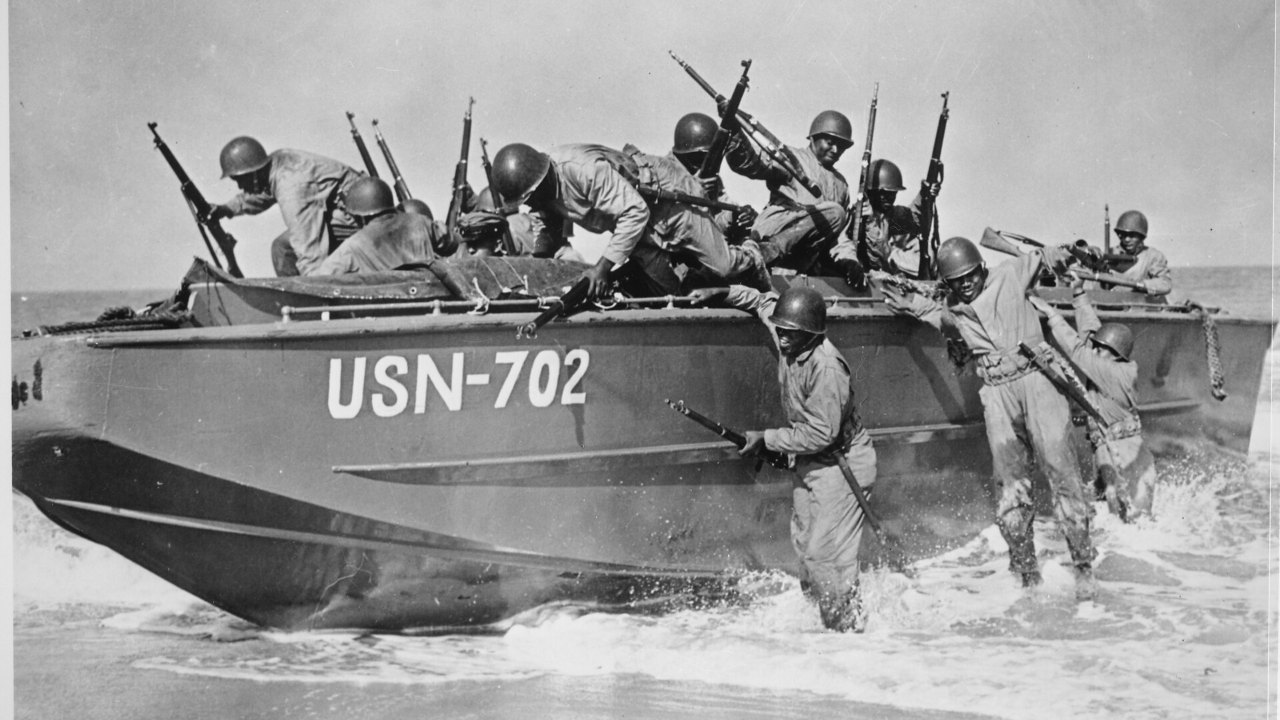
The Atlantic war used the Seabees differently. A March 2017 post on the Navy’s history blog by Lt. Cmdr. Jen Cragg of Navy Expeditionary Combat Command, says that on D-Day, June 6, 1944, Seabees were “among the first to go ashore” as members of naval combat demolition units.
NHHC’s World War II history adds that Seabees placed causeways at Normandy, helped build the Mulberry A artificial harbor, put the ports of Cherbourg and Le Havre back into service, and operated more than 300 craft during the Rhine crossing in March 1945.
What it cost
Construction under fire carried its own losses. NHHC records “272 enlisted men and 18 officers killed in action,” and says “more than 500 Seabees died in accidents, for construction is essentially a hazardous business.” The history credits Seabees with 33 Silver Stars and five Navy Crosses.
NHHC closes its World War II account with the surrender: “On 2 September 1945 Japan formally surrendered.” Its final line is “Thus, the Pacific roads to victory reached their final destination.”