
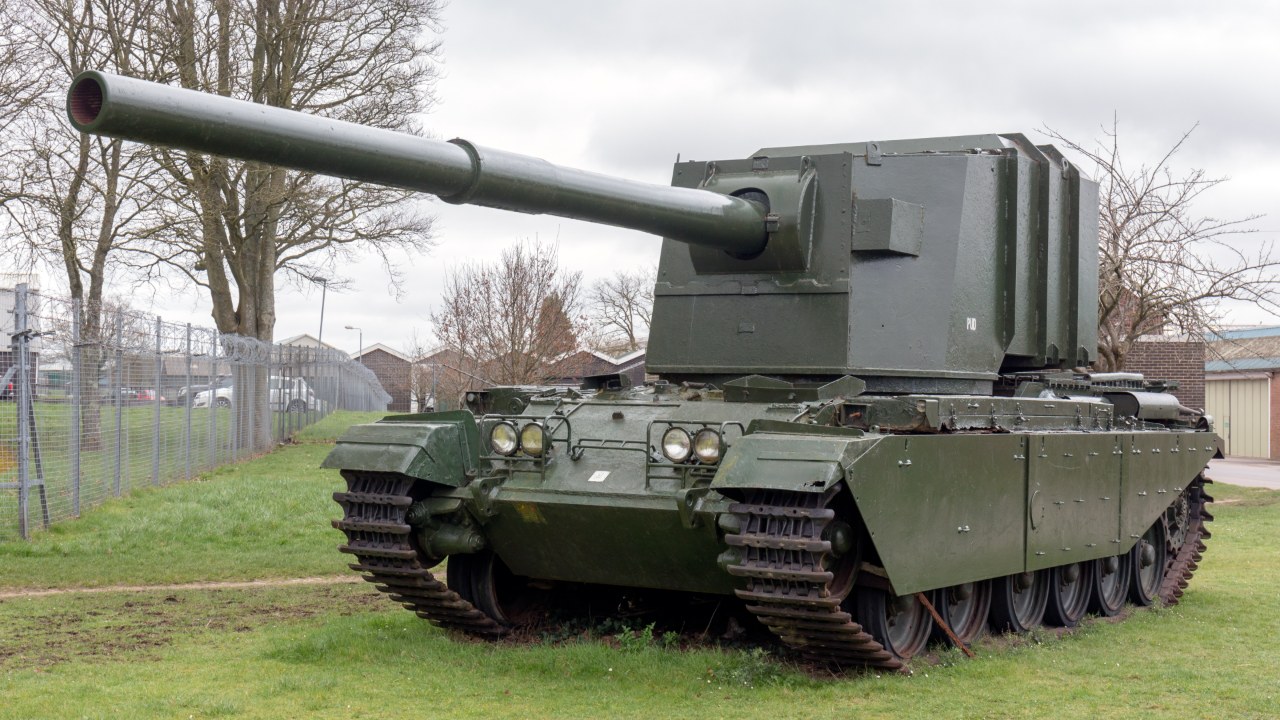
A 183mm bore, 7.2 inches across, sits in a boxy turret on a Centurion hull in Britain’s Tank Museum. The Tank Museum says it is the biggest gun ever fitted to a tank. The FV4005, Britain’s answer to a new generation of Soviet heavy armor, carried just 12 rounds, needed two men to load each one and was cancelled in 1957.
The FV4005 is a case study in a gun outgrowing its tank. The museum’s own account credits the gun with hitting hard and records the price paid for it in ammunition, accuracy and rate of fire.
The museum’s collection entry for the FV4005 puts the headline fact without qualification: “The 183mm calibre L4A1 is the biggest gun ever fitted to a tank.” The entry lists the vehicle’s full name as Heavy Gun Tank Number 1, with a crew of five, a weight of 50.8 tonnes, a top speed of 31.6 km/h (21.5 mph), 76mm of armor and a .50 M2 machine gun as secondary armament.
Built to answer the IS-3
The project began in the late 1940s. According to the museum’s collection entry, it was a British effort to field a long-range, powerful gun “to defeat a new generation of Soviet heavy tanks.” A longer account the museum published on Nov. 16, 2023, “The FV4005,” names the threat: “new Soviet heavy tanks such as the IS-3.”
The requirement was demanding. That article says the gun had to defeat “152mm (6 inches) of armour plate sloped at 60° at 2000 yards.” The answer was a very large gun firing a High Explosive Squash Head round. “The gun was named the L4A1, and the calibre settled on was 183mm, or 7.2”,” the museum writes, giving a muzzle velocity of 2,500 feet per second (762 meters per second).
Two loaders, two rounds a minute
The ammunition explains the crew. The museum’s 2023 article gives the projectile at 145 pounds (65.8kg), with the cartridge case adding 67.75 pounds (30.7kg). Together that is roughly the 97kg, 144cm round cited in the collection entry, which says the FV4005 “needed two loaders” to handle it. The 2023 article explains the division of labor: “a second loader was added to the crew, with each dedicated to loading either projectile or case.”
Speed suffered. “The rate of fire was also too low, at just 2 rounds per minute,” the museum writes. Each shot also put “87 tonnes of recoil force” through the vehicle, according to the 2023 article, which says a recoil spade helped absorb it.
The collection entry is blunt about the tradeoff. The gun was very effective when it hit, it says, “but FV4005 could only carry 12 rounds.” It adds: “It also suffered from poor accuracy at its maximum range of 2000m.”
Stage 1 and Stage 2
The FV4005 went through two configurations on the Centurion Mark 3 hull. “The single Stage 1 turret was a test-bed,” the museum’s collection entry says; the 2023 article adds that its turret could traverse 360 degrees but could be safely fired only within a limited arc to the front.
Stage 2 brought the look the surviving vehicle wears. “The most obvious change was the fully enclosed turret, protected by a 14mm thick shell,” the 2023 article says. Firing trials in 1955 put 150 rounds through the gun with results the museum describes as “satisfactory.”
It was not enough to save the program. “The project was cancelled in 1957 in favour of using missiles,” the collection entry states.
The surviving Stage 2 turret
“The Tank Museum has one of the two FV4005 Stage 2 turrets,” the collection entry says. That turret arrived in 1970 “without the Centurion Mark 3 hull it had been fitted to in service.” In 2007, the museum says, it was mounted on a Centurion Mark 12 hull and placed on display at the museum exit.
The museum’s 2023 article described the vehicle as undergoing restoration to running order, funded in part by donations and merchandise sales. The collection entry now records the result: the vehicle “recently underwent a restoration” and “is now in running order.”
The tank that carried the biggest gun ever fitted to a tank, in the museum’s own words, was cancelled in 1957. What the museum holds is one of the two Stage 2 turrets, on a later Centurion hull and back in running order.
Top image: The FV4005 Stage II at the Tank Museum in Bovington, England, 2017. Image Credit: Morio — CC BY-SA 4.0 / Wikimedia Commons