
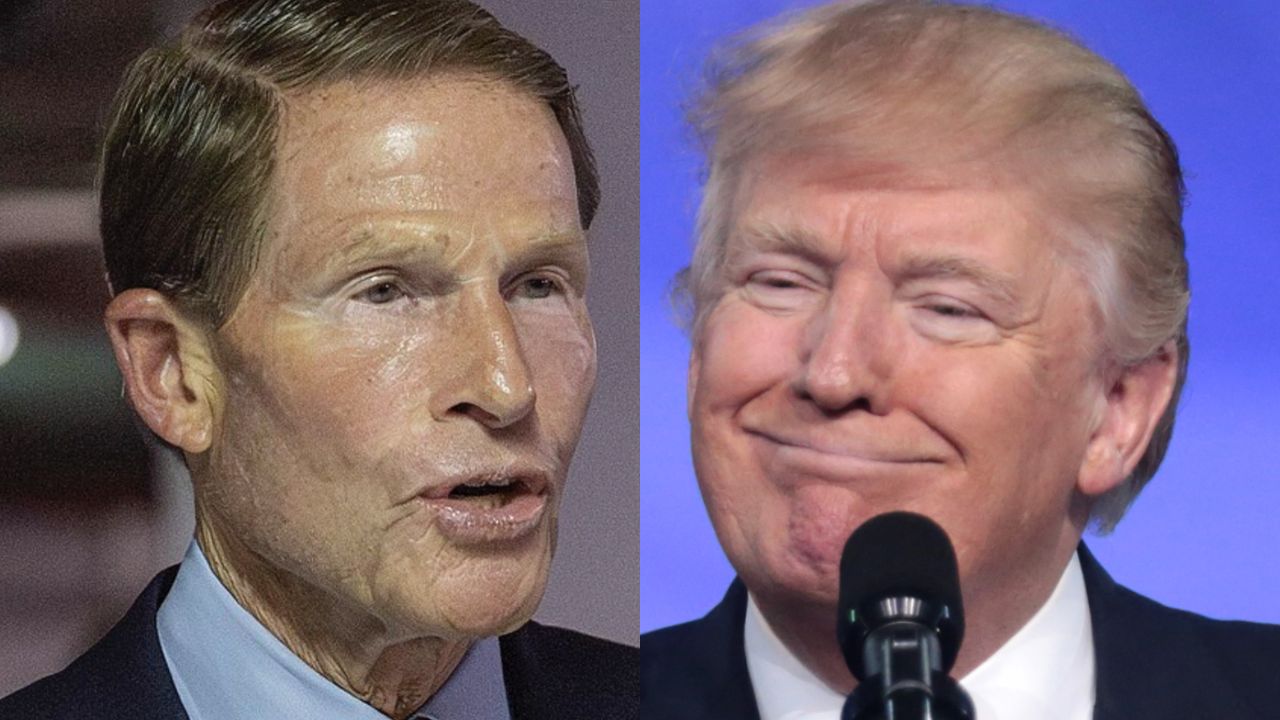
U.S. Sen. Richard Blumenthal of Connecticut said Wednesday that delivering Russian diesel to the Port of New York and New Jersey would violate “a very explicit statute passed in 2022 forbidding imports of Russian fuel,” despite a Treasury Department license issued at President Donald Trump’s direction, as a Greek-owned, Malta-flagged tanker carrying nearly 40,000 metric tons of Russian diesel crosses the Atlantic with its final port still unconfirmed.
“I’m sending a sledgehammer message to shipping companies whose tankers are transporting illegal Russian diesel to our ports. Reverse course while there’s still time,” Blumenthal wrote in a post on X, attaching images of a letter to the tanker’s Greek manager. In thread replies minutes later, he wrote that the delivery would break the 2022 law, that “No President can unilaterally override a statute,” and that Trump’s license “will not absolve you of legal & moral accountability.”
The letter, dated Oct. 27 and addressed to Athanasios (Thanassis) J. Martinos, managing director of Eastern Mediterranean Maritime Limited (EASTMED) in Glyfada, Athens, concerns the Agioi Fanendes. Blumenthal wrote that the vessel left a Russian port on Oct. 22 and, as of Oct. 24, listed a declared destination of the Port of New York and New Jersey with an expected arrival of Nov. 7. He asked Martinos to recall the ship, to refrain from future Russian diesel transactions, and to answer by Oct. 31 which other parties — seller, purchaser, charterer, insurer or P&I provider, terminal operator, or distributor — are involved and whether EASTMED has received direction from the Treasury Department or another federal agency.
Eastern Mediterranean Maritime describes itself as a Greek ship manager offering seaborne transportation to the energy, industrial and agricultural sectors over more than 40 years of operations. EU shipping-emissions records identify Eastern Mediterranean Maritime Limited as the ISM manager of the Malta-flagged Agioi Fanendes (IMO 9798375), a 2019-built chemical tanker of about 29,000 gross tons. Reuters first reported the shipment on Oct. 23. S&P Global Energy, citing its Commodities at Sea data, also reported that the ship left Primorsk on Oct. 22 carrying about 40,000 metric tons of Russian diesel with an expected New York arrival around Nov. 6–7. Ship-tracking service MarineTraffic noted that the vessel’s AIS destination, the location its crew broadcasts, changed on Oct. 23 from New York to “for orders,” industry shorthand for a final port not yet set. An EASTMED spokesperson told the Kyiv Independent that the ship was “proceeding for orders as discharging port is not confirmed yet.” Public AIS data showed the tanker under way in the North Atlantic on Wednesday, still listing “for orders” with an expected arrival of Nov. 7.
Blumenthal grounded the demand in the Ending Importation of Russian Oil Act, Public Law 117-109, enacted April 8, 2022. Section 2 bans importation into the United States of Russian Federation products classified under chapter 27 of the Harmonized Tariff Schedule — covering crude oil, petroleum products and related fuels, including diesel — “in a manner consistent with” Executive Order 14066, which President Joe Biden issued on March 8, 2022, to prohibit imports of Russian-origin crude oil, petroleum, petroleum fuels and related products. Section 3 of the 2022 statute sets a specific path for ending that ban: the president may terminate the prohibition only by submitting a certification to Congress, after consultation and a report, with termination effective 90 calendar days later unless Congress enacts a joint resolution of disapproval. Blumenthal’s letter argues that no executive license can “supersede clear, unambiguous law” and that only Congress can make such imports legally valid.
The Trump administration has authorized Russian diesel under a different instrument. On Oct. 9, President Donald Trump wrote on Truth Social that after a discussion with Russian President Vladimir Putin, Russia would “immediately supply over 300,000 Tons of Diesel Fuel to the American and Global Marketplace, another 500,000 Tons during the month of November, and 1,000,000 Tons immediately thereafter,” with 3,000,000 more tons to follow “within a short period of time,” and that diesel prices would be “COMING DOWN, IN RECORD NUMBERS, AND FAST!” The same day, the Treasury Department’s Office of Foreign Assets Control issued General License 135, which authorizes, through April 7, 2027, transactions “related to the sale, delivery, offloading, or importation, including importation into the United States, of diesel fuel of Russian Federation origin,” while barring debits to U.S. accounts of Russia’s central bank, National Wealth Fund or Finance Ministry. The Treasury said on X it was issuing the temporary license “at President Trump’s direction.”
A week later, Trump signed a separate executive order waiving duties and most sanctions in the Lindsey O. Graham Sanctioning Russia and Iran Act of 2026, including a 500% duty on Russian goods, after certifying the waivers were “in the national interests of the United States.” That order leaves earlier Russia sanctions in place and does not itself create the diesel import pathway; GL 135 does.
Administration officials have defended the diesel opening as a consumer and bargaining measure. Energy Secretary Chris Wright told CNN’s “State of the Union” on Oct. 18 that “if Russia can bring additional diesel to the market and export it, it would benefit American consumers,” according to CNN’s transcript, and that the move was “an incentive to end the war.” Treasury Secretary Scott Bessent told NBC’s “Meet the Press” the same day that “the only thing that has been lifted is the diesel embargo,” per the NBC transcript. Republican Sen. James Lankford of Oklahoma said on the same program, according to the same transcript, that Trump was “trying to walk this fine balance” between pressuring Russia and helping Americans. Other Republicans criticized the broader Graham Act waiver, including Sen. John Cornyn of Texas, who wrote on X that “Helping Putin in Ukraine is reckless.”
Ukrainian President Volodymyr Zelenskyy rejected the diesel arrangement. “This ‘Diesel Deal’ will never be enough to offset the impact of the Strait of Hormuz on global markets. But it will put more money straight into Putin’s pocket to fund this war,” he said in an Oct. 16 European Council address, according to a post on his X account. In another post that day, he wrote, “We can’t accept diesel deals, because gas deals will come next.”
Blumenthal has pressed the issue since the license issued. On Oct. 9 he called lifting sanctions on Russian diesel “an embarrassment” that “makes us complicit in Putin’s war against Ukraine.” On Oct. 13–14 he said online he was leading 12 colleagues demanding that Trump “rescind the disastrous Russian diesel deal.”
U.S. diesel prices remain far above year-earlier levels. The Energy Information Administration’s weekly survey put the U.S. average on-highway diesel price at $6.352 a gallon for the week of Oct. 26, up from $6.276 the prior week and $6.179 on Oct. 12, and $2.634 higher than a year earlier.
The shipment also faces European rules. Malta’s sanctions unit told the Kyiv Independent it was aware of reports about the shipment and that “the relevant attestations are being sought from the vessel’s owners and operators.” Ukraine’s sanctions chief, Vladyslav Vlasiuk, wrote that “an EU-flagged, EU-managed ship may carry Russian diesel only if it was bought at or below the $100 a barrel price cap,” an interpretation a European Commission spokesperson confirmed to the outlet. Asked about the cargo’s value, EASTMED’s spokesperson addressed only its destination.
Neither Martinos nor EASTMED had posted a public reply to Blumenthal’s letter as of Wednesday. The White House and Treasury had not publicly responded to it. The description of the cargo as “illegal Russian diesel” and the claim that GL 135 cannot authorize U.S. imports under the Ending Importation of Russian Oil Act are Blumenthal’s characterizations. OFAC’s license text expressly authorizes importation of Russian-origin diesel into the United States through April 7, 2027; the 2022 statute’s Section 3 termination procedure, by contrast, has not been publicly invoked. Whether GL 135 can lawfully coexist with Public Law 117-109 is a legal dispute the letter asserts but does not settle. The vessel’s loading at Primorsk, its cargo size and its initial New York destination appear in commercial tracking data and in Blumenthal’s letter. Its later switch to “for orders” and EASTMED’s statement that the discharging port is “not confirmed yet” means its final port has not been confirmed.