
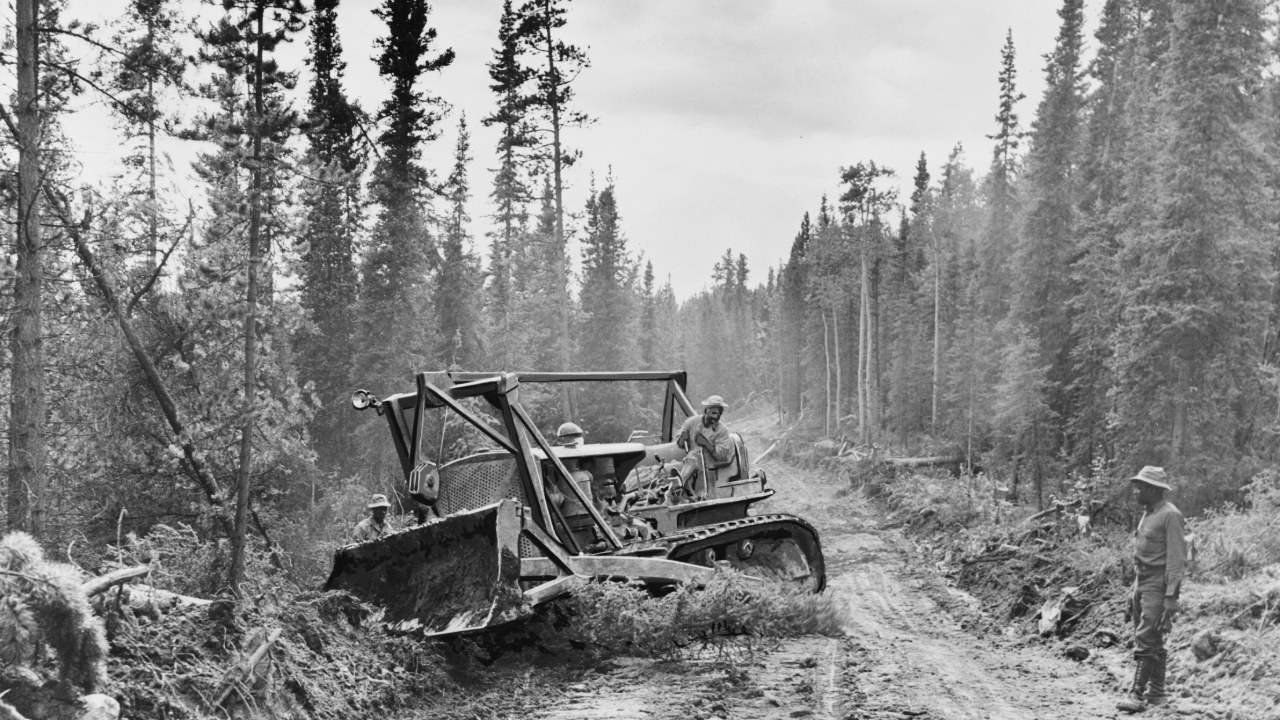
Near Beaver Creek, close to the border between Alaska and Canada’s Yukon, two Army bulldozers working toward each other through the wilderness finally met on Oct. 25, 1942. One belonged to the 18th Engineers. The other belonged to the 97th Engineers, one of three African American regiments on the job. Their meeting was a milestone on the Alaska Highway’s pioneer road, a 1,543-mile route the Army had been ordered to build only eight months earlier.
The road was a wartime project from start to finish, built in segments by separate regiments pushing through forest, muskeg and frozen ground, seven days a week, until the pieces connected.
The Army’s account, “The Alaskan-Canadian Highway,” by Paula Ussery of the Army Heritage Museum, published on army.mil on Oct. 3, 2007, gives the final tally: “The pioneer road totaled 1543 miles with more than 200 bridges and 8000 culverts.” More than 10,000 Army soldiers, Canadian troops and civilians worked through the wilderness “to complete the project in less than a year,” the article says.
A territory that had grown thirty-five-fold
Alaska’s strategic weight had grown fast. Per the Army article, “By September 1941, Alaska’s military population stood at 35,000, a dramatic increase from only 1,000 in 1939.” After Pearl Harbor, the article says, a road link to Canada and the continental United States became a priority.
The Corps of Engineers “was assigned the task of building a rough bush trail and a ‘pioneer road’ on February 14, 1942,” according to the article. The route began at Dawson Creek, British Columbia, “with branches terminating at Fairbanks and Valdez, Alaska.” The specification was spare: “The pioneer road was to be 32 feet wide with single lane bridges.”
Seven regiments, two sectors
The Army split the work into a Northern Sector headquartered at Whitehorse and a Southern Sector headquartered at Fort St. John. “Seven engineer units were assigned to the project,” the Army article records: “the 18th, 35th 340th and 341st Engineers,” “along with the African American 93rd, 95th and 97th Engineers.” A light pontoon company, two engineer topographic battalions and other support units joined them. “Each unit was given approximately a 350 mile section of road to build.”
The ground fought back. The Army article describes extreme temperatures, insects, ice, snow and muskeg, the waterlogged ground of the north. “More than 100 miles of muskeg were corduroyed,” it says, meaning crews laid brush and logs to carry the road. “Despite the obstacles, construction continued seven days a week.” By August 1942, 611 miles were complete; by September, 837.
The 97th Engineers at Beaver Creek
The three Black regiments did that work inside a segregated Army. The National Park Service, in its article “Black History in the Last Frontier: Alaska Highway Engineers,” writes that “black regiments in the segregated military served in subordinate positions” until this point, that “black troops were not typically permitted to use heavy machinery,” and that “they were prohibited from entering towns and were confined to wilderness assignments.” NPS lists the 93rd, 95th and 97th regiments, along with the 388th battalion, as the Black units that deployed to Alaska and Canada.
The NPS article includes a photograph captioned “Meeting of bulldozers at Beaver Creek, Yukon Territory, 25 October 1942.” It names Cpl. Refines Sims Jr. of Philadelphia, of the 97th Engineers, “who won the race with the 18th Engineers,” and Pvt. Alfred Jalufka of Kennedy, Texas, of the 18th Engineers, who offered his congratulations.
The Park Service ties that work to what came after. It notes that the Army “eventually became the first government agency to integrate in 1948,” a step it says is “largely credited in part to the laudable work of the soldiers who built the Alcan.” In 2017, according to NPS, the State of Alaska formally acknowledged the soldiers’ contribution, “setting aside October 25 to honor them.”
Soldiers Summit and after
The official dedication of the Alaska Highway took place at Soldiers Summit on Nov. 20, 1942, “in fifteen degree below zero weather,” per the Army article. The highway served the American and Canadian militaries through World War II, was later opened to civilian traffic and remains in use, the article says. In Alaska, the date the bulldozers met at Beaver Creek, Oct. 25, is the one the state has set aside to honor the Black engineers who helped build it.
Top image: A Caterpillar tractor with a grader widens the roadway of the Alcan (Alaska) Highway, 1942. Image Credit: Office of War Information photo — Public domain / Wikimedia Commons
This article was produced with the assistance of AI and reviewed by Combat Rated editors prior to publication.