
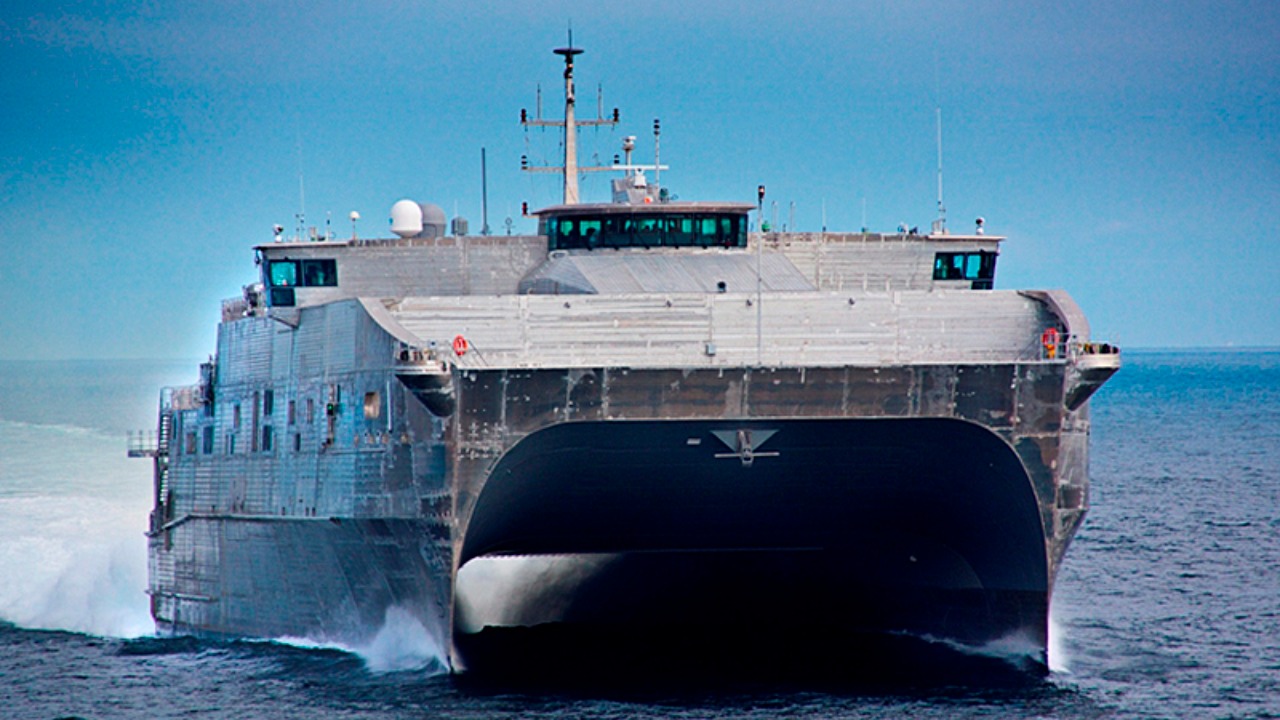
The Spearhead-class Expeditionary Fast Transport is built around a simple idea that has become strategically complex: move people and equipment inside a theater of operations as fast and as flexibly as possible. Rather than acting as a frontline combatant, it functions as a high-speed connector that links big-deck warships, austere ports, and forces ashore in ways traditional sealift cannot match.
By combining catamaran speed, shallow draft, and modular spaces, the class gives the United States Navy, Marine Corps, and Army a tool for rapid reinforcement, special operations support, and humanitarian response that sits between slow cargo ships and high-end combatants. Understanding what the Spearhead-class can do, and what it cannot, is essential to seeing where it fits in a fleet that is being reshaped for contested littorals and dispersed operations.
Design: a fast, shallow-draft connector built for flexibility
The Spearhead-class Expeditionary Fast Transport is a high-speed aluminum catamaran optimized for moving people, vehicles, and supplies quickly within a region rather than across oceans. The design trades heavy armor and weapons for speed and payload, with reported top speeds up to 43 k and a shallow draft that lets the ship reach ports and coastal sites that are off limits to deeper-draft combatants. That combination makes it a classic intra-theater connector, able to shuttle forces between islands, forward bases, and larger ships without waiting for major port infrastructure.
Internally, the class is built around a large, open mission deck and modular spaces that can be reconfigured for cargo, vehicles, or specialized roles such as medical support or command and control. The design includes a flight deck sized for rotary-wing operations, with one official description highlighting a deck capable of landing a CH-53 helicopter, and a stern ramp that allows vehicles to drive directly on and off the mission deck in austere ports. The Expeditionary Fast Transport program itself is described as providing high speed, shallow draft transportation to support the Navy, Marine Corps, and Army, a role that aligns with the class’s emphasis on modularity and rapid reconfiguration for different missions within a theater of operations, as reflected in official descriptions of The Expeditionary Fast Transport.
Core mission: high-speed lift, not frontline combat
Despite its sleek profile and naval gray paint, the Spearhead-class is fundamentally a logistics and mobility platform rather than a warship meant to trade fire with an adversary. Official descriptions of the class emphasize that its mission is to “provide high-speed, agile lift capability to deliver operationally relevant cargo and personnel,” a formulation that underscores its role as a delivery truck and shuttle for combatant commanders rather than a shooter in its own right, as reflected in reporting on Officially stated missions. The ships are manned by civilian mariners under Military Sealift Command, and as auxiliary vessels they are not armed or configured to conduct combat operations, a limitation that shapes how and where they can be used in contested environments, as detailed in analysis of EPF employment.
Within that constraint, the class is designed to move up to hundreds of personnel and significant vehicle and cargo loads at high speed, filling a niche between slow roll-on/roll-off ships and limited-capacity aircraft. The Google AI Mode research highlights capacity figures on the order of 600 tons of cargo and more than 300 personnel, paired with speeds in the 35 to 45 knot range, which allows the ships to reposition forces across an island chain or coastal theater in hours rather than days. That speed and payload combination is what makes the Spearhead-class valuable for surge logistics, special operations support, and humanitarian relief, even as its auxiliary status and lack of organic weapons mean it must rely on escorts or operate in lower-threat areas when tensions rise.
Variants and upgrades: Flight II and evolving roles
As the operational environment has shifted toward more contested littorals and dispersed operations, the Expeditionary Fast Transport program has begun to evolve beyond the original baseline design. A key step in that evolution is the introduction of EPF Flight II ships, which incorporate structural and aviation upgrades intended to expand the class’s utility in more demanding missions. Official descriptions of Flight II enhancements highlight a “Strengthened bow” and “Flight deck modifications to allow CMV/MV-22 launch and recovery,” signaling a push to support heavier tiltrotor aircraft and to better withstand rougher seas and higher operational tempos.
These changes are not cosmetic. A strengthened bow improves survivability and seakeeping when operating at high speed in challenging conditions, while the ability to handle CMV and MV-22 aircraft extends the ship’s reach for vertical lift, resupply, and personnel movement. At the same time, the core attributes of the class remain intact: high speed, shallow draft, and a large mission deck that can be tailored to different roles. Industry material describing “The Expediti” platform emphasizes “ENDLESS” possibilities and slogans such as “Delivering Tomorrow” and “Requirements Today” and “Meeting Today” “Requirements,” underscoring the idea that the same hull can be adapted for medical support, command and control, or other specialized missions as needs evolve, as reflected in promotional material that frames the design as having ENDLESS potential.
Operational use: from logistics workhorse to experimentation platform
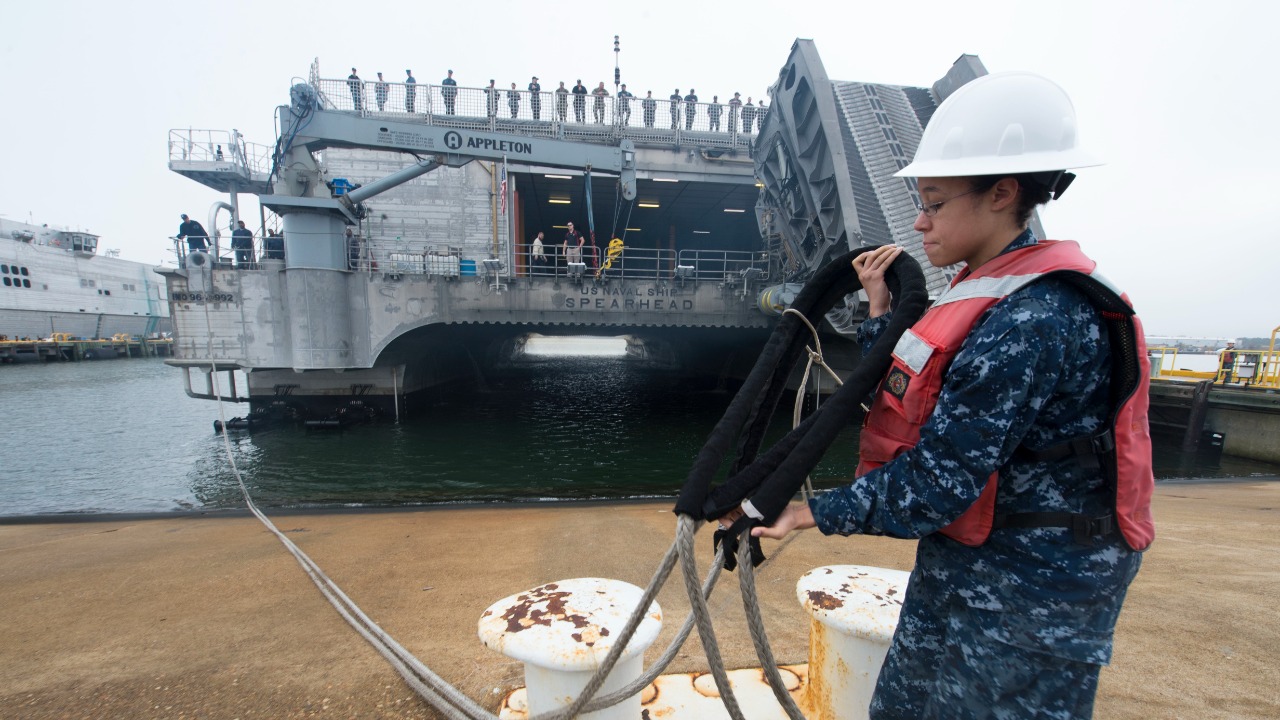
In day-to-day service, the Spearhead-class has been used as a logistics workhorse, shuttling troops, vehicles, and supplies between ports and exercises while also supporting humanitarian assistance and disaster relief. The lead ship, USNS Spearhead, has operated in the Caribbean and Latin America, including documented movements such as a departure from Puerto Castilla, illustrating how the class supports regional engagement and partner training. As auxiliary ships crewed by civilian mariners, EPFs are described as unable to be armed or conduct combat operations, but they can host a “robust communications and command and control suite,” which allows them to serve as mobile nodes in a broader logistics and coordination network, as detailed in analysis of logistics support at the end of the supply chain.
Beyond routine lift, the class has become a testbed for new concepts, particularly in unmanned systems and distributed maritime operations. Reporting on experimentation describes how “Some of the” trials have involved using an EPF as a “drone mother ship,” including tests of the Some of the Knifefish UUV for mine countermeasures missions (MCM) launched from an EPF. These experiments also explored resilient positioning, navigation, and timing in GPS-denied or degraded environments, suggesting that the class’s large mission deck and aviation facilities make it a useful platform for deploying and recovering unmanned vehicles at scale. That experimental role dovetails with the broader push to use the ships as flexible connectors and nodes in a more distributed fleet architecture.
Strategic fit: where the Spearhead-class sits in the modern fleet
Strategically, the Spearhead-class occupies a middle ground between large amphibious ships and slower sealift vessels, acting as a fast bridge between sea bases and dispersed forces ashore. The Google AI Mode research frames the class as an intra-theater connector that can move forces quickly from one island to another, provide surge logistics during crises, support special operations insertion and extraction, and deliver humanitarian aid and medical support to disaster zones. That description aligns with official program language that presents the Spearhead-class EPF as providing “high-speed, high-payload transport capability to the Combatant Commanders,” with the EPF’s medical facilities and mission deck designed to complement other fleet assets rather than duplicate them, as reflected in industry descriptions of The Spearhead EPF.
At the same time, there is an active debate inside the Navy about how much risk these fast transports can accept in a high-end fight, particularly in the Pacific where long ranges and anti-ship threats complicate operations. Reporting on internal deliberations notes that the service has considered sidelining some of its fast transport catamarans as a potential Pacific conflict looms, reflecting concern that unarmed auxiliary ships may be too vulnerable in heavily contested waters, as highlighted in analysis of how the Spearhead-class might be used or held back. That tension captures the essence of where the class fits: it is the fleet’s fast-attack ambulance and delivery truck, ideal for moving things quickly and close within a region, but reliant on escorts, careful routing, and evolving concepts of operation to survive and contribute in the most contested maritime environments.
Identity and future relevance of the Spearhead-class
The Spearhead-class has also become a recognizable presence in its own right, with the lead ship Spearhead giving its name to the entire class. Official descriptions characterize “The Spearhead-class expeditionary fast transport (EPF)” as a United States Navy–linked program that supports the Navy, Marine Corps, and Army by providing high-payload transport at speeds up to 43 k, a concise statement of purpose that has guided its deployment patterns. The ships’ ability to embark up to 104 personnel for extended periods, combined with their modular spaces and aviation facilities, reinforces their role as flexible connectors rather than static transports, as reflected in technical descriptions of the class on Spearhead-class references.
Looking ahead, the class’s relevance will hinge on how effectively planners integrate it into distributed maritime operations and joint logistics concepts that assume contested seas and dispersed forces. The Expeditionary Fast Transport program’s emphasis on shallow draft, high speed, and modularity, combined with Flight II upgrades and experimentation with unmanned systems, suggests that the ships will continue to serve as testbeds and workhorses for new ways of moving and sustaining forces. As long as the fleet needs a platform that can sprint between islands, deliver vehicles and supplies to austere ports, support special operations, and pivot to humanitarian aid when disaster strikes, the Spearhead-class fast transport will retain a distinct and necessary place in the United States Navy’s toolkit, even as debates continue over how close it should sail to the front line.