
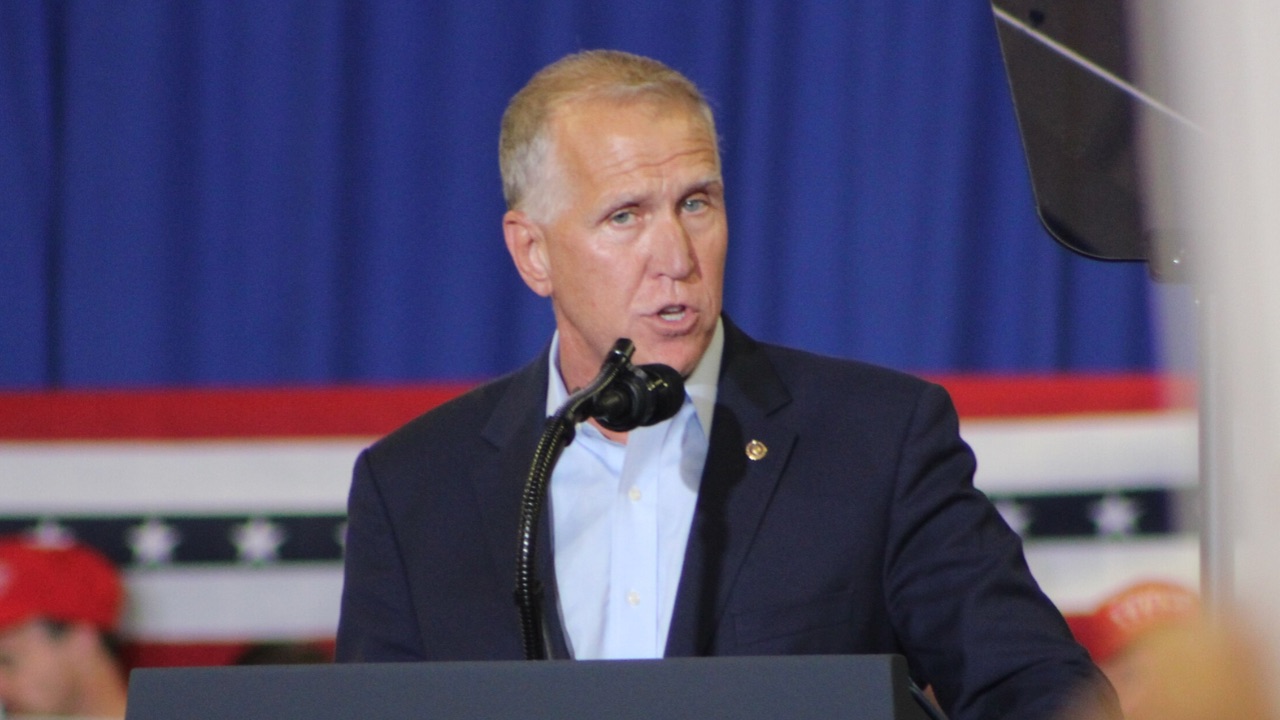
Sen. Thom Tillis (R-N.C.) said he would block President Donald Trump’s nominee to lead the Cybersecurity and Infrastructure Security Agency (CISA), calling him “not a very thoughtful person” after he repeatedly refused to acknowledge that the U.S. Capitol was attacked on January 6, 2021, during a Senate confirmation hearing.
Michael LoSapio, the chief information security officer at Palantir Technologies, told the Senate Homeland Security and Governmental Affairs Committee on Thursday that he did not believe the events of January 6 constituted an attack on the Capitol. He also declined to identify the winner of the 2020 presidential election’s popular vote, prompting criticism from lawmakers questioning his suitability to oversee the federal agency responsible for protecting critical infrastructure, including election systems.
In an interview with The Hill, Tillis said LoSapio’s refusal to recognize the Capitol attack was a straightforward question of judgment.
“It’s binary. The minute you pretend like it didn’t exist or you can’t even acknowledge it, I don’t have any time because it’s not a very thoughtful person,” Tillis said.
The North Carolina Republican’s opposition creates a significant obstacle to the nomination as the Senate approaches the end of the current congressional session. Tillis, who is retiring in January, has said he intends to place a hold on LoSapio’s nomination, according to Federal News Network.
Sen. Ron Wyden (D-Ore.) also announced plans to block expedited consideration of the nomination, creating bipartisan opposition to LoSapio’s confirmation.
“You can’t have an insurrectionist Palantir executive in charge of our nation’s cybersecurity and election security. I will place a hold on Mr. LoSapio’s nomination,” Wyden told Nextgov/FCW.
The controversy emerged during LoSapio’s November 19 confirmation hearing, when Sen. Richard Blumenthal (D-Conn.) asked whether the Capitol had been attacked on January 6, 2021, as Congress met to certify Joe Biden’s victory in the 2020 presidential election.
“I, I don’t know,” LoSapio initially responded, according to the hearing exchange reported by The Hill.
Blumenthal pressed him, asking whether he genuinely did not know. LoSapio then said, “No, I don’t believe it was an attack, no,” adding that he had not been involved in politics.
“You weren’t involved in politics? Were you alive on this planet?” Blumenthal asked.
After LoSapio acknowledged that he was, Blumenthal offered him another opportunity to answer whether the Capitol had been attacked.
“No,” LoSapio replied.
“It was not attacked?” Blumenthal asked.
“No, sir,” LoSapio responded.
Blumenthal also questioned the nominee about the outcome of the 2020 presidential election. LoSapio declined to identify the winner of the popular vote, saying his involvement in the election had been limited to voting for Trump, according to The Associated Press.
Biden won the 2020 presidential election, receiving 306 electoral votes to Trump’s 232, and also won the national popular vote. On January 6, 2021, a crowd of Trump supporters breached police barricades and entered the Capitol while lawmakers were counting electoral votes. The violence interrupted the proceedings, forced lawmakers and then-Vice President Mike Pence to evacuate or seek shelter, and injured numerous law enforcement officers.
The questions carry particular significance for LoSapio’s prospective position because CISA, an agency within the Department of Homeland Security, works with state and local election officials to protect election infrastructure from cyber and physical threats. Its responsibilities also extend to securing critical systems supporting energy, communications, transportation and other essential services.
LoSapio has substantial private-sector technology and cybersecurity experience. In his prepared testimony to the committee, he said he had spent 20 years working in technology and cybersecurity, beginning in systems administration at Seton Hall University and Stevens Institute of Technology.
He joined Palantir in 2013 as a founding engineer for its cloud-hosted environment, later worked at Oscar Insurance and MemSQL, and returned to Palantir in 2017. He became the company’s chief information security officer in September 2024, overseeing teams responsible for security monitoring, incident response, identity management, infrastructure and network protection.
LoSapio also described emergency management experience outside the technology industry, including serving as fire chief of the Warren Township Fire Department and coordinating responses to local emergencies. Before his hearing, the White House defended his nomination by citing his technical qualifications and experience protecting Palantir against threats from foreign governments, according to Nextgov/FCW.
The confirmation hearing also raised questions about how LoSapio would manage CISA’s budget and workforce following significant staffing reductions and changes to the agency’s programs under the Trump administration.
Sen. Elissa Slotkin (D-Mich.) pressed the nominee on whether the agency required additional personnel and funding. LoSapio declined to assess its current resource needs, saying he could not evaluate the agency’s condition without first examining its operations from within.
“I can’t comment on the current state of CISA because I’m not inside today,” LoSapio said, according to Federal News Network’s account of the hearing.
He also argued that increased spending did not necessarily produce better cybersecurity outcomes, emphasizing the importance of allocating resources effectively.
“I don’t necessarily believe more money means more security,” LoSapio said. “I believe spending money on the right solutions in the right ways actually decreases risk.”
The agency has been operating without a Senate-confirmed director for nearly two years. Trump’s previous nominee, Sean Plankey, withdrew in April after his confirmation stalled amid a dispute involving Sen. Rick Scott (R-Fla.) and Coast Guard contracts, according to Nextgov/FCW.
CISA’s leadership vacancy has continued as the agency confronts cybersecurity threats, infrastructure vulnerabilities and questions about its staffing and operational priorities. Federal News Network reported that the agency was working to replace employees who departed during earlier workforce reductions.
Under Senate procedures, a hold allows a senator to signal opposition to expedited consideration of a nomination, including approval by unanimous consent. A hold does not automatically defeat a nominee, and Senate leadership can still pursue confirmation through procedures requiring additional floor time.
However, the objections from Tillis and Wyden complicate LoSapio’s prospects as Republicans face a limited legislative calendar before Democrats assume control of the Senate in January. If the nomination remains pending when the current Congress adjourns, it would ordinarily be returned to the president unless the Senate agrees to carry it over.
LoSapio has not been formally rejected by the Senate, and the White House has not announced a replacement. Tillis’s comments nevertheless make clear that the Republican senator is unwilling to support the nomination following LoSapio’s testimony about the January 6 attack.