
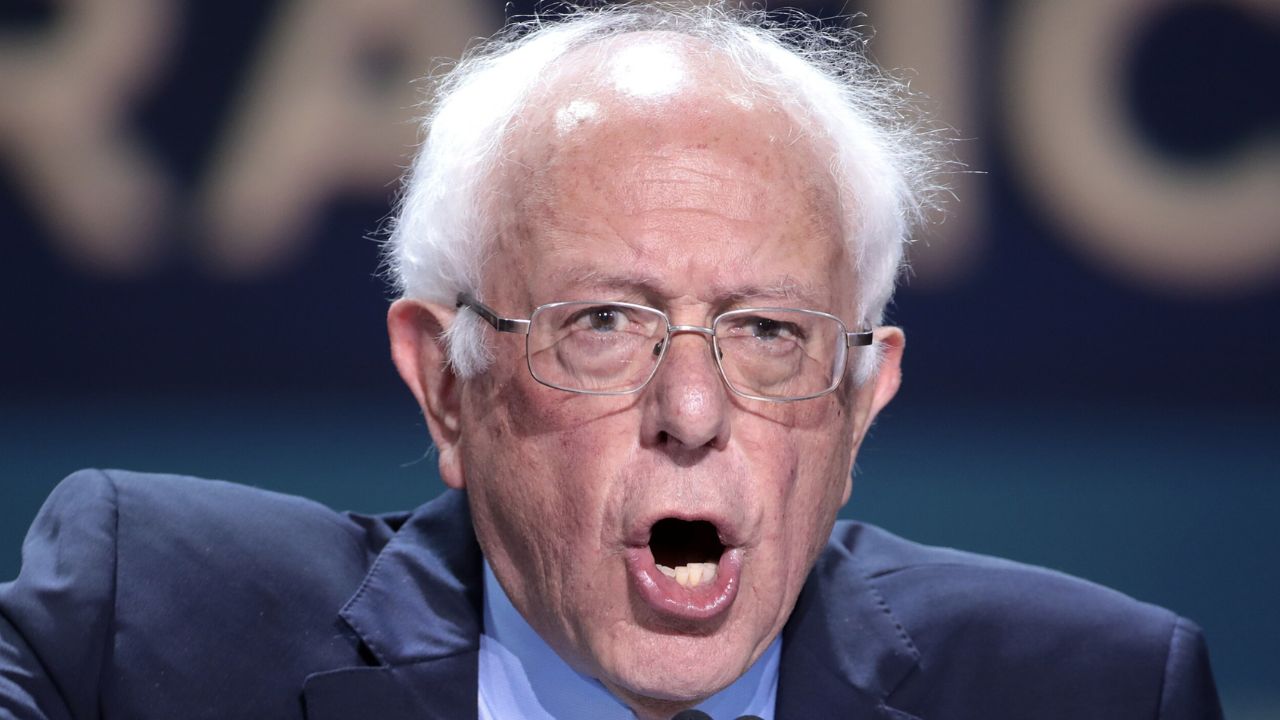
Sen. Bernie Sanders is calling on Americans to use the 2026 midterm elections to hold President Donald Trump and his administration politically accountable, urging voters to end Republican control of both the House and Senate. In a November 3 message, the Vermont independent made clear that he views the election as an opportunity to challenge the administration’s agenda and change the balance of power in Washington.
Sanders published the following statement on X at 6:27 a.m. Eastern time:
“On this Election Day, we must vote to hold Donald Trump and his corrupt administration accountable.
We must end Republican control over the Senate and House. Please get out and vote — and make sure your friends do as well.”
The statement contains three central appeals: holding Trump accountable, ending Republican control of Congress and encouraging widespread voter participation. Sanders is not simply urging Democratic supporters to participate in an ordinary election. He is explicitly connecting the outcome to the ability of Congress to investigate, challenge and constrain the administration during the remaining two years of Trump’s term.
Sanders has spent much of Trump’s second presidency criticizing what he describes as an increasingly concentrated system of political and economic power. In a February 2025 essay published through his Senate office, he argued that defeating Trumpism would require a nationwide grassroots movement rather than relying exclusively on politicians in Washington. He identified oligarchy, authoritarianism and the concentration of wealth as central concerns, while calling for Americans across the country to organize politically.
In that essay, Sanders also pointed to the narrow Republican majority in the House at the time, arguing that a small number of congressional votes could determine whether the administration’s legislative priorities advanced. His argument was that public pressure on lawmakers could prevent the passage of legislation he considered harmful to working families.
His criticism has extended to Trump’s foreign policy, particularly the war with Iran. Sanders has repeatedly challenged the administration’s authority to conduct military operations without congressional authorization and has called for Congress to exercise its constitutional role in decisions involving war. He has supported War Powers resolutions intended to restrict the administration’s military campaign and has argued that the conflict has endangered American servicemembers while creating broader instability.
Sanders has also connected the war to the financial pressures facing American households. On October 1, he joined 19 Democratic senators in urging the Trump administration to increase emergency funding for the Low Income Home Energy Assistance Program, known as LIHEAP, to $7 billion. The lawmakers argued that higher heating costs associated with the Iran war were placing additional pressure on low-income families, older Americans and people with disabilities.
The senators specifically requested an emergency appropriation of at least $3 billion to help households manage heating expenses. Their letter warned that without additional assistance, states could be forced to reduce benefits, turn away eligible families or exhaust their available funding before winter ended. The effort demonstrates how Sanders has attempted to translate his criticism of the war into a domestic spending and affordability debate.
He has also challenged the administration’s handling of military assistance connected to the conflict. Sanders has pursued congressional action to block arms sales and has argued that the president cannot bypass Congress when making decisions with major consequences for American security and foreign policy. His position has consistently emphasized congressional oversight and limits on executive war powers.
The senator’s economic criticism is closely connected to his broader argument about the distribution of wealth and political influence. Sanders has repeatedly argued that working families are facing higher costs while wealthy individuals and large corporations maintain substantial political influence. In his 2025 essay, he described the concentration of wealth among billionaires as a central concern and argued that the political system was increasingly responsive to wealthy interests.
That criticism is part of what Sanders means when he refers to Trump’s administration as corrupt. His November 3 statement does not identify a particular investigation or legal proceeding. Rather, the wording reflects his broader political criticism of the administration and his belief that Republican control of Congress has allowed Trump’s agenda to advance with insufficient oversight.
The election could directly affect that oversight. Republicans currently control both chambers, giving them control of committee leadership, legislative scheduling and the congressional agenda. If Democrats win the House, they would gain the ability to lead investigations and exercise subpoena and oversight authority through committees. A Democratic Senate majority would also change committee leadership and the chamber’s control over legislation and nominations.
According to Reuters’ Election Day reporting, Democrats need to gain at least three House seats and four Senate seats to take control of both chambers. All 435 House seats and 35 Senate seats are being contested. Polling and nonpartisan election forecasts have favored Democrats in the House, while the Senate outcome has remained less certain.
Sanders’ call to end Republican control is therefore tied to a concrete political objective: changing who controls the committees, legislative agenda and oversight responsibilities in Washington. A Democratic majority would not automatically reverse Trump’s policies, and legislation would still face the president’s veto authority and other procedural requirements. However, it would create a different congressional environment for investigating the administration and challenging its priorities.
His final appeal is directed beyond his own supporters. By telling voters to make sure their friends also participate, Sanders is emphasizing turnout as an essential part of the Democratic effort to win congressional seats. The message reflects his long-standing preference for broad grassroots political mobilization rather than relying solely on elected officials to produce political change.
The November 3 election is consequently a major test of the strategy Sanders has promoted throughout Trump’s second term. His message frames the result as a decision about whether Republicans should continue controlling Congress or whether Democrats should take over and use their new position to hold the administration accountable.