
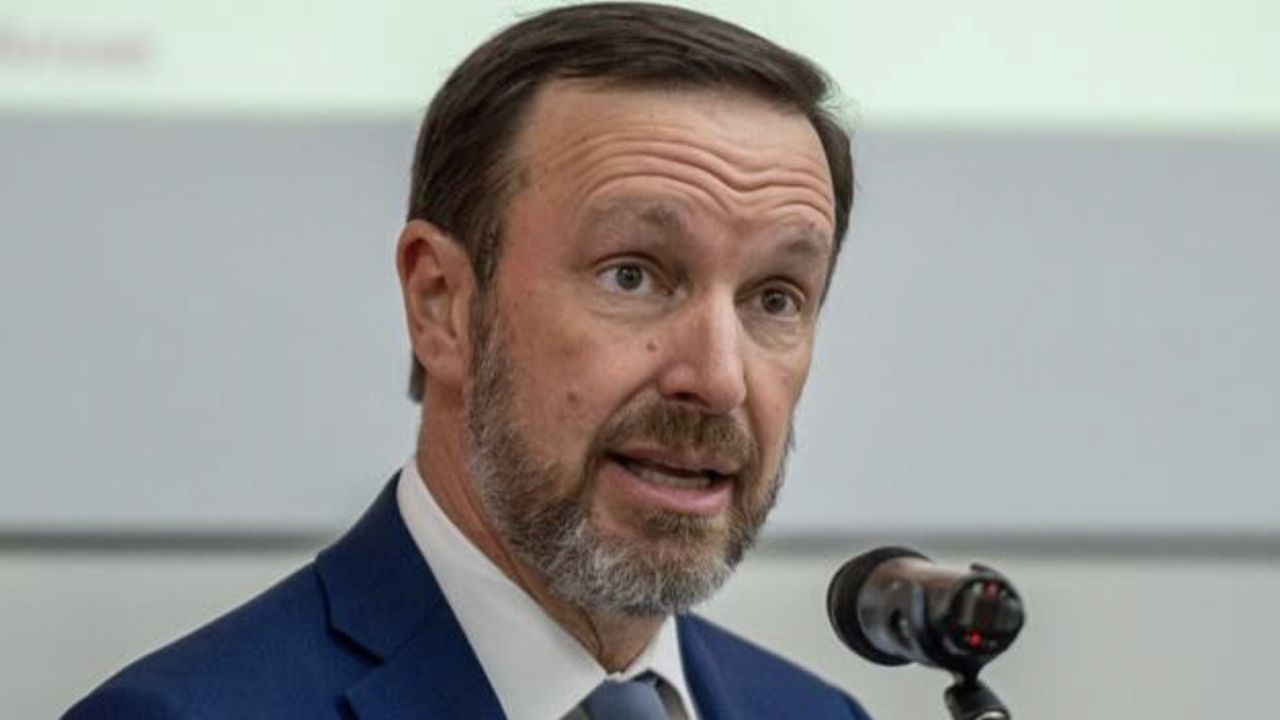
Sen. Chris Murphy, D-Conn., said Wednesday that the Department of War’s refusal to let him visit Al Udeid Air Base in Qatar or speak with military leaders in the Gulf is “just very clearly a cover-up” meant to keep Americans from seeing the damage the Iran war has done to U.S. bases, speaking at a Middle East Institute debrief in Washington on his early October congressional trip to Qatar and Saudi Arabia.
“I really, to this day, have not heard a credible explanation from the administration as to why they have a policy of denying us access to bases when we are in the region,” Murphy said at the event, which was moderated by Missy Ryan of The Atlantic and broadcast by C-SPAN. “They have sort of sniffed around the edges of an argument about not having the resources or about protecting our safety, but none of it holds up to scrutiny.”
He said he had been in Baghdad “during the height of the surge” and visited forward operating bases in Afghanistan “during major military operations,” arguing that those trips undercut the safety and resource explanations. “This is just very clearly a cover-up,” he said. “They do not want the American people to understand the damage that’s been done to these bases.”
Murphy, a member of the Senate Foreign Relations and Appropriations committees, said the denial also cut him off from commanders. “They don’t want members of Congress to have the opportunity to directly talk to our military leadership and our troops in the region because that is where we often get the unvarnished truth about what is possible and what is not possible,” he said. “I was not only denied access to Al Udeid, but I was also denied the ability to talk to any Department of Defense leaders, any military leaders in the region while I was there.”
He said his office made a formal request and that he followed up in person with Adm. Brad Cooper, the commander of U.S. Central Command. “When I told him that I was even being denied access to a briefing, he was surprised and told me that he would go back and review that decision,” Murphy said. “But by the time I got there, apparently his request to review that decision was of no avail.”
Murphy first made the accusation during the trip. In an Oct. 7 office release issued as he was leaving Riyadh, he called the Al Udeid denial unprecedented in his two decades in Congress and said Secretary of War Pete Hegseth’s department was hiding “the consequences and the true costs of the Iran war.” A day later, in a longer Oct. 8 press release, he said there was “an active cover-up going on right now” and that Hegseth was “determined to hide the cost and the consequences of this war from the American public.”
On his X account after the trip, Murphy wrote that Hegseth had ordered a bar on base entry and meetings with military leaders “to hide the cost of the war.” In a follow-up post the same night, he said a request for a substitute briefing at the embassy was refused because the policy “prohibited military leaders in the region from even talking to me.”
In a day-by-day account of the trip that his office released Oct. 10, Murphy wrote that Al Udeid, the largest U.S. base in the region, “sustained significant damage from Iranian strikes,” and that “if Americans are going to be asked to send billions of dollars for repairs, I wanted to see the damage with my own eyes.”
A senior Department of War official gave a different account. In a statement provided to Connecticut public radio station WSHU, the official said Murphy’s office “was informed before his trip to the Middle East that he would not receive Department of War support to access Al Udeid Air Base, consistent with the Secretary of War’s directive on travel restrictions in the region ordered on March 3, 2026.” The official said the Office of the Secretary of War for Legislative Affairs communicated the decision in advance and that “the Department applies the Secretary’s guidance evenly.”
A senior Defense Department official gave the same statement to Military Times. That report also said Al Udeid had been damaged by drone strikes during the Iran conflict and that State and Defense department travel guidance in early March advised Americans to leave parts of the region, including Qatar.
Murphy has acknowledged that he was told before he left that base access would not be supported, but he says he departed Washington expecting at least a military briefing in the region. WSHU reported that he confirmed the advance notice at an Oct. 8 press briefing and that no briefing was provided. At Wednesday’s event, he contrasted the Pentagon’s handling of the trip with the State Department’s. “The State Department did support our visit,” he said. “They did allow me to see the damage that had been done to the embassy in Riyadh.” He called it “an important contrast between the State Department, which is supporting our right of oversight and the Department of Defense, which is engaged in the cover-up.”
The Middle East Institute said Murphy traveled to Qatar and Saudi Arabia to assess the Iran war’s regional impact and met Qatari Emir Sheikh Tamim bin Hamad Al Thani and Saudi Crown Prince Mohammed bin Salman, describing him as the first Democratic senator to visit the Gulf since the conflict began. Murphy’s Oct. 8 release said his office reached out weeks in advance, followed with a written request focused on Al Udeid, and that he spoke personally to Cooper before leaving.
Murphy has said he plans to seek language in appropriations and defense authorization bills requiring that members of Congress be given access to overseas bases. Military Times quoted him saying he does not expect such language to pass before the end of the year but expects it to shape next year’s funding and authorization debates.
The “cover-up” charge is Murphy’s characterization of why he was denied access and briefings. The Department of War says the Al Udeid bar followed a March 3 directive restricting travel in the region, that Murphy’s office was told in advance, and that the guidance is applied evenly. Both sides agree that he was refused entry to Al Udeid and received no military briefings in the region during his October trip. They disagree over whether the refusal reflected a security policy applied to everyone or an effort to conceal war damage and costs.