
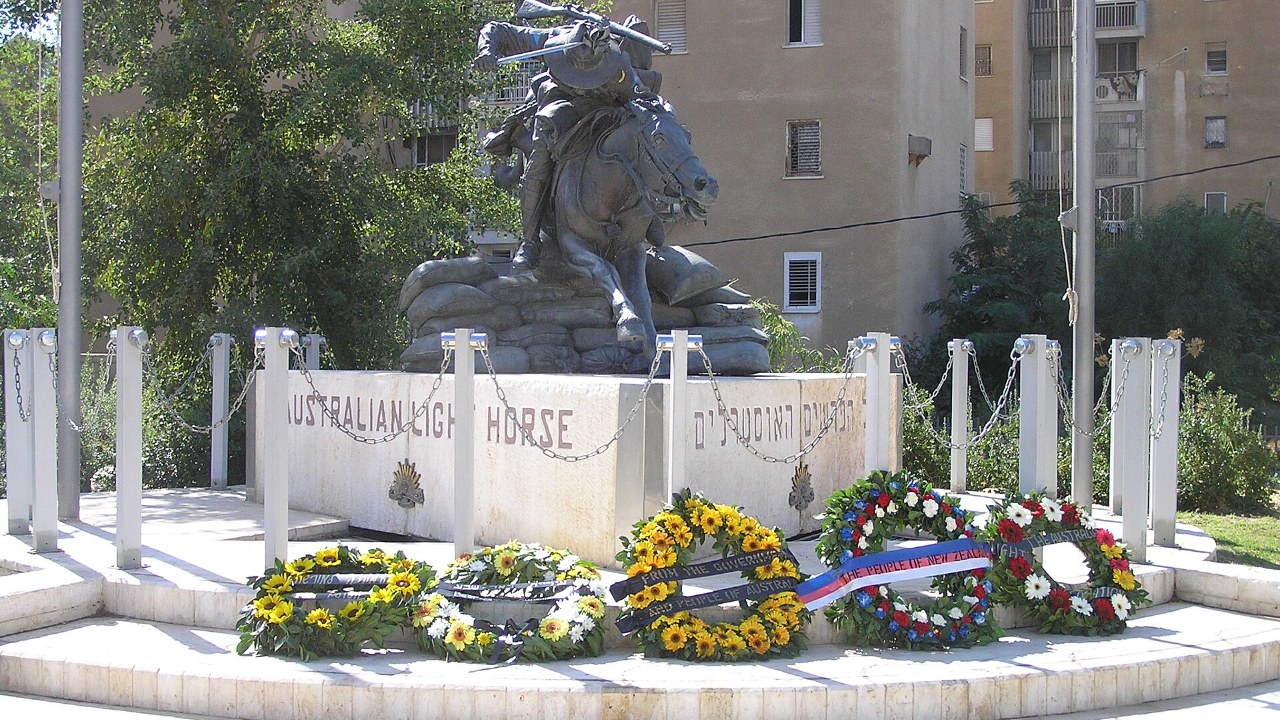
With the light failing on Oct. 31, 1917, two regiments of Australian light horsemen went at the Turkish trenches outside Beersheba at the gallop. They carried no sabres, only long bayonets, and they were after something more valuable than ground: the town’s wells.
The charge of the 4th Light Horse Brigade took the town before dark and broke open the Ottoman line that had held through two failed British attacks on Gaza earlier that year. The Australian War Memorial counts its cost in the two charging regiments at 31 killed and 36 wounded.
Those figures, and the capture of more than 700 prisoners, come from the Australian War Memorial’s account of the battle, which calls it “the last great cavalry charge.” The Memorial’s other published histories of the day, cited below, agree on the casualty count.
A line that would not break at Gaza
Beersheba anchored the eastern end of the Turkish defensive line that ran from Gaza on the coast. Two frontal attacks on Gaza, in March and April 1917, had failed, the Memorial’s encyclopedia entry says; taking Beersheba would let British Empire forces outflank the line instead of hitting it head-on again.
Water drove the plan. A Memorial history of the charge, drawing on notes by Ashley Ekins of its Military History Section, says Lt. Gen. Sir Harry Chauvel, commanding the Desert Mounted Corps, located old wells at Asluj using Palestine Exploration Fund records and local informants, and took about a fortnight to restore them. On the night of Oct. 30, about 40,000 Allied troops moved toward Beersheba on a night march of more than 40 kilometers. The horses carried loads averaging about 120 kilograms and would have no water until the town fell, according to that history.
The defenders were not numerous, but they were dug in. The Memorial’s history puts the garrison at about 1,000 riflemen with nine machine guns and two aircraft. Its trenches on the east and south had no barbed wire, a detail aerial photographs had revealed, according to the AWM London account.
The order at 3:30 p.m.
The day did not go to plan. British 20th Corps infantry attacked from the west and south at dawn with more than 100 guns in support, and by 1 p.m. had driven the Turks from the western and southwestern defences, but the wells were still in Turkish hands, the Memorial’s history says. Anzac Mounted Division troops did not take Tel el Saba, about 3 kilometers east of the town, until 3:15 p.m.
At 3:30 p.m., with only a few hours of light left, Chauvel ordered Brig. Gen. William Grant’s 4th Light Horse Brigade to attack, according to the Memorial’s history of the charge. Grant chose a mounted charge rather than the light horse’s usual approach of riding up and dismounting to fight. German bombing scattered the brigade on its way forward, and it did not reach its start position until 4:50 p.m., the AWM London account says.
The 4th Light Horse Regiment formed on the right, the 12th on the left and the 11th in reserve. It was, the Memorial says, the first time the Australian Light Horse was used purely as cavalry. The horsemen went from trot to gallop under shrapnel; British artillery silenced Turkish machine guns on the flank. Some troopers jumped the front and main trenches, others dismounted and attacked from behind, and other squadrons rode straight into the town.
Most of the 4th Regiment dismounted at the trenches and fought on foot, while about 150 men of the 12th Regiment got through to Beersheba itself, led by Captain Robey with Captain Jack Davies following, according to the Memorial’s history.
The wells, the prisoners and the cost
The prize was largely intact. Nearly all of Beersheba’s wells were taken undamaged, and a recent storm had filled nearby pools, the AWM London account says. The Memorial’s history notes that retreating Turkish forces blew up a locomotive and one well.
The prisoner count varies a little across the Memorial’s own pages. The AWM London account says the brigade captured over 700 prisoners. The Memorial’s encyclopedia entry lists 38 Turkish and German officers and “about 700 other ranks,” and its history of the charge gives a range of 700 to 1,000.
On casualties the pages agree: 31 light horsemen killed and 36 wounded. The encyclopedia breaks that down as two officers and 29 other ranks killed, and eight officers and 28 other ranks wounded. Among the dead, the Memorial’s history records, were Edward Cleaver, who had enlisted in 1914, and Albert “Tibbie” Cotter, the Australian cricketer. At least 70 horses died.
The capture turned the Gaza–Beersheba line. Turkish forces began withdrawing from Gaza on Nov. 6 after severe fighting, according to the encyclopedia, and British troops entered Jerusalem on Dec. 9, 1917, the AWM London account says.