
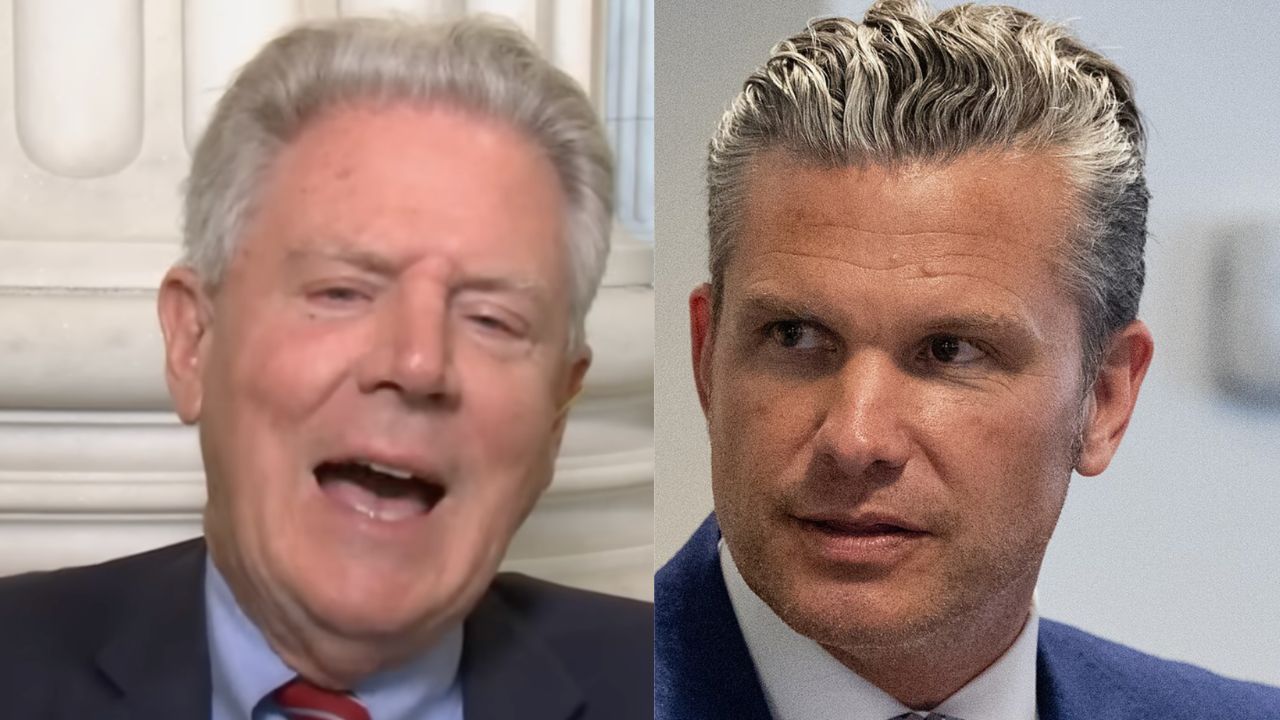
U.S. Rep. Frank Pallone Jr., the New Jersey Democrat who serves as ranking member of the House Energy and Commerce Committee, condemned the Pentagon’s plan to livestream the firing squad execution of Fort Hood shooter Nidal Malik Hasan on Sunday, declaring that the rule of law cannot be turned into a violent media spectacle and calling the proposal “barbaric.” The post is a direct rebuke of Defense Secretary Pete Hegseth, who said the Dec. 3 execution would be “public.”
Pallone made the remarks in a post on X at 9:12 a.m. on Sunday, Oct. 11, 2026. The full post read:
“There’s a reason the United States has not publicly executed someone in nearly a century—much less by firing squad. The rule of law cannot be turned into a violent media spectacle, and our children don’t deserve to live with the memory of a public execution.
It’s just barbaric.”
Pallone attached to the post a report from The Associated Press detailing the Pentagon’s announcement. The post makes three distinct arguments: that the United States has long avoided public executions, that the legal system should not be staged as entertainment, and that children should not be left with the memory of watching the state kill someone.
The Plan Behind the Post
Hegseth, speaking to the conservative outlet Real America’s Voice this week, said of the execution, “We’ll make sure that people are able to watch it, that it’s public.” The Army announced that the execution would take place at Fort Hood on Dec. 3. Pentagon spokesperson Sean Parnell said earlier in the week that President Donald Trump had approved it.
Pentagon officials clarified on Thursday that the execution would be livestreamed, with more details to follow. The White House referred questions about the plan to the Pentagon. Hegseth has said soldiers with rifles would carry out the sentence at 1 p.m., the same hour Hasan opened fire at the Texas Army base in 2009, and has said the public nature of the execution is meant to show that there are “serious consequences for these types of things.”
Hasan, a former Army psychiatrist with the rank of major, was convicted of killing 13 people and injuring 32 others in the Nov. 5, 2009, shooting at a medical building on the base, where soldiers were waiting for immunizations and medical clearance for deployment. His execution would be the first carried out by the U.S. military in more than 65 years. The last military execution took place on April 13, 1961, when Army Pvt. John Bennett was hanged, and Hegseth has said the military has not executed a service member by firing squad since World War II.
Pallone’s Argument
Pallone’s reference to “nearly a century” points to a long gap in American practice. The last widely recognized public execution in the United States took place in Kentucky in 1936. His warning about children also touches a specific rule. Army regulations bar anyone under 18 from witnessing a military execution, and the number of permitted witnesses is limited to victims, their family members, the prisoner’s lawyer and at least two members of the news media.
Sen. Jack Reed of Rhode Island, the top Democrat on the Senate Armed Services Committee, said a public execution would require Trump to approve a waiver of that policy. Trump said on Friday that he “absolutely” approved of the execution but had not made a determination on showing it by livestream. Vice President JD Vance said he would not “be watching” a livestream and added that he did not know whether it would happen.
Condemnation Across Party Lines
Pallone’s criticism echoes a wave of objections from lawmakers in both parties. Reed called the plan “a barbaric spectacle” and said it was a stunt meant to distract from failings in Hegseth’s tenure. Sen. Chris Murphy, a Connecticut Democrat, asked during a television interview whether Hegseth was mimicking ISIS executions and called public executions “medieval.”
Several Republicans also broke with the Pentagon. Sen. Thom Tillis of North Carolina, who has said he regrets his 2025 vote to confirm Hegseth, said Hasan should face the death penalty but called the broadcast “beyond disgusting,” adding that public executions are what dictatorships like Iran and Afghanistan carry out. Rep. Austin Scott of Georgia, a member of the House Armed Services Committee, said he supports the death sentence but not livestreaming it. Rep. Andy Ogles of Tennessee took the opposite view and called a public execution what the “terrorist deserves.”
The United Nations human rights office also objected, with a spokesperson saying that broadcasting the execution would be “tantamount to a public execution” and would breach the absolute prohibition of torture. FCC Chairman Brendan Carr said his agency would defer to Hegseth on whether U.S. networks could air it.
Legal Experts Weigh In
Legal experts offered mixed assessments of the plan. Deborah Denno of Fordham University said a livestream could make capital punishment “much more transparent,” while Elisabeth Semel of UC Berkeley Law said she did not recall a case in which the government itself instigated a televised execution and described the plan as spectacle. Brenner Fissell of Villanova Law said firing squads can be quicker and cleaner than other methods but argued the choice reflects the “lethality culture” Hegseth has promoted.
The timeline also remains uncertain. Eugene Fidell of Yale Law School said Hasan could file a habeas petition in civilian court that could delay the execution well beyond the current administration. Hasan, however, leaked documents during his trial in which he told military mental health workers he could “still be a martyr” if executed, and his lawyers during the trial concluded his goal was a death sentence.
A Contrast With Trump’s Own Words
The plan also sits awkwardly beside Trump’s past criticism of Iran. Trump spoke out against public executions there, at times citing the killing of protesters as a rationale for military action before he attacked Iran on Feb. 28. Amnesty International reported at least 17 public executions worldwide in 2025, 11 of them in Iran and six in Afghanistan.
The announcement also follows a broader federal expansion of execution methods. The Justice Department announced in April that firing squads would be a federally permitted method, and the Trump administration has sought death sentences against 44 defendants. Five states currently permit firing squads: Idaho, Mississippi, Oklahoma, South Carolina and Utah.
Pallone’s Record on the Iran War
Pallone has been a consistent critic of the administration’s handling of the Iran war. In a March 5 statement explaining his vote for the House War Powers Resolution, he said the Constitution is clear that only Congress can declare war, recalled his 2002 vote against the Iraq War authorization, and said decisions about war belong to the American people’s representatives. He added that service members had already died in a war Congress never authorized.
Hegseth has faced sustained Democratic opposition over the war. On April 15, House Democrats led by Rep. Yassamin Ansari of Arizona introduced six articles of impeachment accusing him of “high crimes and misdemeanors,” including launching the Iran war without congressional authorization. The Pentagon dismissed the effort as “just another Democrat trying to make headlines,” and with Republicans controlling the House, the articles were not expected to pass.
The Pentagon has said more details about the livestream will follow, and the execution remains scheduled for Dec. 3 at Fort Hood.