
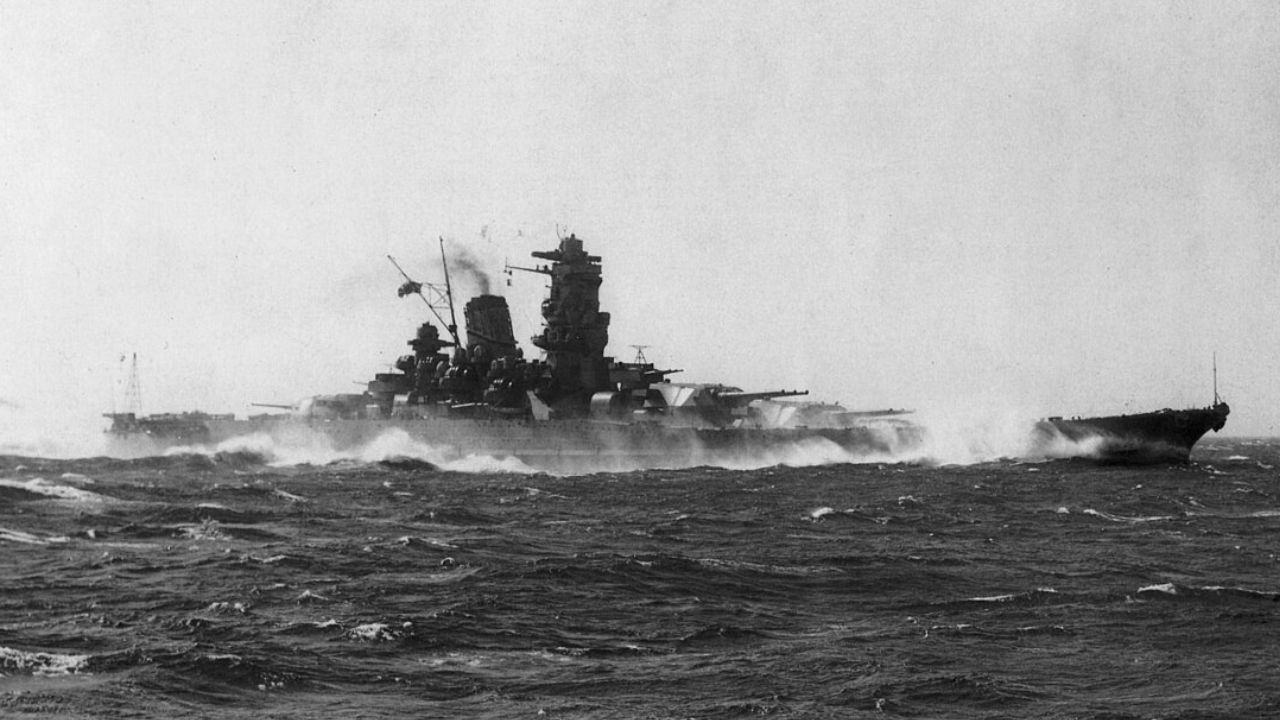
The IJN battleship Yamato is often treated as the ultimate expression of big-gun naval thinking: a warship built at immense scale to win a decisive surface battle. Its legacy, however, is inseparable from the way naval warfare was changing around it. The Yamato-class is widely cited as the largest battleship ever built by full-load displacement—depending on which measurement state a source uses—and Yamato was ultimately destroyed not by another battle line, but by massed carrier air power. That contrast is the point: peak battleship design arrived just as aircraft could find, fix, and strike major surface units repeatedly.
Because “largest” can be measured different ways, it’s worth being explicit about the metric. Guinness World Records frames the Yamato/Musashi standard at roughly 71,659 tons at full-load displacement and 263 m length, while Wikipedia likewise lists Yamato at 71,659 t (full load). Those numbers anchor the superlative without pretending there is only one yardstick—and they underline the scale of national effort invested in a platform whose survival increasingly depended on air cover and the ability to control the airspace above it.
IJN battleship Yamato and the Yamato-class
Yamato was the lead ship of Japan’s Yamato-class and is widely described as the largest battleship ever built when comparisons are made using full-load displacement, as reflected in Wikipedia’s overview. The strategic logic behind the class was decisive-battle thinking: build a ship that could outgun and outlast opponents in a surface engagement. The irony, also captured in Wikipedia’s framing, is that this “peak battleship” entered a battlespace where air power was already making even the biggest surface combatants increasingly vulnerable.
That vulnerability is not a matter of trivia. The significance of Yamato is that it shows what happens when industrial scale is concentrated into a single concept of combat power while the center of gravity shifts elsewhere. A battleship’s armor and guns mattered most when the fight could be forced into the range and geometry of surface gunnery. By 1945, the more reliable way to apply force at sea was increasingly from the air, at distance, with repeatable strikes.
“Largest battleship ever built” metrics (full-load displacement and length)
Guinness World Records credits the Yamato/Musashi benchmark at about 71,659 tons full-load displacement and 263 m in length, while Wikipedia also lists Yamato at 71,659 t (full load). The editorial caution is straightforward: “largest” can mean different things (standard vs. full-load displacement), so the defensible claim is the one tied to a stated measurement state rather than a generic superlative.
Those measurements also help explain why the ship became such a consequential symbol. The larger the platform, the larger the strategic wager behind it—and the higher the risk if warfare evolves faster than the platform’s assumptions about survivability. In Yamato’s case, that assumption was that the decisive fight would be a surface engagement where size, armor, and gun caliber could be brought to bear.
The 46 cm (18.1-inch) Type 94 main battery
The Yamato-class carried nine 46 cm (18.1 in) Type 94 guns, which Wikipedia notes are often described as the largest naval guns ever mounted on a warship. This was the class’s defining expression of overmatch: not incremental improvement, but a deliberate attempt to dominate the surface fight Japan expected to face.
But overmatch only matters if it can be applied. By the final year of the war, the key question was less whether Yamato could win a gun duel and more whether it could survive being located and attacked repeatedly by aircraft. In that environment, main-battery dominance did not guarantee the chance to fight on favorable terms.
Operation Ten-Go (Ten-ichi-go): the one-way sortie
Japan’s response to the Okinawa invasion included Operation Ten-Go, which sent Yamato with escorts toward Okinawa in April 1945, as described by the U.S. Naval History and Heritage Command (NHHC) and discussed in U.S. Naval Institute (USNI) coverage of the Imperial Navy’s final sortie. The operation is widely framed as a last ride—explicitly a one-way sortie—defined by strategic desperation at a moment when Japan could not plausibly guarantee the kind of air cover a capital ship needed.
Retellings often compress the mission into a single motive or a single intended end state. Here, the safer reading is narrower: the sources support the shape of the problem. A battleship optimized for a different era was being pushed into an environment where the enemy’s decisive arm was airborne, and where the ship’s ability to reach its objective would be contested primarily by carrier aviation.
Task Force 58 carrier aviation on 7 April 1945
According to Wikipedia’s summary, Yamato was sunk by American carrier aircraft during Operation Ten-Go on 7 April 1945. USNI’s discussion of the final sortie reinforces the central analytical point: the carrier could mass aircraft, strike at distance, and then reattack until the target was overwhelmed. That is less a slogan than a description of how carrier task forces converted deck space into repeatable, coordinated combat power.
For Yamato, this meant the fight was not defined by a single exchange of salvos. It became an attritional problem shaped by repeated strikes—an engagement model in which a battleship’s gun caliber could not, by itself, prevent continued attack cycles once the ship was found and engaged.
Strike scale and counting differences: “~280” vs “386” aircraft
NHHC’s H-gram material illustrates both the scale of the carrier strike and why reported numbers can vary. One Navy history account describes Task Force 58 launching a first wave of about 280 aircraft and then additional waves, while another NHHC publication chapter states carriers launched 386 planes that day. These figures should not be blended into a single “definitive” number, since they can reflect different counting methods—aircraft launched versus aircraft that attacked, or total sorties across multiple waves.
Even with that caution, the operational takeaway is consistent across the accounts: carrier aviation could generate mass quickly and sustain pressure through follow-on waves. That scaling is central to the story because it shows how air power could concentrate effect against a single surface unit and keep striking as the situation developed.
USS Bennington (CV-20)
NHHC’s H-gram narrative names aircraft attacking Yamato from USS Bennington (CV-20), giving the story a concrete deck-to-target linkage rather than a vague “U.S. planes did it.” The specificity matters because it shows the attack as an organized system: carrier, air group, launch cycle, and strike coordination—each part enabling the next.
In practical terms, the carrier functioned as a mobile airfield that could bring combat power to the battleship. That advantage was not just reach but repetition: the ability to launch, recover, and launch again as the fight unfolded.
USS Hornet (CV-12)
The same NHHC account also identifies USS Hornet (CV-12) as a source of attacking aircraft. Naming Hornet alongside Bennington helps clarify how carrier task forces operated as a networked striking force—multiple decks contributing aircraft into the same engagement rather than relying on a single carrier’s air group.
That structure matters for understanding why a lone surface unit could be overwhelmed. The attacker did not depend on one “make-or-break” strike from one ship. Pressure could be sustained and renewed, and the engagement could continue across multiple waves.
USS Yorktown, USS Intrepid, and USS Langley (TG 58.4 in the cited narrative)
NHHC’s H-gram narrative further lists later groups including USS Yorktown, USS Intrepid, and USS Langley, described there as part of TG 58.4. Carrier/task group attributions can vary across authors and sources, so the cleanest approach is to keep this list explicitly tied to the NHHC narrative that names it. Even with that caveat, the picture remains clear: multiple carriers contributed to an extended strike cycle.
This is the broader mechanism behind the headline’s claim. The “air power that sank it” was not a single aircraft or a single deck, but a carrier system that could coordinate, mass, and keep returning—turning a heavily armed battleship into a high-value target facing repeat attacks.
Losses and outcome framing (per NHHC): lopsided exchange
NHHC’s H-gram summary frames the outcome in stark exchange terms: Task Force 58 sank Yamato (and other ships) with very low U.S. losses—described in that narrative as the loss of ten aircraft and 12 men. Loss figures are often debated or rounded in broader retellings, so the responsible way to use these numbers is exactly as presented here: as an attribution to NHHC, not as an uncontested absolute.
What the sourced framing supports is the larger conclusion. By full-load displacement, the Yamato-class sat at the top of the battleship era, armed with nine 46 cm Type 94 guns—and it was still brought down by concentrated carrier aviation on 7 April 1945. Yamato endures as a case study in how quickly dominance hierarchies can change at sea: the most imposing surface ship afloat could be neutralized when the decisive combat system was airborne, scalable, and able to strike again and again.