
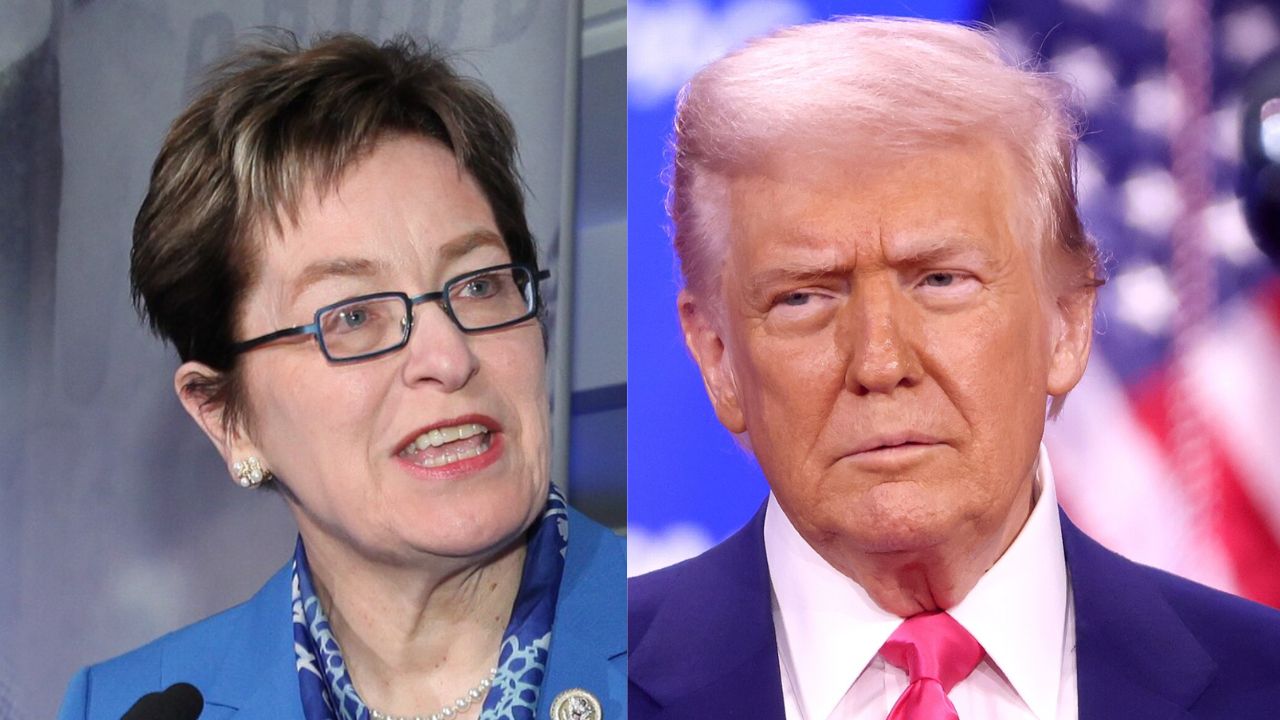
U.S. Representative Marcy Kaptur (D-OH), the longest-serving woman in the history of Congress, issued a sharply worded statement on Saturday accusing President Donald Trump of piling a new trade war against Canada on top of what she has repeatedly called an unauthorized “war of choice” in Iran, warning that both conflicts will leave ordinary Americans to bear the cost.
Kaptur’s statement came in response to a Reuters report confirming the United States had imposed 50% tariffs on roughly $20 billion worth of Canadian goods after trade talks between Washington and Ottawa collapsed, with each side blaming the other for the breakdown. The tariffs took effect just after midnight Saturday.
The Full Statement
Posting to X on Saturday, August 22, 2026, at 5:45 p.m., Kaptur wrote:
“His endless war of choice in Iran isn’t enough, now the President is launching a fresh trade war on our ally Canada, and we will once again pay the price. This new 50% tariff is a dire and unacceptable threat to our Great Lakes economy. The GOP must rein in this destructive reckless Administration.”
Background On The Collapsed Trade Talks
The tariffs Kaptur is responding to followed three days of negotiations in Washington between Canada’s minister for U.S. trade relations, Dominic LeBlanc, and U.S. Trade Representative Jamieson Greer. According to Reuters, the two sides appeared close to an agreement hours before talks fell apart, one that sources said would have lowered tariffs on steel, aluminum and autos and potentially returned American alcohol to Canadian liquor store shelves.
Canadian Prime Minister Mark Carney announced he had suspended negotiations and ordered Canadian negotiators to return to Ottawa, saying in a statement that “last-minute changes in the U.S. proposed terms were unfair, uneconomic, and called into question the reliability of any deal.” Carney pledged Canada would retaliate “dollar for dollar” against the new duties. Greer, for his part, told reporters at a White House briefing that Canada had “declined to finalize the trade deal under the terms agreed earlier this week,” calling it “a missed opportunity for Canada to partner with the United States.”
A senior Trump administration official told Reuters that the U.S. offer would have placed Canada in the best tariff position of any major exporter to the United States, but that Canadian negotiators had pushed for additional concessions on steel, aluminum, autos and softwood lumber. No further talks were scheduled as of Saturday.
Carney, speaking to reporters Saturday, called the new tariffs “a miscalculation,” saying the U.S. had “asked too much, and offered too little” in the final round of negotiations. Canada has pledged $25 billion to protect Canadian workers and businesses affected by the American tariffs.
Kaptur’s Long-Running Opposition To Trump’s Iran War
Kaptur’s Saturday statement is the latest in a monthslong campaign against what she has consistently described as an illegal and unauthorized war in Iran. When U.S. strikes on Iran first began on February 28, 2026, Kaptur, a senior member of the House Appropriations Subcommittee on Defense, said the Trump-Vance Administration had “singularly launched a regime change war on Iran and deployed US military forces and assets by fiat without Congressional authorization,” adding that “no authorization for the use of military force in Iran was passed by either chamber of Congress.”
In April, after Trump warned that “a whole civilization will die tonight” in reference to Iran, Kaptur said the president had launched his war “promising to liberate its 93 million people from a tyrannical regime,” only to later “threaten to annihilate them.” She called the rhetoric “unhinged saber rattling” and said Trump was “using the might of the United States military to wage war without constitutionally mandated approval from Congress.”
By early June, Kaptur and a bipartisan coalition forced a vote on the House floor aimed at ending the conflict. “Today after months of dawdling and delay, we finally got a vote in the House and passed bipartisan legislation to bring an end to the President’s war of choice in Iran,” Kaptur said, adding that Trump had “promised lower costs and an end to costly foreign wars, but he has done the exact opposite,” pointing to the tens or hundreds of billions of taxpayer dollars spent on the conflict.
More recently, after the Pentagon changed how it counted American casualties in the conflict, Kaptur wrote on X that “the President can’t erase the cost of his reckless war by changing how the deaths of 4 service members killed in action are counted,” calling the move “shocking” and insisting Americans “deserve transparency, not tricks and games when brave soldiers’ lives are lost.”
A Pattern On Canada And The Great Lakes Economy
Saturday’s statement also fits a pattern of Kaptur defending U.S.-Canada trade relations throughout the Trump administration. In February 2026, after Trump threatened to delay the opening of the Gordie Howe International Bridge connecting Detroit and Windsor, Ontario, Kaptur said “degrading the Gordie Howe Bridge is just the latest example of this Administration driving the car backwards, hurting an economy that was already straining America’s workers,” noting that Canada had paid entirely for the bridge’s construction and that the Great Lakes freshwater economy is the third-largest in the world.
She struck a similar note in March 2025, when Trump first proposed 25% auto tariffs on Canada, Mexico, South Korea, Japan and Germany, saying the administration needed to “do more to address the US manufacturing and technology job washout in the automotive and transportation industries” and calling for the United Auto Workers to be given “a seat and a say at the table” in any trade strategy.
As Co-Chair of the bipartisan House Great Lakes Task Force, Kaptur traveled to Ottawa in September 2025 for talks with Canadian counterparts, describing Canada as Ohio’s largest trading partner and noting that trade between Canada and Ohio totaled $38.9 billion, supporting more than 300,000 jobs in the state. She and her office have repeatedly referred to the two countries’ shared economic region as “The Great Lakes Nation,” calling it the third-largest economy in the world.
Broader Context
The new tariffs mark a sharp escalation in tensions between Trump and Carney, who was elected last year on promises to stand up to the U.S. president and remains broadly popular domestically; polls have shown most Canadians oppose making further concessions to Washington. The dispute also complicates prospects for a broader renegotiation of the U.S.-Mexico-Canada free trade agreement, which is due for review.
The tariffs come as Trump’s Iran policy also faces continued scrutiny. A recent PolitiFact analysis found that despite Trump’s claim of having achieved “the essential denuclearization of Iran,” Iran likely retains materials and machinery capable of producing nuclear weapons, and the 2026 war has produced a harder-line Iranian government less amenable to a negotiated nuclear settlement.
Kaptur’s Saturday statement did not specify what congressional action she believes Republicans should take against the new tariffs, but it continues a consistent line of argument from her office: that the Trump administration’s foreign and trade policy decisions are being made without adequate congressional input, and that the economic and human costs are falling disproportionately on working-class communities in Ohio and across the Great Lakes region.