
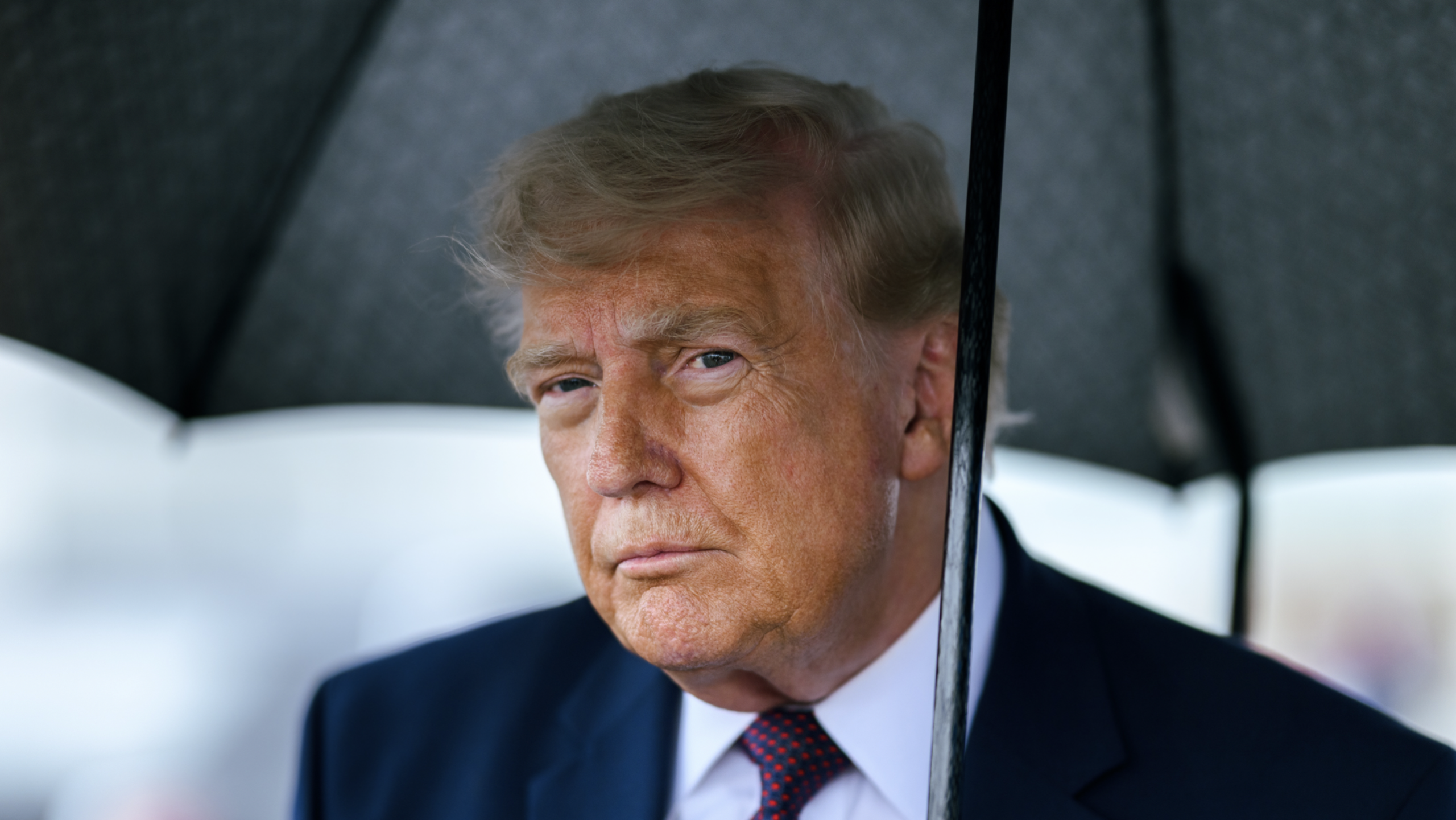
President Donald Trump on Friday made one of his most sweeping personal claims yet about his own treatment by the federal government, telling reporters at a Cabinet meeting that he was “probably” abused more than anyone in American history, even as he insisted the money at the center of a stalled Justice Department fund was never meant for him.
Asked about a Truth Social post from earlier in the day in which he said victims of government weaponization should be compensated, Trump pivoted immediately to defending the broader concept behind the fund. “I’m talking about the weaponization of large numbers of people by the Biden administration,” he said, describing a group whose “lives have been ruined” and whose “families have been decimated,” adding that some had “gone to prison for no reason whatsoever.”
The fund in question, a roughly $1.8 billion pool established as part of a settlement agreement between the IRS and Trump’s personal legal team, was designed to compensate people who claimed to have been targeted by federal law enforcement, including individuals prosecuted in connection with the January 6, 2021, Capitol riot. It has drawn bipartisan criticism since its creation, with lawmakers in both parties calling it a slush fund that risked benefiting the administration’s political allies.
Trump was emphatic Friday that the fund was never intended to benefit him personally, pointing instead to the political violence he says he and his family have endured, including at his Mar-a-Lago residence. “This fund was not for me. This fund was for those people that have been weaponized, that have been abused. They attack my house, Mar-a-Lago, where I live,” Trump said, adding that “big damages should have been given to me,” but that he did not want anything for himself.
It was in that context that he made his broader historical claim. “I think there’s a group of people in this country, history will show that were treated like nobody else has ever been treated. So badly, so horribly,” Trump said, before adding of his own experience: “I probably was abused more than anybody in the history of our country.”
Trump: I probably was abused more than anybody in the history of our country. pic.twitter.com/qaBVajuZkW
— Acyn (@Acyn) July 31, 2026
The fund has become the central obstacle to the Senate confirmation of Todd Blanche, Trump’s nominee for attorney general, who currently serves as acting attorney general. Two Republican senators on the Judiciary Committee, John Cornyn of Texas and Thom Tillis of North Carolina, have withheld their votes, saying they will not support Blanche’s confirmation until they receive written assurance that the fund is permanently dead and that a related tax-immunity provision shielding Trump and his family is narrowly defined.
Blanche has testified under oath before the committee that the fund is dead and that he will not release any of its money, and that the audit-immunity provision does not extend beyond the original lawsuit or to future actions by federal agencies other than the IRS. Cornyn has said he wants that testimony formalized in writing before he will vote to advance the nomination, and the committee postponed a planned vote this week as negotiations with the Justice Department continued.
At the Cabinet meeting, Trump defended Blanche as the wrong person to be caught in the middle of the dispute, describing him as an unusually capable pick who is being used as leverage in a fight that predates his nomination. “Todd Blanche, he’s a very very good man and he shouldn’t be in the middle of this. He should get approved because you will never get anybody like him,” Trump said. “To make him a pawn in this whole thing, this is being done by a senator.”
Trump did not name Cornyn directly in that portion of his remarks but made clear he believed the senator’s opposition was personal rather than principled, tying it to his own decision to endorse a primary challenger against Cornyn earlier this year. “I endorsed his opponent. As soon as I endorsed his opponent, his opponent went through the roof and won the primary,” Trump said. Cornyn lost his Texas Republican primary this summer after Trump backed a rival candidate.
Trump characterized Cornyn’s continued opposition to Blanche as a byproduct of that political defeat rather than a genuine policy disagreement, though he said he understood the reaction. “The man that lost, the man I didn’t endorse, has become very angry, and that’s okay. I probably would do the same thing. I think I’d do the same thing,” Trump said.
When a reporter followed up by asking whether Trump agreed with Blanche’s own assessment that the fund was dead, Trump offered a more ambivalent answer, suggesting he still believed compensation was warranted even if the mechanism for delivering it was gone. “I wish it weren’t, to be honest with you,” Trump said of the fund’s demise. “I think people were horribly treated, horribly abused. Horribly abused and I’d like to see them compensated for the pain.”
He again invoked the toll he says the prosecutions took on the people involved, including deaths by suicide among those who faced legal consequences tied to political rallies. “They committed suicide. Many people committed suicide. They went down for an innocent journey,” Trump said, describing what he called the weaponization of government under the Biden administration as having “destroyed lives.”
Asked about the scope of the audit-immunity provision that Cornyn and Tillis want narrowed as a condition for confirming Blanche, Trump again returned to the personal rivalry with Cornyn, describing the senator’s past praise for him turning to resentment after the primary loss. “Don’t forget the senator thought he was phenomenal when I lost,” Trump said, seemingly a reference to Cornyn’s prior support before their falling-out. “When he lost, he lost because of me.”
Beyond the fund, Blanche’s confirmation has also faced separate resistance tied to his prior role as a defense attorney in the criminal case of Jeffrey Epstein, with a group of Epstein survivors pressing senators to oppose his nomination over his handling of the case and his treatment of them, according to Senate aides. Combined with the unresolved fund dispute, that opposition has left Blanche’s path to confirmation uncertain heading into August, with the Judiciary Committee’s Republican majority narrowed following the recent death of Sen. Lindsey Graham.
Trump’s Friday remarks reiterated a position he had staked out on social media hours earlier, in which he called for Blanche to be “immediately approved” as attorney general while continuing to defend the fund’s original intent, even as the administration works to finalize written language that would formally close the door on its revival.