
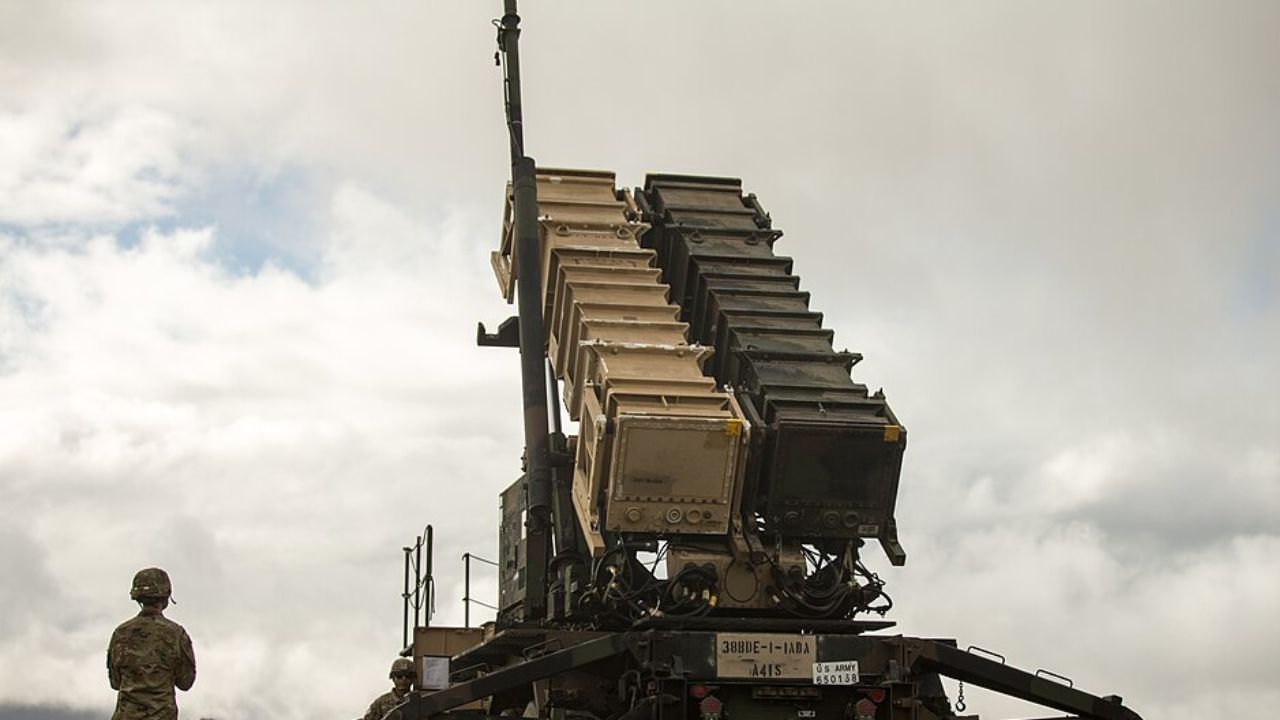
The Patriot (MIM-104) missile defense system is often described as a single weapon that “shoots down missiles.” In reality, Patriot is a system-of-systems: radar, command-and-control, communications, power, and launcher-mounted interceptors designed to work together. That integrated architecture—along with the tradeoffs it imposes—helps explain why Patriot remains a central air and missile defense capability for the U.S. Army and a sought-after system among NATO and partner countries.
Patriot’s continued relevance also reflects the modern threat environment. Recent conflicts have underscored how drones and missile barrages can pressure air defenses, pushing planners toward layered defense rather than reliance on any single “perfect” shield. In that layered approach, Patriot is typically used to defend fixed sites and key assets such as population centers, air bases, logistics hubs, and critical infrastructure.
What Patriot is (and isn’t)
Patriot is a long-running, U.S.-origin surface-to-air missile defense program used to counter aircraft and certain missile threats. It is produced and modernized by Raytheon (RTX) and fielded by the United States and a broad international user base. Its mission is not to “cover a whole country” continuously, but to protect prioritized areas based on what commanders decide matters most at a given time.
It is also not an impenetrable dome. Effectiveness depends on the system’s configuration, the threat type, radar line-of-sight, crew proficiency, rules of engagement, and how many threats arrive at once. Public debates about Patriot can also hinge on different definitions of “success,” ranging from a hard kill to a neutralization or diversion that reduces damage.
How it works: detect, track, decide, engage
At a high level, Patriot follows a repeatable process: detect a target, build and maintain a track, decide whether and how to engage, then guide an interceptor in an attempt to defeat the threat. The key point is that the “weapon” is the battery as a whole. The launcher does not make the engagement decision on its own; that decision is made through the system’s command-and-control element using sensor data and, when available, information from the broader network.
The detect-and-track phase depends on radar coverage and the ability to hold a reliable track long enough to support an intercept attempt. In practice, performance is influenced by emplacement, terrain, clutter, and line-of-sight. Public discussion often compresses this into a single range figure, but real engagement conditions are situation-dependent, and many specifics are not publicly detailed.
Radar and the limits of geometry
Patriot’s radar is foundational: it searches for targets, refines tracks, and supports engagement planning. But radar coverage is constrained by physics and geography. If the radar cannot see a target because of line-of-sight limits, terrain masking, or poor placement, the interceptors cannot compensate for that missing picture.
This is a frequent point of confusion. A launcher may be visually prominent, but real-world coverage depends on how the battery is emplaced, what the radar can observe from that location, and how well the system is connected to other sensors and command nodes. Those factors—along with identification requirements and rules of engagement—can shape outcomes as much as the interceptor itself.
Command-and-control: where the fight is managed
Patriot’s command-and-control element turns radar tracks into decisions. It helps classify and prioritize targets and supports engagement choices, particularly during complex raids that can include drones, cruise missiles, aircraft, and ballistic missile threats. In an integrated air and missile defense (IAMD) approach, that same command-and-control function is also where Patriot can contribute to a broader shared air picture rather than operating as an isolated battery.
These decisions matter because air defense is often a resource-management problem under severe time pressure. Interceptors are expensive and limited, and commanders must decide what to shoot at, when to shoot, and how many shots to take. When attacks become saturated—many threats arriving within a short window—those choices become even more consequential, and no single system can guarantee a perfect defense.
Launchers and interceptors: the visible component
Launchers are the part most people recognize: canisters aligned and ready to fire. But a launcher is best understood as the delivery mechanism for interceptors that are cued and controlled by the rest of the system. Without the radar picture, communications, and command decision chain, the launcher is simply equipment in place.
Patriot interceptors have evolved over time, and public reporting often distinguishes variants by intended threat set and software upgrades. What should not be assumed is universal capability against every current or emerging missile type. Patriot is designed to counter aircraft and certain missile threats, and real-world performance can vary depending on configuration and modernization state.
Can Patriot stop ballistic missiles?
Patriot is widely associated with ballistic missile defense and is used against certain missile threats as part of broader air and missile defense. But “ballistic missile” is a broad category covering a wide range of trajectories, speeds, and countermeasures, and public information does not capture every detail that shapes engagement outcomes. A grounded way to think about Patriot is as a proven component in layered defense, not a single answer to every missile problem.
This layered view also explains why Patriot is often discussed alongside other systems—such as THAAD, NASAMS, SAMP/T, or Iron Dome—at a conceptual level. These systems are generally associated with different roles and threat sets, and they are most effective when integrated rather than treated as interchangeable. The practical takeaway is that air defense is an ecosystem, and Patriot is one important node in it.
Interception isn’t binary: what “success” can mean
Engagement outcomes are not always captured by a simple “hit” or “miss.” A target may be destroyed, its warhead may be neutralized, or it may be deflected enough to reduce damage. Public claims can be incomplete or contested—especially during wartime—and detailed engagement information is not always released, which can make headline summaries misleading.
Even when a threat is defeated, the operational question remains: at what cost, and with what remaining capacity? If a battery expends interceptors quickly during a barrage, it may be less able to respond to a follow-on wave. That dynamic is one reason adversaries may attempt saturation attacks—to strain decision-making and deplete inventories, not only to score direct hits.
Why demand is high: deterrence, assurance, and practical defense
Patriot’s strategic value is straightforward. It helps defend key assets and complicates adversary strike planning by forcing attackers to account for a capable air and missile defense layer. In alliance terms, deployed Patriot units can also serve as assurance because they represent a visible, personnel-intensive commitment that has direct operational meaning.
Ongoing demand also reflects continued drone and missile attacks in recent conflicts and the resulting focus on layered air defense and modernization. Patriot’s broad international user base reinforces that trend: shared systems and operating concepts can improve coordination, even when countries field different mixes of capabilities.
Readiness, stockpiles, and the cost problem
One of the most important Patriot realities is simple arithmetic. Interceptors are expensive and finite, and a battery can carry only so many ready rounds before resupply is required. Production capacity, delivery timelines, and sustainment therefore shape what Patriot can do in a prolonged crisis as much as technical performance shapes a single engagement.
Readiness is also human. Training, maintenance, and performance under stress influence how effectively a battery responds to fast-moving raids and ambiguous tracks. In practical terms, “having Patriot” is not the same as having a fully integrated, well-practiced air defense team with the communications, authorities, and logistics to operate effectively over time.
What changes next: modernization and integration
Patriot’s future is closely tied to integration—how well it connects to wider command-and-control networks and contributes to a unified air picture. As air threats diversify, the value of sharing tracks, cueing sensors, and coordinating engagements increases. That direction aligns with the broader IAMD approach, where no single radar or interceptor is expected to carry the mission alone.
For policymakers and defense planners, the practical questions are less about whether Patriot “works” in the abstract and more about how many batteries and interceptors are available, how quickly they can be repositioned, and how coverage is prioritized. Put simply: Patriot can meaningfully defend what it is positioned to defend, but it cannot be everywhere at once. The strategic challenge is deciding what must be protected, sustaining the stockpiles to keep defenses viable, and integrating Patriot into a layered network that can adapt as the next barrage looks different from the last.