
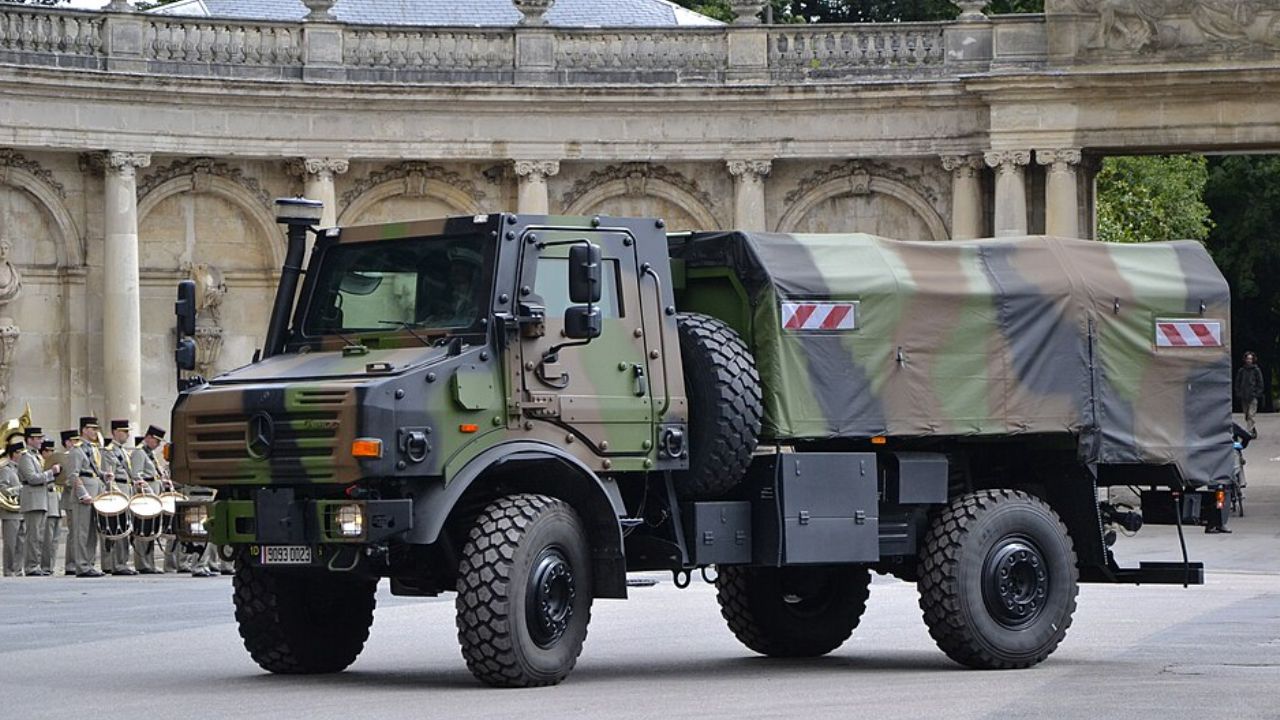
Some vehicles are built to look tough, and some are built to be tough. The Mercedes-Benz Unimog sits firmly in the second category, and it’s been proving that point for decades. Put it on a road that turns into a bog, a rock garden, or a steep, rutted climb, and it just keeps going in a way that makes regular trucks look like they showed up wearing the wrong shoes.
Across farms, forests, construction sites, disaster zones, and remote mountain roads, the Unimog has earned a reputation as the machine you call when the job is somewhere “out there.” It isn’t trying to win a beauty contest or a drag race. It’s trying to reach places where the map gets vague and the ground gets mean.
A truck that doesn’t panic when the pavement ends
Ordinary trucks are happiest when the surface is predictable and traction is plentiful. Throw them into deep mud, off-camber slopes, loose gravel, or uneven washouts, and you’ll see the limits fast: spinning wheels, bottomed-out frames, and drivers negotiating with gravity. The Unimog’s whole personality is built around not having those awkward conversations.
Its key advantage is simple: it’s designed from the start as an off-road implement carrier, not a road truck that got a “rugged package.” That means high ground clearance, suspension travel that actually matters, and a drivetrain meant for crawling rather than just cruising. When conditions get ugly, it stays composed instead of fighting itself.
Portal axles: the quiet trick that changes everything
One of the Unimog’s signature features is its portal axles, which sound like sci-fi but are basically clever engineering. Instead of the axle sitting in line with the wheel hub, a set of gears drops the hub lower, letting the axle sit higher. The practical result is more clearance under the axles, right where most vehicles get hung up.
This is why a Unimog can straddle rocks and ruts that would belly out a typical truck. It’s not just about big tires, either; it’s about where the hard metal parts live relative to the ground. In off-road terms, that’s the difference between “interesting adventure” and “someone call a recovery vehicle.”
All-wheel drive that’s made for real work
Plenty of trucks have all-wheel drive, but the Unimog treats traction like a core job requirement, not a feature. Many configurations include selectable differential locks, meaning you can force power to keep moving even if one or more wheels are slipping. On soft ground or uneven terrain, that’s huge.
It also typically offers very low gearing for slow, controlled movement. You’re not trying to blast through obstacles; you’re carefully stepping over them. It’s the off-road equivalent of using a scalpel instead of a hammer, except the scalpel weighs several tons and can mount a snowblower.
Flexy chassis, steady wheels
Another reason the Unimog keeps going is how it handles twisty, uneven ground. Its suspension and chassis design are meant to maintain wheel contact and absorb uneven surfaces without unloading a tire into the air. If you’ve ever watched a normal truck teeter across deep ruts, you know how quickly things get sketchy when a wheel loses grip.
The Unimog’s articulation helps it stay planted, which keeps traction more consistent. That translates to fewer sudden surprises and less reliance on momentum. And in rough terrain, momentum is a tool that’s useful right up until it becomes a problem.
It’s not one vehicle, it’s a platform
The Unimog’s other superpower is that it’s less “truck” and more “Swiss Army vehicle.” Depending on the model and setup, it can take on roles as a snow plow, a forestry rig, a utility repair unit, a military transport, a fire response vehicle, or a farm machine. The chassis is designed to accept implements and specialized bodies, so it can be customized to match the terrain and the job.
That matters because tough terrain isn’t the only challenge. Sometimes the job is hauling water to a remote wildfire line, reaching a downed power pole after a storm, or maintaining roads that only exist on a county spreadsheet. The Unimog doesn’t just arrive—it arrives with equipment that can start solving the problem immediately.
Why “ordinary trucks” get stuck in the first place
Most regular trucks are designed around a compromise: decent payload, decent ride comfort, decent highway manners, and acceptable off-road ability for the occasional rough track. Their ground clearance is often limited where it counts, their gearing is tuned for road speeds, and their weight distribution isn’t optimized for crawling through soft terrain. They can absolutely do hard work, but there’s a point where the design priorities start pushing back.
When the path turns into mud soup, deep snow, jagged rocks, or steep switchbacks, those compromises show up. A long wheelbase can scrape; a low-hanging differential can snag; road-focused tires can turn into smooth rollers. The Unimog, on the other hand, was basically raised from birth to expect the worst.
Real-world scenes where the Unimog earns its reputation
In alpine regions, Unimogs are commonly seen tackling steep grades and narrow mountain routes, often with snow equipment or maintenance gear attached. In forestry work, they can move through uneven, debris-strewn ground while hauling tools and loads that would punish lighter vehicles. In municipal service, they’re used for year-round duties—snow in winter, mowing and sweeping in summer—because the base vehicle is built to handle rough conditions day after day.
And in disaster response, that capability gets even more valuable. Flooded roads, washed-out shoulders, and fields turned into mud can block conventional trucks from reaching people and equipment. A Unimog’s combination of clearance, traction control, and low-speed control gives it a better shot at getting through without turning the mission into a recovery operation.
It’s not “fast,” but it’s stubborn in the best way
If you’re expecting a Unimog to behave like a sporty pickup, you’ll be disappointed—this isn’t that kind of party. The driving experience is more about capability than comfort, and the tradeoffs are real: complex hardware, specialized maintenance needs, and a price tag that reflects what it can do. But that’s the deal with purpose-built tools; you pay for the parts you don’t notice until you desperately need them.
What you get in return is a vehicle that doesn’t flinch when conditions get messy. It’s the kind of machine that makes bad roads feel less like a barrier and more like a suggestion. And honestly, there’s something comforting about a truck that looks at a muddy, rutted, half-frozen track and basically says, “Okay, and?”