
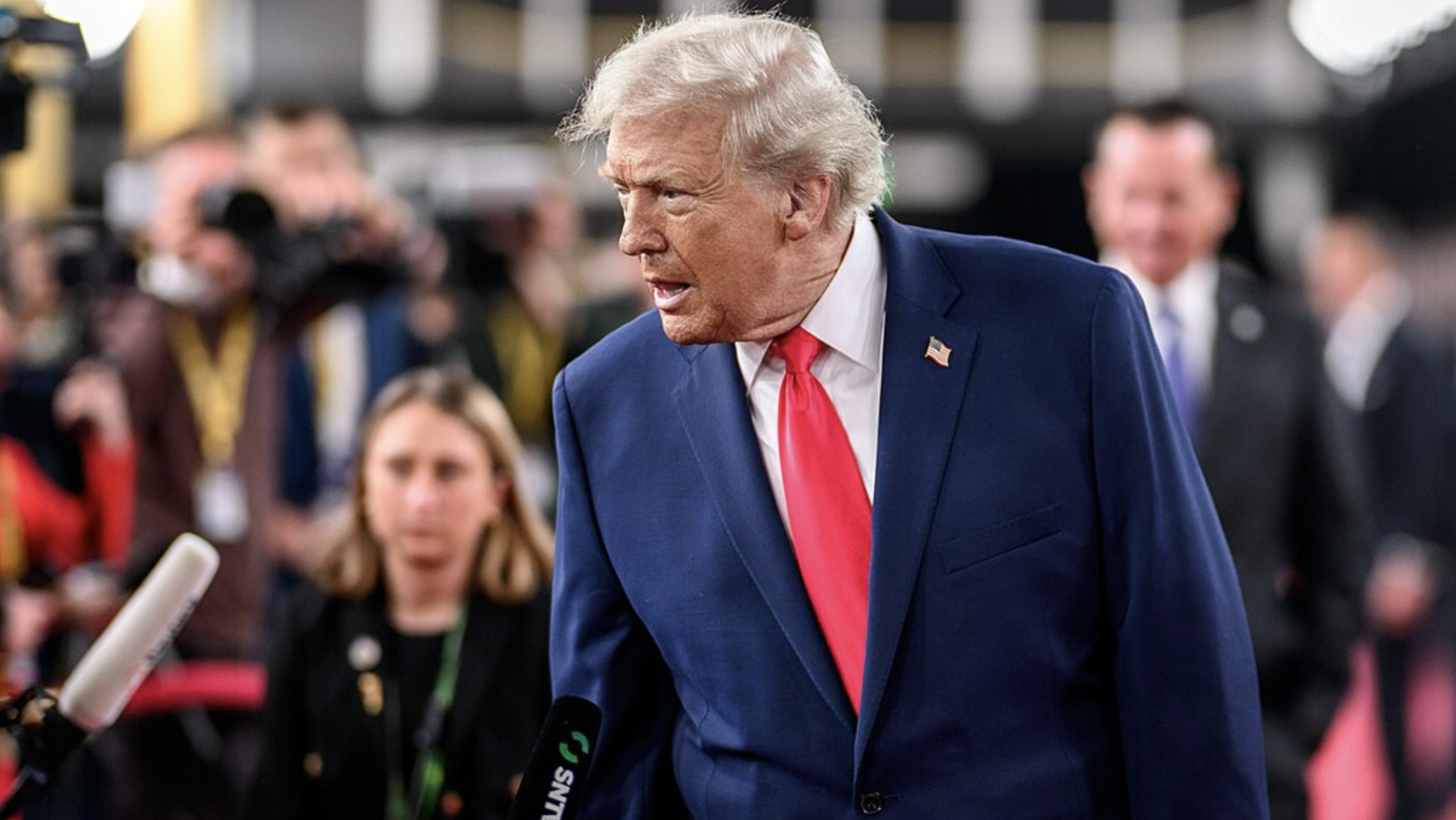
President Donald Trump grew visibly irritated with a reporter Tuesday who pressed him on the endgame of the war with Iran, dismissing the question and insisting that Tehran is secretly desperate to reach a settlement even as fighting continues nearly five months after the conflict began.
The exchange took place during a press availability following Trump’s bilateral meeting with Lebanese President Joseph Aoun at the White House, where reporters were permitted to ask questions on a range of topics after the two leaders discussed a separate framework aimed at ending hostilities between Lebanon and Israel. A reporter raised the subject of Iran, noting that there were no visible signs the country was prepared to stop fighting.
“There are no signs that Iran is ready to stop fighting,” the reporter said. “So what is the plan? Is the plan to just keep bombing until they give up?”
Trump responded sharply. “What do you know something that I don’t know?” he said. “You don’t know what the dialogue is behind the scenes, that they want to meet desperately to try and end it because they’re getting decimated. You don’t get that when you listen to your fake station. But you don’t know. You don’t know anything. You know something I don’t know? Well, tell us. I will tell you they want to desperately meet and until they’re ready to meet in a meaningful way, we have no interest.”
The confrontation reflected a pattern that has recurred throughout the war, in which Trump has alternated between describing Iran as militarily crippled and suggesting the country is on the verge of capitulating in private negotiations that have not been independently confirmed. Publicly available diplomatic reporting has offered a more mixed picture of the state of talks between Washington and Tehran than Trump’s characterization suggested.
The war began on February 28, 2026, when the United States and Israel launched joint strikes that killed Iran’s supreme leader, Ayatollah Ali Khamenei, and targeted the country’s nuclear and military infrastructure. A ceasefire brokered by Pakistan took effect in early April following a round of direct talks in Islamabad between a 300-member US delegation led by Vice President JD Vance and an Iranian delegation headed by parliament speaker Mohammad Bagher Ghalibaf. That truce held for roughly three months.
The ceasefire collapsed in early July after Iran launched fresh attacks on commercial vessels in the Strait of Hormuz, prompting renewed US strikes. Trump wrote on social media at the time that the United States had agreed to continue talks with Iran even as he declared the ceasefire over, stating, “The Islamic Republic of Iran has asked us to continue ‘talks.’ We have agreed to do so, but the United States has stated to them, in no uncertain terms, that the Cease Fire is OVER!” Qatari mediators subsequently traveled to Tehran in an effort to revive negotiations, according to reporting at the time.
By mid-July, US officials described talks as continuing but unresolved, with the status of the Strait of Hormuz emerging as the central obstacle to progress. A senior US official said the two sides would “never” move on to discussing Iran’s nuclear program without an Iranian guarantee of safe passage through the strait, and Deputy US Ambassador to the United Nations Tammy Bruce told the Security Council on July 10 that Washington preferred “a diplomatic solution” but could not negotiate “while Iran reneges on the basic obligations.” She added that the US hoped “Iran chooses to come back into compliance with its obligations and to engage seriously in talks toward reaching a final deal.”
That public diplomatic record complicates the picture Trump offered Tuesday, in which he suggested Iran was privately begging for a resolution while publicly showing no willingness to stop fighting. Trump did not elaborate on what channel the “dialogue behind the scenes” was occurring through, nor did he specify what conditions Iran would need to meet for the United States to consider talks “meaningful.”
The war has taken a toll on both sides. Iranian state and independent monitors have reported significant military and civilian damage from months of strikes, while Iran’s retaliatory attacks on US and allied positions across the Middle East have killed at least 17 American service members, according to figures cited by the administration, with the Pentagon confirming 13 combat deaths in the war’s opening weeks. Trump has said he intends to travel to Dover Air Force Base to honor the fallen.
Trump has repeatedly dismissed unfavorable characterizations of the war’s progress as products of biased media coverage, a pattern that continued Tuesday when he accused the questioning reporter of relying on a “fake station” for information. The president has made similar claims throughout the conflict about being in possession of information unavailable to the public that supports his framing of the war’s trajectory, without disclosing the substance of that information.
Diplomatic efforts led by Pakistan and Qatar have continued in parallel with the fighting, with both governments working to bring the US and Iran back to a durable ceasefire. Pakistani Prime Minister Shehbaz Sharif, who brokered the original April truce, has continued to describe his government’s mediation as aimed at achieving “sustainable peace” between the two countries, though the collapse of that earlier ceasefire in July has underscored how fragile any renewed agreement is likely to be.
Trump closed the exchange by reiterating that the United States would not change its posture toward Iran until the country demonstrated genuine willingness to negotiate, a threshold he did not define, leaving unresolved the question the reporter had originally posed about how the administration intends to conclude a war now well past the timeline he initially set for it.