
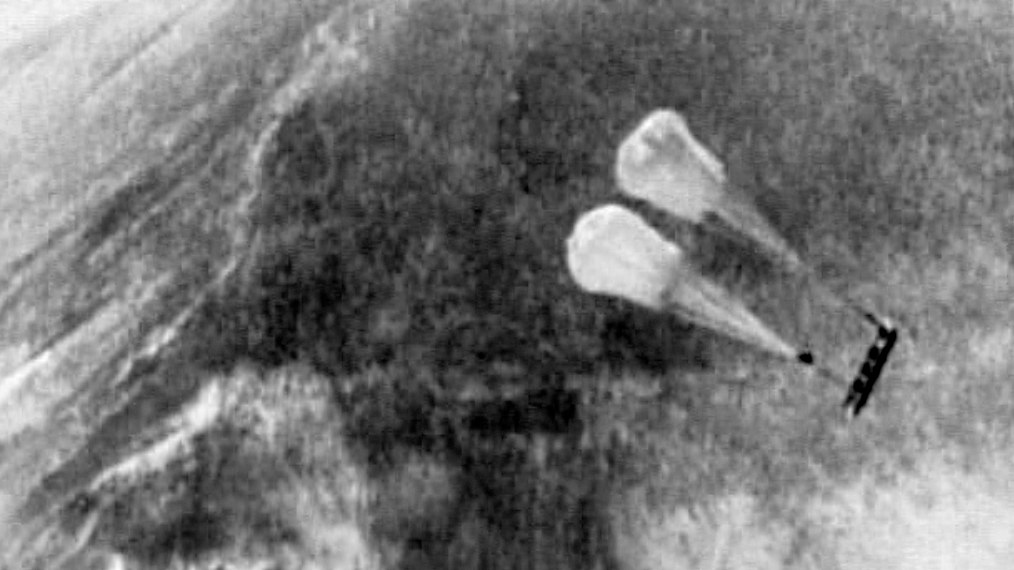
Sixteen feet of missing bridge stood between the 1st Marine Division and the road south from the Chosin Reservoir in December 1950. The answer came by parachute: eight C-119 Flying Boxcars of the 314th Troop Carrier Group, each carrying one steel Treadway bridge section, flew over the drop zone near Koto-ri on Dec. 7. Four sections were all the engineers needed.
One of the unit’s historians later called it “an event unique in the history of combat airlift,” and it was flown with a load that had failed its only test drop the day before.
The 314th’s own history office tells the story. In “314th delivers bridge to combat troops,” Chris Rumley, 314th Airlift Wing historian, wrote that “the Chinese had destroyed a bridge traversing a 1,500 foot gorge in the Funchilin Pass,” leaving a gap the column could not bypass. “There was no way around the 16-foot gap,” he wrote.
A column cut off
The trap closed in late November. Rumley’s history says Chinese forces struck X Corps on the night of Nov. 26, and that “the following night, two Chinese divisions attacked the 1st Marines and cut off their supply route to the south.”
The 314th was already flying for the encircled units. “On November 29th, 12 C-119s from the 314th Troop Carrier Group began delivering supplies to the surrounded units,” Rumley wrote. The group’s C-47 crews also flew out 4,689 casualties from Hagaru-ri in six days, according to the same history.
The Marines then fought their way south. Rumley wrote that “the procession of 10,000 Marines and 1,000 vehicles took 38 hours” to cover the 11 miles from Hagaru-ri to Koto-ri. Below Koto-ri lay the pass and the broken bridge.
A request for a bridge by air
Maj. Gen. Oliver Smith asked for something new. “General Smith made an unusual request to Combat Cargo Command,” Rumley wrote: drop the bridge from the air.
A second 314th heritage feature, “Combat Airlift Help Dates Back to Korea,” by 314th Airlift Wing historian Mark Wilderman, gives the rigging detail. On Dec. 6, riggers dropped a single 2,900-pound M-2 Treadway span from a 314th C-119 at Yonpo airfield, hung under six 24-foot G-1 parachutes. Five of the six failed to open, and the span was damaged beyond repair, per Wilderman’s account. The riggers concluded the webbing had tangled and broken.
They changed the rig overnight. For the real mission, Wilderman wrote, each of eight Treadway sections went under two 48-foot G-5 parachutes, and he describes the loaded items as weighing 4,000 pounds each. Rumley gives the bare sections as “each 16 feet long” and weighing “2,900 pounds.”
Eight Flying Boxcars over Koto-ri
Only four sections were needed for the repair, but eight were requested, according to Wilderman. “On Dec 7th, eight planes from the 314th TCG, loaded with one bridge section each,” flew the mission, Rumley wrote. Wilderman identifies the aircraft as C-119s from the group’s 61st Troop Carrier Squadron: three left Yonpo five minutes apart, and five more followed. The drops were made from 800 feet at 120 knots, according to Wilderman.
The bigger parachutes worked. “Six of the sections, however, landed intact on the drop zone,” Rumley wrote, after noting that “one section was destroyed on impact and one fell into enemy hands.” His verdict was brief: “Needing only four sections to complete the bridge, the Marines were in business.”
Across the gap and south
The two histories differ slightly on timing. Rumley wrote that on the morning of Dec. 8, “the Marines broke out of Koto-Ri and were soon out of harm’s way.” Wilderman wrote that combat engineers had the bridge back in operation on Dec. 9, and that the last UN troops cleared Funchilin Pass on Dec. 11.
The 314th’s work was not done. From Dec. 14 to 17, the group flew the evacuation of X Corps from Hungnam; “it dispatched a total of 176 C-119’s,” Rumley wrote. Across the campaign, troop carrier units “evacuated more than 4,000 patients and more than 2,000 tons of cargo,” per the same history.
The record closes with an award. Rumley wrote that the 314th Troop Carrier Group earned a Distinguished Unit Citation for the campaign, “the first such combat award earned by any Air Force unit in the Korean War.” Both accounts are published by the 314th Airlift Wing at Little Rock Air Force Base, Arkansas.
Top image: An M-2 Treadway bridge section descends under parachutes after a drop by the 314th Troop Carrier Group, Dec. 7, 1950. Image Credit: U.S. Air Force — Public domain / Wikimedia Commons