
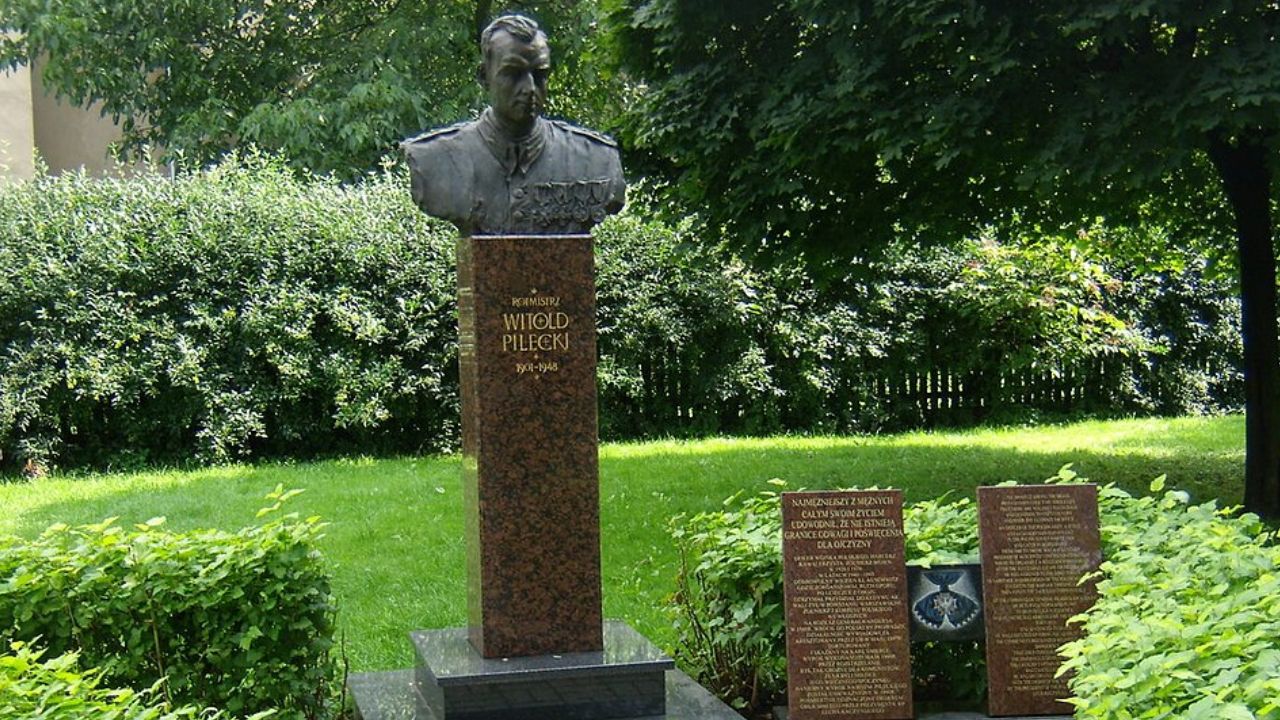
Witold Pilecki’s story can sound like wartime fiction until it is traced through documents and place names. A Polish Army cavalry officer (a rotmistrz, often rendered as captain), he deliberately entered the Nazi camp system to build an intelligence network from the inside. He survived the war, only to be executed by Poland’s postwar Communist security state. The through-line matters because it links Warsaw street roundups, KL Auschwitz, and Mokotów Prison into a single chain of coercive institutions rather than a vague “hero narrative.”
For defense-minded readers, the point isn’t only personal courage. It is tradecraft under extreme constraints: insertion, clandestine organization-building, reporting pathways, exfiltration, and then the reality that a political settlement can turn wartime service into a liability overnight. The most defensible anchors in this account are institutional and documentary: Auschwitz-Birkenau Memorial & Museum materials on resistance, the Pilecki Family Home Museum’s biographical account, the Institute of National Remembrance (IPN) on his death, and a surviving execution protocol hosted on Google Arts & Culture.
Witold Pilecki (Polish Army cavalry officer; “rotmistrz”/captain) — deliberate capture to enter Auschwitz (Warsaw, 19 Sept 1940)
Pilecki’s operation began with an insertion method almost without parallel: he volunteered to be arrested so he could infiltrate Auschwitz under an assumed identity. The Auschwitz-Birkenau Memorial & Museum describes him as a “volunteer for Auschwitz” who deliberately allowed himself to be captured in September 1940. In many narratives this is tied to a Warsaw street roundup (łapanka) on 19 September 1940; that specific “roundup detail” should be handled carefully and kept tied to museum and IPN-type materials rather than treated as an unexamined set piece.
Strategically, the decision was aimed at intelligence and organization, not symbolic sacrifice. The core objective was to learn what was happening inside the camp system and determine whether any organized capability could survive there—setting the pattern for what followed: entry, network formation, reporting, and eventual escape.
Auschwitz resistance cell “ZOW” (Związek Organizacji Wojskowej / Union of Military Organization) — founded/co-founded inside the camp
Once inside Auschwitz, Pilecki helped create an internal underground organization commonly referred to as ZOW, the Związek Organizacji Wojskowej (Union of Military Organization). The Auschwitz-Birkenau Memorial & Museum’s resistance history page credits him as a founder and emphasizes the organization’s purpose: support prisoners, collect intelligence, and inform superiors outside the camp about conditions and crimes. That framing is essential. It places Auschwitz not only as a site of mass terror, but also as human terrain where clandestine organization existed despite a system designed to prevent it.
At the same time, the limits of what can be stated with confidence should remain explicit. Membership size, structure, and operational reach vary by source. For a piece meant to hold up under scrutiny, it is safer to describe ZOW as an underground network focused on prisoner support and reporting, without locking in precise headcounts or detailed organizational charts not supported here.
Pilecki’s Auschwitz reporting (“Pilecki’s Report” / reports sent from the camp) — information routed to the Polish government-in-exile and Allies
Pilecki’s work mattered only if information could move from Auschwitz to decision-makers. Wikipedia’s overview of “Pilecki’s Report” notes that from March 1941 onward his messages were forwarded through Polish underground channels to the Polish government-in-exile in London and onward to the British government and other Allies, and it summarizes the later publication history of the compiled report(s). The “who received what” and “what impact did it have” questions are frequently contested, so this overview should not be treated as the sole backbone for claims about Allied responses or operational effects.
Even with that caution, the operational takeaway is straightforward: intelligence about industrialized mass violence was being gathered and transmitted during the war via clandestine networks, with the Polish government-in-exile functioning as a relay point. That connection also highlights a recurring policy problem: early warning is only as useful as the options and political will available to act on it.
Escape from Auschwitz (night of 26/27 April 1943) — breakout via camp bakery with named accomplices
After years inside Auschwitz, Pilecki shifted from collection to exfiltration. The Muzeum Dom Rodziny Pileckich (Pilecki Family Home Museum) specifies that he escaped on the night of 26/27 April 1943. It also provides two concrete details often blurred in retellings: the escape route ran via the camp bakery, and his escape partners were Edward Ciesielski and Jan Redzej.
Here, restraint remains the right approach. Escape mechanics are frequently dramatized, so the most responsible version is the museum’s basic description. In operational terms, the escape mattered because it enabled direct debriefing, further reporting, and renewed activity outside the camp system.
“Executed by his own government after the war” — execution by Communist authorities in Poland at Mokotów Prison, Warsaw (25 May 1948)
The headline’s twist is literal: Pilecki was executed after the war by the Communist authorities in Poland. Poland’s Institute of National Remembrance (IPN) and Auschwitz e-learning materials state that he was murdered/executed at Mokotów Prison in Warsaw on 25 May 1948, commonly described as a shot to the back of the head. This is where wording matters. “His own government” refers to the postwar Communist government and its security-court system, not a continuation of the prewar Polish state he served as an officer.
The consequence is stark without needing embellishment: a man recognized in Auschwitz-Birkenau Memorial & Museum materials as a volunteer who infiltrated Auschwitz could be treated as an enemy by the new state and eliminated through formal proceedings.
Primary-document anchor: “Protocol/report on the execution” (25 May 1948) — identifies sentence/case references and execution formalities
Pilecki’s story is less vulnerable to partisan reframing when it is anchored to surviving documents, not only repeated anecdotes. A “report on the execution”/protocol—hosted on Google Arts & Culture—records the carrying out of the death sentence at Mokotów Prison on 25 May 1948, including timing and bureaucratic sign-offs, as well as references to court decisions. The significance is administrative trace: it documents that the state processed his death through a formal, papered procedure.
One caution is built into the medium. Google Arts & Culture is the host platform, not necessarily the originating archive, so any institutional credit on the artifact should be treated as the authority behind the document rather than the website itself. Even without parsing legal language beyond what is presented, the protocol reinforces a critical point: repression can be bureaucratized, leaving a paper footprint that later reconstruction depends on.
Named places/operational framing for Combat Rated (concrete geography and “system” context): Warsaw łapanka → KL Auschwitz → Mokotów Prison (Rakowiecka St., Warsaw)
Viewed as a map rather than a myth, Pilecki’s arc runs through three named systems and places: a Warsaw łapanka mechanism used for arrests, the KL Auschwitz camp system, and Mokotów Prison in Warsaw’s Mokotów district, often given as Rakowiecka Street. Auschwitz educational materials (including the Auschwitz e-learning site) cover the roundup/arrest context and his role in Auschwitz, while IPN materials cover the execution at Mokotów. The geography helps keep the narrative concrete and traceable.
For Combat Rated’s audience, the lesson is not abstract. The same person can be a high-value intelligence operator against one totalitarian system and a disposable target to another. Pilecki’s volunteered infiltration—validated in Auschwitz-Birkenau Memorial & Museum materials—shows intelligence being generated under conditions designed to prevent it. His killing—documented by IPN and anchored by an execution protocol—shows how a postwar security state can remove inconvenient witnesses and independent legitimacy once the shooting war ends.