
In the spring of 1999, NATO’s air campaign over Yugoslavia produced one of modern air warfare’s most replayed “myth-buster” moments: a stealth strike aircraft—the Lockheed F-117A—was shot down by a surface-to-air missile system whose lineage reaches back to the early 1960s. It’s easy to compress that into “old tech beats new tech.” The more useful takeaway is narrower: stealth is not the same as invisibility, and a disciplined air-defense unit can still create a brief, lethal engagement window.
The baseline facts are widely repeated and relatively consistent in mainstream summaries. On 27 March 1999, during Operation Allied Force (the NATO bombing of Yugoslavia in the Kosovo War context), an F-117 went down after a Yugoslav Army unit fired an S-125 Neva/Pechora (NATO: SA-3 “Goa”). The incident is commonly framed as the only confirmed combat loss of the F-117 and is often cited as the first stealth aircraft shot down in combat. Where accounts diverge is the “how”: the exact detection and cueing chain, the radar modes used, and what (if anything) was modified—details The Aviationist notes are frequently asserted without firm documentation in many retellings.
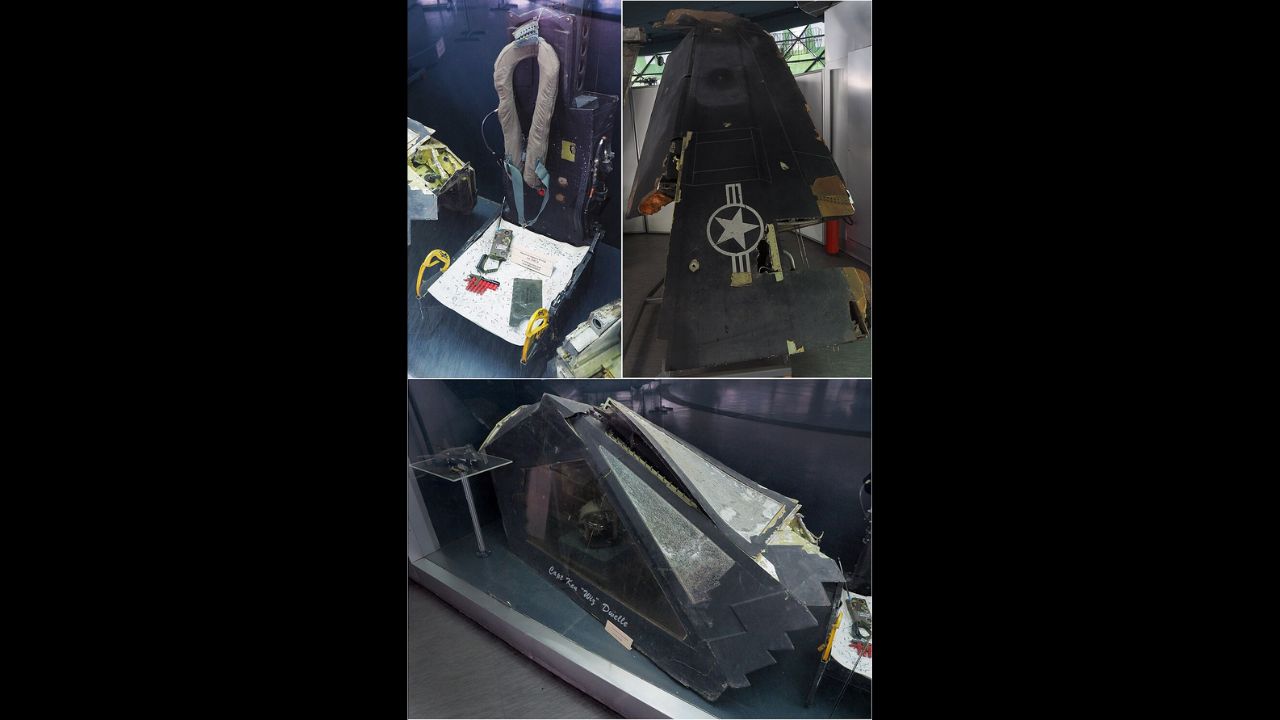
Pictured above: Ejection seat, wing and canopy of F-117 with serial number 82-0806 at the Belgrade Aviation Museum in late 2018.
Isayev S-125 “Neva/Pechora” SAM system (NATO: SA-3 “Goa”) — the “1960s missile” in the headline
The system at the center of the story is the Isayev S-125 “Neva/Pechora,” known to NATO as the SA-3 “Goa.” The S-125 family was first deployed in the early 1960s (commonly given as 1961–1964), which makes “1960s-era” a fair description of the design’s origins. That label, however, can mislead if it implies the 1999 shootdown was simply an “antique missile” moment. The shock value comes from an older-design SAM still being relevant when paired with 1999-era fieldcraft.
This distinction matters because the popular takeaway—“ancient tech beat stealth”—often outruns what can actually be documented. As The Aviationist cautions, many specific technical claims about radar settings, cueing, and alleged modifications are widely repeated without clear support. In this case, the S-125’s early-1960s lineage is straightforward; the precise technical recipe used in 1999 is where certainty drops.
The specific shootdown event: “1999 F‑117A shootdown” (Operation Allied Force / NATO bombing of Yugoslavia)
The engagement is typically dated to 27 March 1999, during NATO’s bombing of Yugoslavia, with the F-117 hit by an S-125 fired by a Yugoslav Army unit. The incident’s historical weight comes from what it did to assumptions. Stealth aircraft were built to reduce detection and engagement ranges, not to guarantee immunity, yet an F-117 was still brought down during a campaign in which NATO expected to manage much of the integrated air-defense threat through planning and pressure.
That prominence is also why overconfident storytelling tends to accrete around it. The overall timeline is well established in broad summaries; the enabling details remain debated in secondary accounts, including The Aviationist’s retrospective. Treating the “how” as contested isn’t a dodge—it’s the responsible way to separate what is stable from what is often inferred.
The aircraft: Lockheed F‑117A Nighthawk, USAF serial 82‑0806 (“Vega 31”)
This incident can be anchored to a specific airframe: the downed aircraft is commonly identified as USAF F-117A serial 82-0806, callsign “Vega 31.” Keeping the story tied to 82-0806 “Vega 31” helps prevent the narrative from sliding into a generic “stealth jet got shot” legend and supports a clearer case-file structure.
Even with a tail number and callsign, caution still applies. Compilations of the event note that some popular accounts misstate identities and details, and that broader “inside story” claims often appear without solid sourcing. The cleanest approach is to treat 82-0806 “Vega 31” as the confirmed focal point and label additional anecdotes as unverified unless a stronger record is introduced.
The Yugoslav unit: 3rd Battalion / 250th Air Defense Missile Brigade (Army of Yugoslavia)
The credited shooter is generally identified as the 3rd Battalion of the 250th Air Defense Missile Brigade, operating the S-125 system. In English-language retellings, the naming can shift between battalion/division/battery depending on translation and service terminology, and the Serbian Air Force museum site uses its own phrasing. For readers, the key point is that this was not an abstract “Serbian SAM”: it is attributed to a specific unit element that survived long enough under NATO pressure to execute a successful engagement.
That survivability is part of the practical lesson. NATO’s campaign emphasized suppressing and destroying air defenses, yet the unit credited here still found an opportunity to take a shot—and that shot became historic. Whether the decisive factor was emission control, positioning, timing, or other methods often claimed in retellings is exactly where documentation becomes uneven; what can be said without overreach is that effective fieldcraft can keep an air-defense unit alive long enough to matter.
Named commander frequently credited: Zoltán Dani
The story is also commonly told through a named commander: Zoltán Dani is identified as the commander frequently credited with the shootdown. Including him isn’t just color. It reinforces that air defense is not merely a hardware comparison; it is decision-making under constraints. The “1960s missile” framing can obscure that by turning the event into a technology parable rather than an outcome shaped by tactics and discipline.
The sourcing boundary matters here, too. Some Dani-related claims about additional events and logs are treated as uncertain in summaries, so it’s safest to keep the focus on what is broadly supported: Dani is widely associated with the unit credited for downing the F-117 on 27 March 1999. Anything beyond that should be treated as reported rather than proven unless backed by stronger documentation.
Location anchor: Buđanovci (near Ruma), Serbia
Geography helps turn a headline into analysis, and Buđanovci—near Ruma in Serbia—is repeatedly cited as the crash/shootdown area. The Serbian Air Force museum page places the event near Buđanovci, providing a concrete reference point for maps and for understanding that this occurred in a real, bounded battlespace—not an abstract demonstration. Spelling is worth a quick note: Buđanovci is also rendered Budjanovci, and readers may encounter both.
Location matters because air-defense engagements are shaped by routes, timing, and survivability pressures on both sides. With the context available here, it’s better to avoid asserting a precise flight corridor or radar geometry. The defensible point is simpler: Buđanovci gives the incident a tangible terrain anchor, which makes the story more than trivia.
Serbian Ministry of Defence commemoration detail (useful “local official” color, but not technical proof)
On the Serbian side, the Ministry of Defence has publicly commemorated the shootdown, stating it occurred on 27 March 1999 and providing a specific time—20:42—while attributing the action to the “3rd AA missile division.” That kind of institutional remembrance is useful as a window into how the event is held in national narrative on the other side of the engagement, and it offers a concrete timestamp that many Western summaries do not foreground.
Commemoration, however, is not technical documentation. The stated time and unit-role phrasing are best treated as claims from a national institution unless independently corroborated—especially when translations and organizational terms can vary between sources. Used carefully, it adds “local official” color and reinforces the event’s lasting significance without overpromising proof of exactly how the detection-and-fire sequence unfolded.
USAF historical treatment: “Manned Aircraft Losses over the Former Yug
On the U.S. side, the context also points to USAF historical treatment under the truncated title “Manned Aircraft Losses over the Former Yug…,” indicating the shootdown appears in official or semi-official recordkeeping rather than existing only as a journalistic anecdote. Even without quoting that material here, the relevance is straightforward: the event sits in the category of recorded combat loss, which strengthens the “what happened” even if debate continues over “how it happened.”
Put together, the lasting consequence is a more sober view of what stealth buys you. The 27 March 1999 loss of F-117A 82-0806 “Vega 31,” attributed to an S-125 Neva/Pechora crew in the 250th Air Defense Missile Brigade near Buđanovci, is a reminder that low observability reduces risk; it doesn’t erase it. And as The Aviationist’s caution about contested technical specifics underscores, the responsible lesson isn’t a single “magic trick,” but the uncomfortable reality that older designs, smart tactics, and a short-lived opportunity can intersect in a way that changes history.